

Negative gentrification: Akkurgan Street in Tashkent is losing its pedestrian amenities.
In 2017, Akkurgan Street in Tashkent was targeted for "gentrification," creating conditions for residents and making the location a desirable business destination. Nearly nine years later, the number of businesses has increased, but the sidewalks are now occupied by cars, and one of them was demolished, with plans to rebuild it only in a year. Gazeta reports.
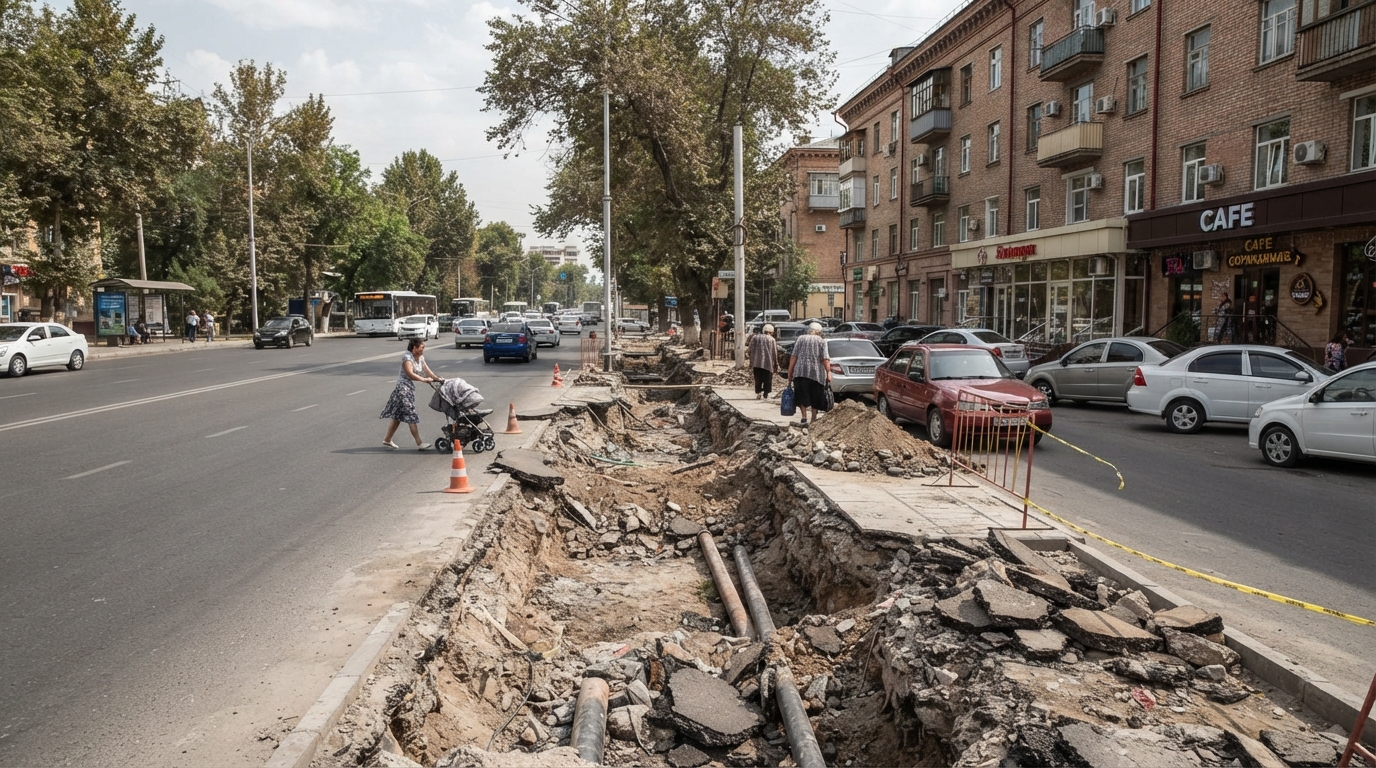
Negative Gentrification: Akkurgan Street in Tashkent Losing Pedestrian Infrastructure
In 2017, a Gazeta correspondent attended a discussion of the "My City" pilot project, aimed at improving the infrastructure of the Mirzo-Ulugbek District. One of the key ideas was the "gentrification" of Akkurgan Street (formerly Novomoskovskaya). It was hoped that the creation of pedestrian and bicycle infrastructure would make the street more attractive for investment and increase property values. The comfortable environment was expected to attract designer coffee shops, restaurants, galleries, and theater studios.
Almost nine years have passed since then. New establishments and shops have indeed appeared on Akkurgan Street. Old trees have also been preserved, giving the street a pleasant appearance. However, it has never become a comfortable urban environment, and, moreover, is gradually losing its significance as a promenade.
The reason for this, as is the case throughout Tashkent (with rare exceptions), lies in the failure to make human welfare the primary principle of city governance at all levels.
Akkurganskaya was developed in several stages. The oldest building, according to the Age Tashkent project, dates back to 1936 and is located at the end of the street. Further down the street are the so-called "Stalin-era" buildings from the 1950s and early 1960s. The buildings closer to Mustaqillik Avenue (formerly Pushkin Avenue) were built primarily in the 1970s.
Tashkent's "Stalin-era" buildings—brick buildings with thick walls, high ceilings, and spacious apartments—are popular with both residents and businesses. Although the later "Stalin-era" buildings on Akkurganskaya lack the characteristic decor of the "Stalinist Empire" style, opening a business in a historic building near the city center remains attractive. Along the street, only a few ground-floor apartments remain residential; most are occupied by shops and offices.
Since the 1970s, a tram line ran along Akkurganskaya Street. It was closed in 2008, after which the tracks were dismantled, and the few freed-up lanes were converted to cars. It was the removal of the tram that gave this relatively small, kilometer-long street its extraordinary width of eight lanes.
As mentioned earlier, the street still boasts many mature trees with spreading crowns. However, walking beneath them has become increasingly difficult and even dangerous with the passage of time and the increasing number of cars.
This year, the situation reached a critical point – a fairly long section of the sidewalk on Akkurganskaya Street was simply… destroyed.
The sidewalk along building No. 21A was not perfect, but it was perfectly passable, even suitable for pushing strollers, something residents enjoyed doing both during the day and in the evenings. However, in mid-May, special equipment suddenly began tearing up the entire width of the sidewalk – an excavator was breaking up the old, dense asphalt with its bucket, raising clouds of dust.
Neither residents nor businesses operating along this stretch were explained what kind of work was being done or when it would be completed. A temporary passageway was also not organized. Since then, pieces of torn-up asphalt, large stones, and crushed stone have lain where the sidewalk once stood, and in dry weather, the slightest breeze causes clouds of dry clay to rise into the air.
Some entrepreneurs—those more focused on street traffic than regular customers—have noted a decline in customer numbers.
In May, a Gazeta correspondent submitted a request through the Xalq nazorati service to find out the cause of the incident and when the sidewalk was scheduled to be returned to the public. In July, the request's chat stated that the issue would be "positively resolved" by the khokim of the Mirzo-Ulugbek district as part of a comprehensive program for the improvement and landscaping of mahallas in 2026–2027, by the end of the second quarter of 2027.
Other city residents who contacted them about this received a similar response – they were told there was currently no money for repairs.
In other words, the sidewalk was deliberately destroyed, and local residents were left to wait over a year for its restoration. During this time, winds will carry dust, including into apartment windows and into people's lungs, while rain, snow, and ice will make the pedestrian area completely impassable.
Why did they decide to open the sidewalk without a plan or funding? Wouldn't it be logical to charge those who decided to prematurely destroy it for the costs of repairing the sidewalk?
Why has it become the norm to so blatantly disregard the interests of the people?
Similar situations are occurring in other districts of Tashkent. It's hard to find a more glaring example of treating residents as a factor that can be ignored.
Parking on sidewalks, widespread throughout Tashkent, has also affected Akkurganskaya.
The problem is most noticeable in the area of the Yoshlik (formerly Start) stadium. Cars are parked here both along the curb and directly on the sidewalk. Judging by the presence of "parking attendants" who direct drivers and collect a voluntary fee from them, the parking is quite organized.
Entry to this "parking lot" occurs directly through the crosswalk at the intersection of Akkurgan and Osiyo Streets. Therefore, pedestrians waiting for the traffic light to clear often have to step aside for a car crossing directly toward them in order to enter the sidewalk.
Furthermore, after a recent traffic light upgrade at the same intersection, the pedestrian traffic light was installed not at the side of the roadway, but behind the sidewalk. Because of this, the space between the roadway and the traffic light looks like a driveway to the parking lot, although it is a sidewalk and should remain a safe place for pedestrians to wait.
In May, a Gazeta correspondent reported this situation to the Traffic Management Center (TMC) and requested that the traffic light be moved to the beginning of the crossing, the sidewalk be protected from parking, and the zebra crossing be protected from cars. There was no response.
The sidewalk near the stadium is wide enough to create a full-fledged public space—shaded by trees, not just the open area in front of the stadium. Instead, cars occupy the lion's share of the sidewalk. Pedestrians are left with a path about 1.5 meters wide. Part of this narrow passage is occupied by ice cream refrigerators, and sometimes cars even park on it. Furthermore, charging stations for electric vehicles have been installed in the area occupied by cars. However, their presence still does not make the sidewalk a legal parking area.
A similar situation is observed across the road—from the intersection of Akkurganskaya and Osiyo almost to the exit onto Mustakillik Avenue. Cars occasionally occupy the sidewalk, which also serves as a bus stop.
The situation improved slightly after one store installed barriers in front of its premises to prevent cars from driving onto the sidewalk. The organizers also painted a "pedestrian crossing" along the sidewalk, in a space already designated for pedestrians.
Nevertheless, public safety shouldn't depend on the goodwill of a single business. A unified engineering solution for creating a car-free sidewalk is needed throughout Akkurganskaya Street, not a protected island outside a single store.
Further down the street, the sidewalk is periodically occupied by cars from customers and employees of coffee shops, pharmacies, and stores.
A typical view from the terrace of a popular local coffee shop.
The situation is particularly challenging at the entrance to a residential area, where cars are often parked in several rows, blocking access along the sidewalk. Pedestrians, including those with strollers, are forced to squeeze between the cars.
Any urban design should be primarily focused on the interests of residents—not just drivers, but pedestrians, because every driver is also a pedestrian before and after getting behind the wheel.
International recommendations for urban street design recommend physically separating pedestrian spaces from the roadway—with curbs, bollards, trees, planters, and parklets.
Typical tree trunks at the beginning of Akkurganskaya Street. Asphalt and concrete were poured to create parking spaces.
Such elements don't "dissuade" drivers from driving on the sidewalk; they eliminate this possibility, while maintaining continuous and accessible passage for people.
Such solutions can be implemented at low cost, without waiting for a complete street reconstruction.
As the National Association of City Transportation Departments (NACTO) notes, well-designed streets generate higher revenue for businesses because they not only provide transportation infrastructure but also serve as public spaces, transit hubs, and a hub for potential customers.
Business development does create additional value for the street, while simultaneously increasing demand for parking. However, it can't be met at the expense of pedestrians. Akkurganskaya Street has a fairly wide roadway—organized paid parking along the shoulders could be considered, based on the experience of Poytaxt Parking.
And most importantly: safe and well-maintained sidewalks on Akkurganskaya Street, throughout the city, and throughout the country—should belong to pedestrians. Without any compromises.
Comment from the Tashkent City Hall
The Tashkent City Hall told Gazeta that the work on the damaged sidewalk is related to the installation of an electrical cable and that the section should be repaired in the coming weeks. A budget has been allocated for street reconstruction in 2026–2027, including the creation of pedestrian-friendly conditions. The project will be presented to local residents for review.