

The court sided with the residents of the Ak-Kurgan mahalla in a dispute over the construction of a new mahalla center.
Residents of the Akkurgan mahalla in the Mirzo-Ulugbek district successfully sued to overturn a decision to build a new mahalla center. The court determined that the existing committee building was suitable for use, but residents' consent for the new building had not been obtained.
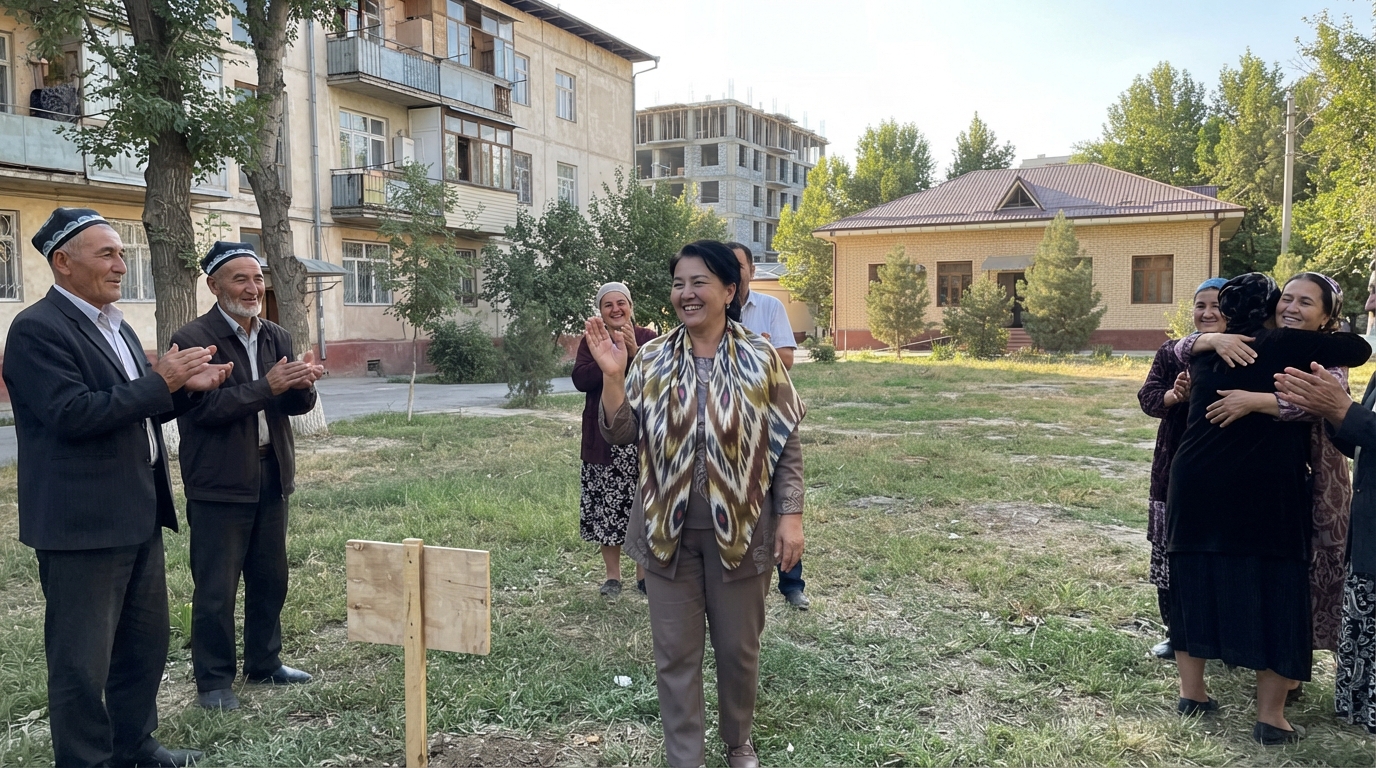
The Tashkent Interdistrict Administrative Court ruled in favor of residents of the Akkurgan mahalla, upholding their claim to invalidate a decree issued by the capital's mayor. The dispute concerned the allocation of 0.05 hectares of land near building No. 60A on 1st Akkurgan Drive for the construction of a five-story mahalla center. The hearing, at which Gulbakhor Kamalova and other residents acted as plaintiffs, took place on August 4.
Gazeta previously covered this conflict. Residents of buildings Nos. 23, 23a, 23b, 50, and 60 expressed their opposition to the construction of a new mahalla committee building on a site containing a parking lot, a green area, and utility lines. In their opinion, the project would have placed additional strain on the courtyard's infrastructure. A collective petition against the construction was signed by 128 people.
According to a decree issued by the Tashkent mayor on October 27, 2025, which envisaged the implementation of a pilot project to build standard "modern" mahalla centers, the Sadiya Ramiz community was allocated a plot of land adjacent to its building for a new center under a public-private partnership. The document explained the need for the construction as a result of a lack of space in the existing mahalla committee building. However, the program for creating standard mahalla centers, to which the mayor's decision referred, applies to citizens' gatherings that do not have their own office building or work in premises that require repair and do not meet urban planning standards.
During the hearing on July 20, the court visited the proposed construction site and inspected the existing mahalla committee building. According to community activist and chairperson of building No. 23b, Gulbahor Kamalova, the judge also spoke with residents of neighboring buildings.
Following the inspection and review of the case materials, the court determined that the existing mahalla building is fit for use, does not require repairs, and complies with urban development standards. It was registered in 2012 and has a total usable area of 340.34 square meters. The building contains nine office spaces, including a meeting room, offices for the khokim's assistant, the youth leader, the prevention inspector, a pension office, and others.
The court concluded that the existing spaces are sufficient for the work of the mahalla committee staff. Consequently, "Akkurgan" is not one of the citizens' gatherings for which the presidential decree provided for the construction of new buildings.
The court paid special attention to the issue of public approval of the construction. According to the decision, no meetings with residents regarding the construction of the new center were held prior to the adoption of the khokim's decree in October 2025. Public consent for the construction of a five-story building in front of building No. 60A was also not obtained. The court excluded the minutes of the meeting of March 26, 2026, attached to the case file, containing a list of signatures from several citizens, from evidence of public consent. The decision notes that residents' consent should have been obtained initially, whereas the document on the work performed only appeared five months after the contested decision was adopted.
It was also taken into account that the allocated area is a green space intended for residents to walk. The court found the transfer of this land for the construction of a five-story building to be unlawful and a violation of citizens' rights and legally protected interests.
As a result, the residents' demands were satisfied. The Tashkent mayor's decision of October 27, 2025, was invalidated insofar as it allocated a 0.05-hectare plot of land next to building No. 60A for the construction of a mahalla building. The decision can be appealed to the Tashkent City Administrative Court within one month of its adoption.
According to Kamalova, residents were uncertain about the outcome of the trial until the very end and considered the possibility that the decision might be made against them. "When the judge announced that our demands had been satisfied, residents began applauding. "It was important to us that the court didn't limit itself to reviewing documents, but came to the site, inspected the site itself, the existing mahalla building, and listened to the residents," the activist said.
Now the residents intend to seek legal registration of the land associated with the existing mahalla committee building. According to Kamalova, this is necessary to "prevent similar disputes from arising in the future."