

"The courtyard was a meeting place. Now there's no room left for anyone." Three stories from the Lolazor mahalla about how city residents are fighting for their courtyards.
Construction of a multi-story business center in one of the courtyards of the Lolazor mahalla was halted after authorities intervened. However, in neighboring courtyards, residents continue their years-long struggle to preserve playgrounds, green spaces, and the familiar urban environment. Gazeta tells their stories.
"The courtyard was a meeting place. Now there's no room left for anyone." Three stories from the Lolazor mahalla about how residents are fighting for their courtyards.
The situation in the Lolazor mahalla, where, following public outcry and government intervention, construction of a business center in the courtyard was halted and a criminal case was opened, has become one of the most discussed in Tashkent. However, just a few minutes' walk away are two other courtyards where similar conflicts are unfolding. A Gazeta correspondent visited each of them.
Late last week, the Lolazor mahalla in the Mirabad district found itself in the spotlight. Following a series of media reports about residents' struggle against the construction of a five-story business center on the site of the former mahalla building, children's playgrounds, and sports fields, and the public outcry, the head of the Presidential Administration, Saida Mirziyoyeva, arrived on the scene. She instructed the Prosecutor General's Office to review the legality of residential courtyard development projects throughout Tashkent. The construction itself has been halted.
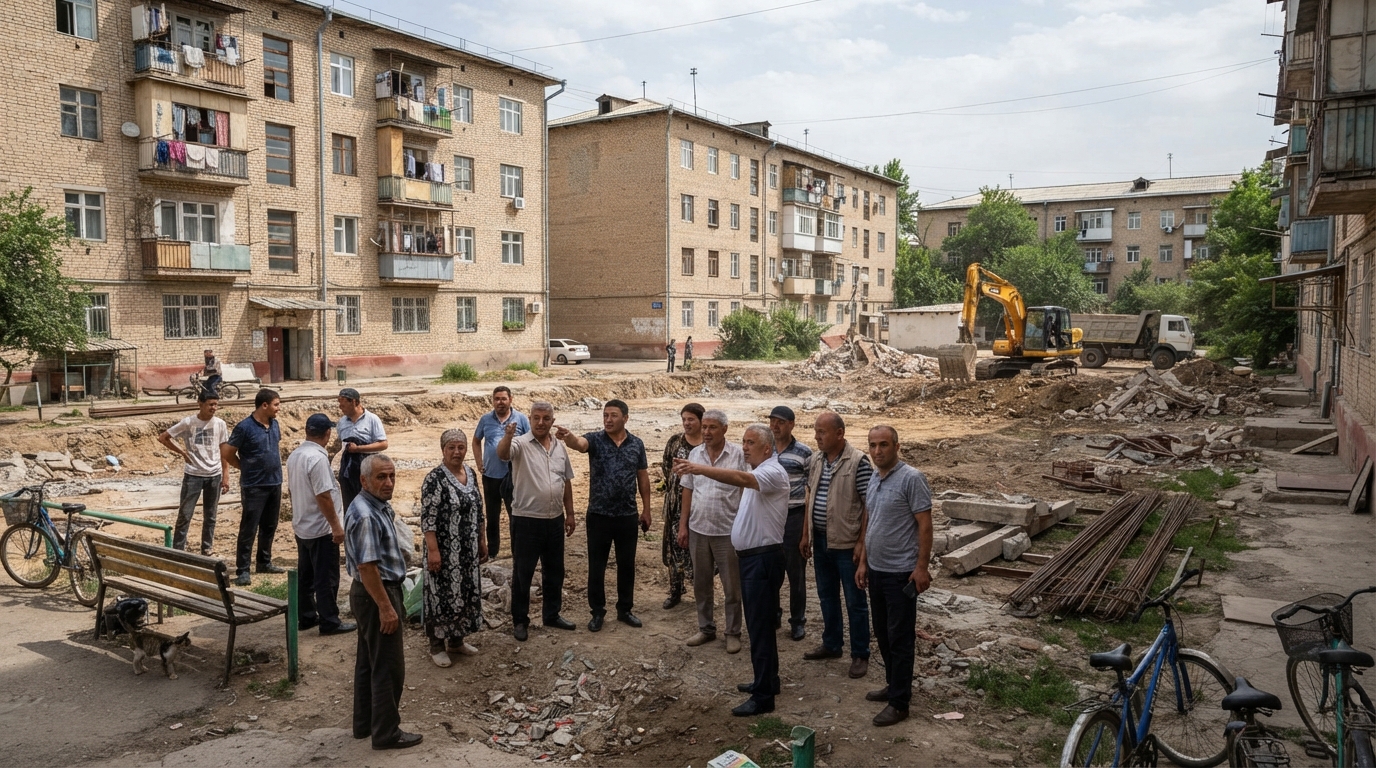
When a Gazeta correspondent visited the courtyard of that same mahalla, surrounded by buildings No. 27/5, 27/6, 27/7, and 27/8, last weekend, it was noisy, dusty, and crowded.
An excavator was dismantling the remains of the former building, workers were clearing the area and collecting construction debris, which trucks were hauling away one after another. The metal fence, which had enclosed the area just a few days earlier, had already been dismantled. Landscaping work was underway at the site where the business center was planned.
A few meters from the cleared area, about 15 nearby residents gathered. Some were watching the equipment at work, others were discussing the latest news. Relief was palpable in their conversations—the construction had been stopped. However, there was no sense of certainty that the story was truly over.
"We're not relaxing yet." "We'll only be at peace when the playground and sports ground are truly restored, trees are planted, and we can be sure that another construction fence won't appear in this place in a few months," said resident Fatima Temirkhodzhaeva.
According to her, no one could have imagined that the public space, where the mahalla committee building, the playground, and the sports ground, along with trees, had stood for many years, could disappear. This space was used not only by residents of nearby buildings but also by those in neighboring courtyards.
"This was the heart of our courtyard. Neighbors gathered here, holidays were celebrated, and hashars (traditional events) were held. Children constantly played on the playground, and young people played sports," said resident Alla Avanesova.
A four-meter metal fence was erected around the site in early May 2026. According to residents, many initially thought the area was being prepared for reconstruction. In the following weeks, they tried to find out exactly what was going on: they contacted the mahalla chairman and the developer's representatives, asking to see the permits and explain the basis for the work. However, according to the residents, they never received any clear answers. While they were trying to figure out what was happening, work on the site continued.
"I asked to see the building permit, cadastral documents, and khokimiyat decisions. They told us, 'Whoa, whoa, we'll show you.' In the end, they showed us nothing. Then, in the confusion, they demolished the mahalla building, removed the playground, and chopped down the oaks, paulownias, and fruit trees we had planted ourselves, even though they weren't bothering anyone. They simply leveled the site for construction," recalls Alla Avanesova.
Only after the property's passport was released did residents, according to them, first learn that the future building was a five-story business center with a walkable roof and two-level underground parking.
"We thought the mahalla building would be renovated and, at most, a second floor added. No one expected such a massive building to appear in the middle of the courtyard. All the surrounding buildings were built in 1956 in the Stalinist Empire style, and it would have been completely out of place with the existing architecture. The most incomprehensible thing for us is how such a decision could have been made without the residents' participation. We weren't invited to a meeting, weren't told about the project, and didn't collect signatures," said Fatima Temirkhodzhaeva.
"The building belonged to the mahalla. If it needed repairs, why didn't the mahalla itself or the management company do it? Why did they shift these responsibilities to a complete stranger? The most offensive thing is that no one stood up for the rights of the residents, for our children. "After all, it was the mahalla committee that was primarily supposed to protect the interests of the people who live here," added Alla Avanesova.
By mid-summer, residents admit, they had almost given up hope of stopping the construction. Numerous appeals to the khokimiyat, the prosecutor's office, cadastral authorities, and other agencies increasingly received perfunctory responses, with the applications themselves being redirected from one agency to another. Their final attempt was a collective petition to the Presidential Administration requesting that the documents used for construction be verified.
Residents didn't expect their petition to receive such a widespread response.
"For us, it was a true miracle. We saw that even the humblest person fighting for their yard can be heard," shares Fatima Temirkhodzhaeva.
Following the visit of the delegation led by Head of the Presidential Administration Saida Mirziyoyeva, residents began receiving dozens of messages of support from various districts of the capital.
"People congratulated us, writing, 'We're so happy for you.' Many said this story gave them hope. We really hope that our case will be resolved and that there won't be any more construction behind our backs," the woman adds.
This caution is explained by the experience of recent years. According to residents, the neighborhood has already lost several public spaces in recent years. A hotel with a parking lot has appeared in the place of a children's playground near building No. 27/5, and a business center has been built next to building No. 27/8. Therefore, the playground near the former Lolazor mahalla building remained one of the last places where residents of several buildings could gather.
Until recently, there was a playground in the courtyard of building No. 27/3, where, according to residents, several generations of children grew up. Pine trees grew around it, which the residents themselves had planted and nurtured, and the playground was a gathering place for families with children.
According to resident Elena Politaeva, the site was fenced off with a high metal fence in April 2025. No one explained to residents what exactly was planned for the area. When they tried to get answers from representatives of the developer and local authorities, they simply replied that "everything was going according to plan," but provided no documents or specific explanations.
"Then one night, they simply removed the entire playground. Swings, slides, horizontal bars, a gazebo—everything was gone. By morning, the playground was completely empty. After that, construction would stop and then resume," she recalls.
After numerous complaints from residents, a new playground was installed nearby. However, according to Elena Politaeva, she was unable to replace the old one.
"This playground is designed for very young children. Older children don't find it interesting anymore. Moreover, the play elements are too close together—it's unsafe to play. The old playground may not have been as modern, but children spent entire days there. "We even wanted to build a small soccer field nearby, but that area also ended up behind a construction fence," she said.
Work on the site resumed several months ago. According to information in the property's passport, the project's client was the ARX STROY PROJECT private housing association. A five-story building was planned for the 1,979-square-meter site. Approximately 30% of the land (593 square meters) was to be allocated to the mahalla, with the remaining 70% (1,385 square meters) for the investor's residential complex.
"They cut down several large trees, and fenced off the entire area with a metal fence. Previously, there was grass, trees, and shade here, but now there's concrete, asphalt, and iron. It's especially noticeable in the summer: the courtyard literally scorches, and the residents of nearby houses are the ones who suffer the most," says Elena Politaeva.
After construction on a neighboring plot in the Lolazor mahalla sparked widespread public outcry and was halted, changes have occurred here too.
When a Gazeta correspondent visited the courtyard last weekend, the construction fence had already been dismantled and the building's passport had been removed.
Residents have not yet been informed of the future of this plot.
While the conflict over construction in the first two courtyards only erupted in recent years, residents of building No. 27/10 have been fighting for their public space since 2018. This area once housed utility storage rooms, a playground, and a green space where residents of several neighboring buildings would gather. Now, in their place stands a sun-baked, empty space with a solitary bench.
"As children, we played football here with the kids from the neighboring courtyards and held tournaments. Neighbors would gather on the benches, discuss the news, and watch the children. This place was always bustling with life. Now that's gone." "The courtyard was a meeting place. Now there's no room for anyone," said Vladimir Davydov, a resident of the building.
According to residents, in February 2018, the approximately 440 square meter storage rooms in the courtyard, which had been used by residents for decades, were transferred to the furniture company Viva Victoria as compensation for property expropriated during the construction of Tashkent City. It was then, they say, that the first plans to develop the site emerged.
"The storage rooms have always been part of our courtyard. They used to store coal for stove-heated houses here, and later, residents used them as utility rooms. We wanted to officially register them ourselves, pay the state, and obtain a land registry, but we weren't allowed to. And then it turned out the land belonged to another owner," said Ksenia Romashkina-Blummer, a resident of the neighboring building.
Over the past eight years, residents have seen several development options for the site. According to them, initially, there were plans to build a hotel here, then a business center, and later, a residential complex. At the same time, the area began to be cleared and old trees, some of which subsequently died, were replanted.
"This green space grew alongside several generations of residents. We knew who planted which tree and told our children about it. Today, all that remains is a vacant lot. Over the past few years, we have continued to plant new saplings, care for them, and hope to restore the courtyard to its former glory," notes Natalya Shishkina, another resident of the building.
Over the past years, residents have repeatedly appealed to government agencies, and their interests have been represented in court by the prosecutor's office and the khokimiyat. Despite this, the fate of the plot remains uncertain. The story of the neighboring courtyard in the Lolazor mahalla has given residents, for the first time in a long time, hope that their voices will be heard.
"We are not against city development, but it shouldn't come at the expense of the people. Today, the problem of infill development affects all of Tashkent. Residents are being deprived of their yards, children of their playgrounds, and entire neighborhoods of their green spaces. Is this development? Business can and should be social. If an entrepreneur doesn't think about people, the environment, and what will remain after construction, such a project is doomed from the start," concluded Ksenia Romashkina-Blummer.
The story of the Lolazor mahalla is just one of a series of conflicts unfolding similarly in various districts of Tashkent. In recent weeks alone, Gazeta reported on residents' protests against infill development in the Akkurgan and Chulpan mahallas. Several months earlier, the editorial staff wrote about the long-standing struggle of residents of the Yunus Rajabi mahalla to preserve a football field—the only sports facility in the area. All these stories once again raise questions about how openly decisions affecting public spaces are made and how residents can participate in their discussions. So far, the answers are not favorable to the city and its residents.