

"We are fighting to restore our identity, not Soviet-era memories." Alisher Qodirov once again criticized the Cultural Heritage Agency
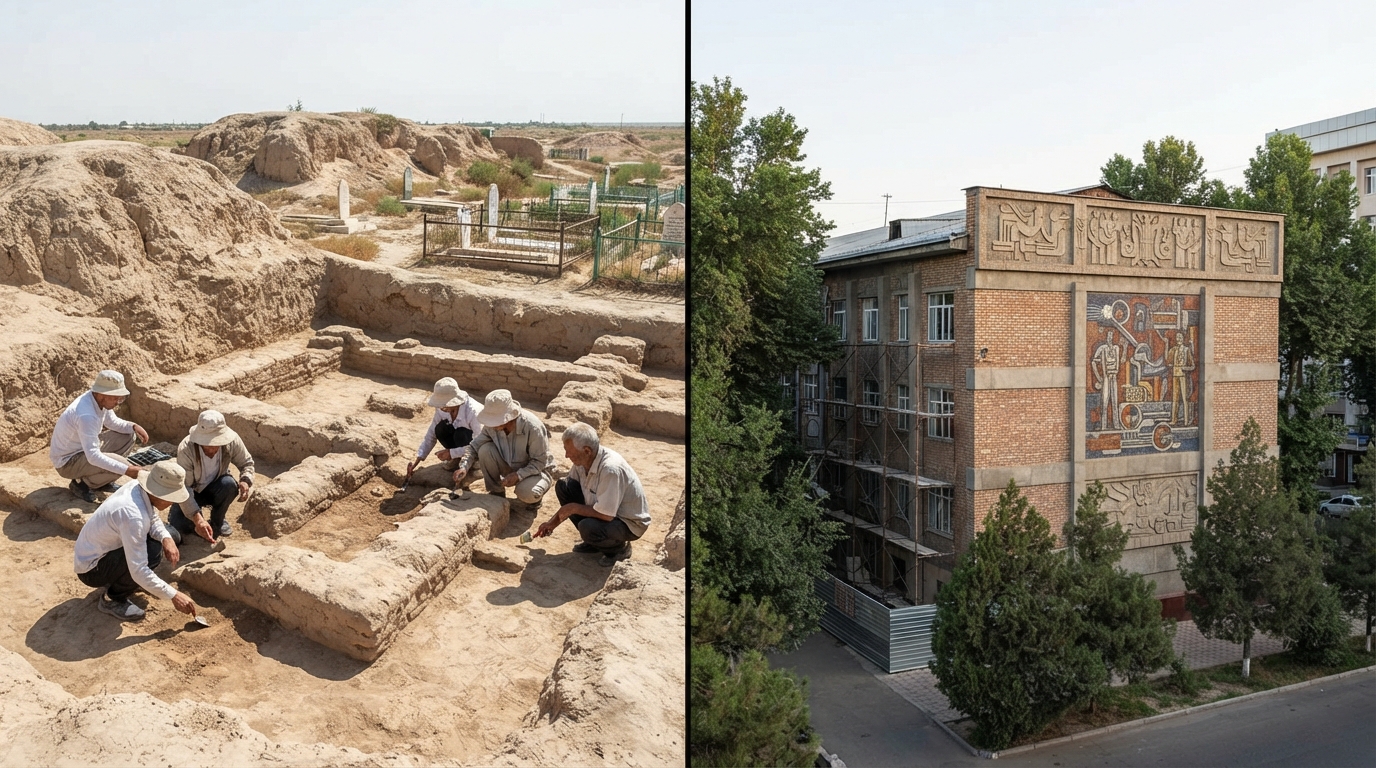
“We are fighting to restore our identity, not Soviet-era memories.” Alisher Qodirov criticized the Cultural Heritage Agency again
Alisher Qodirov, the chairman of the “Milliy Tiklanish” Democratic Party and a deputy, has once again raised objections against the Cultural Heritage Agency regarding the protection of cultural heritage sites.
This time, Qodirov raised the issue of a historical site associated with Sulaymon Boqirg‘oniy. According to him, the people of Karakalpakstan respect Boqirg‘oniy as Hakim Ota and take his teachings seriously.
The deputy stated that history students from Nukus University discovered a structure at this location, believed to date back to the 11th century, which was the scholar's madrasah. However, due to a lack of resources and the emergence of new graves on the site, the work has been halted.
Qodirov criticized the Cultural Heritage Agency in this regard, calling the agency's prioritization of protecting Soviet-era structures and mosaics a serious mistake that must be corrected.
“A part of society can be as tolerant or cosmopolitan as they wish, but not a single state agency on the path of national development can be like this. Just as our national interests are a priority in any relations, cultural heritage must also be prioritized based on its ideological essence,” the deputy wrote.
He concluded his thoughts by saying: “Remember, we are fighting to restore our identity, not Soviet-era memories.”
The dispute between Alisher Qodirov and the Cultural Heritage Agency began over the preservation of a cultural heritage site located at 7 Babur Street in Tashkent.
Qodirov opposed the preservation of this site, stating that the agency should first focus on protecting sites related to national culture. The deputy emphasized that the Cultural Heritage Agency is “not an agency of universal human values, but the agency of our national culture.”
In response, the Cultural Heritage Agency stated that the building at 7 Babur Street was built in 1935 and is associated with the architect Aleksey Shchusev, who worked in Tashkent. It was also mentioned that scientists and professors who contributed to the development of Uzbek science and culture lived in this building in various years. The agency stated that a cultural heritage site should not be evaluated by the criterion of “do we need it today or not?”
Following this, Qodirov responded to the agency's statement, raising issues related to Sarmishsoy, Shahi Zinda, Mizdahkan, Mingtepa, and the ancient Quran manuscript in Bukhara. He criticized the agency for issuing an official response instead of answering deputies' questions during the budget report in the Legislative Chamber.
“The party will not issue a counter-response, of course, but we will try to use our authority of parliamentary inquiry or hearing to get answers to our questions,” Qodirov said.
Later, the Cultural Heritage Agency responded to the deputy's objections again. According to the agency, except for Sarmishsoy, no official deputy inquiry had been received previously on behalf of the party or faction regarding the sites mentioned by Qodirov. Regarding the Sarmishsoy issue, it was stated that a working group led by Qodirov conducted a study in 2025, after which a deputy inquiry was submitted and an official response was provided.
The agency announced that 4.2 billion soums from the state budget and another 1.2 billion soums from the agency's fund were allocated for the work in Sarmishsoy. It was also mentioned that a total of 2.4 billion soums of state funds were directed in 2024–2025 for the protection and museumification of Mingtepa.
The agency also emphasized that no funds from the republic's budget have been spent on the site on Babur Street so far, stating, “Let's measure cultural heritage by value, not by nation.”