

“Let us measure cultural heritage by value, not by nation.” The Cultural Heritage Agency has once again responded to Alisher Qodirov’s objections
“Let us measure cultural heritage by value, not by nation.” The Cultural Heritage Agency has once again responded to Alisher Kadirov’s objections
The Cultural Heritage Agency has once again reacted to the objections of Alisher Kadirov, the chairman of the “Milliy Tiklanish” Democratic Party and deputy, regarding the state of cultural heritage sites.
According to the agency, no official deputy inquiry had previously been received on behalf of the party or faction regarding the sites and issues raised by Kadirov, with the exception of Sarmishsoy.
Regarding Sarmishsoy, it was stated that a working group led by Alisher Kadirov conducted a study in 2025. Based on the results of this study, deputy K. Tojiyev submitted a deputy inquiry to the director of the agency, and an official response was provided in accordance with the established procedure.
It was also reported that there had been no prior official deputy inquiries regarding Mizdakhqan, Shakhi Zinda, the Quran manuscript in Bukhara, and Mingtepa. Nevertheless, the agency noted that it had provided information to the public on these matters.
### 4.2 billion soums of budget funds directed to Sarmishsoy
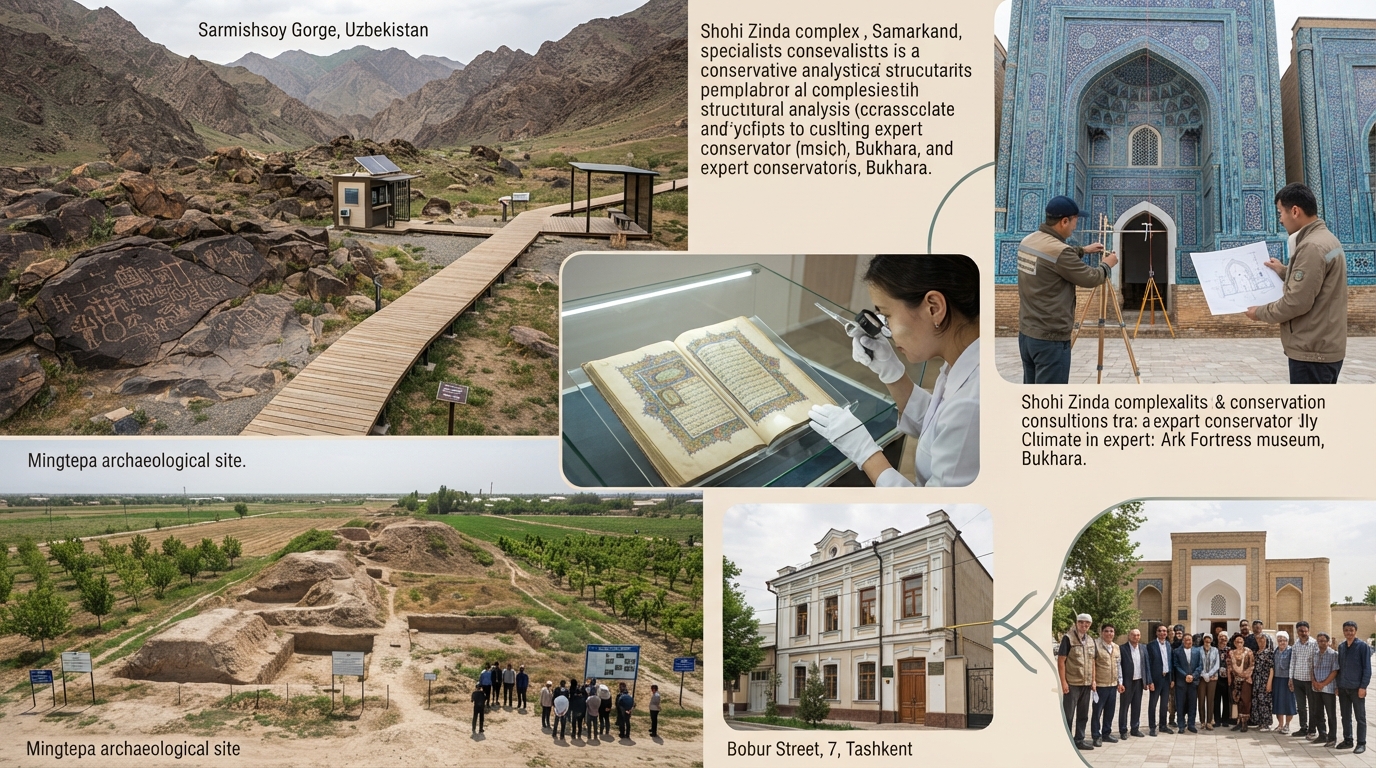
According to the agency, 4.2 billion soums have been allocated from the state budget to protect cultural heritage sites, create conditions for visitors, and develop tourist infrastructure in Sarmishsoy.
At the expense of these funds, two entrance gates, information centers, a 2.5-kilometer pedestrian path leading to the petroglyphs, five shelters, a parking lot, a solar-powered night lighting system, video surveillance cameras, and other infrastructure facilities have been built.
In addition, another 1.2 billion soums were allocated from the agency’s fund. With these funds, a visitor center and a checkpoint at the beginning of the gorge are being established.
On this basis, the agency stated that the conclusion that “billions were spent on Sarmishsoy, but the agency did nothing” is not supported by the work carried out and the allocated funds.
### Explanation on Mizdakhqan and Shakhi Zinda
In 2017, 800 million soums were allocated from the state budget for the Mizdakhqan complex, and repair and restoration work was carried out on the Mazlumkhan Sulu, Madaminkhan, Qirq Chopon, and Shomun Nabiy mausoleums. In 2024, another 290 million soums were directed to the Mazlumkhan Sulu mausoleum. A grant of 80,000 dollars was attracted to conduct conservation and archaeological research at the Rajab Khalifa mosque-mausoleum.
The entrance portal of the Shakhi Zinda complex was studied in 2022–2023 with the participation of Polish specialists. According to the agency, the deviation of the portal relative to the vertical axis had existed previously, and no new significant deformation was detected during re-measurements.
In particular, initial measurements recorded a deviation of 46 centimeters on the left side and 31 centimeters on the right side. In comparative measurements, the deviation on the left side decreased by 4 millimeters, and the deviation on the right side decreased by approximately 8 millimeters.
### Where is the Quran manuscript in Bukhara kept?
The agency reported that the Quran manuscript mentioned by Alisher Kadirov is being kept in the storage room on the first floor of the Ark Fortress of the “Bukhara” State Museum-Reserve.
It is planned to involve international specialists to stabilize the condition of the manuscript, conserve it, and organize the necessary restoration work. In particular, organizational work is underway to involve specialist Axel Delau. In 2023, he also participated in the restoration of some pages of the Katta Langar Quran within the framework of Uzbekistan–France cooperation.
### The issue of lands in Mingtepa was also addressed
The agency stated that some lands around Mingtepa were allocated for the establishment of orchards and vineyards in 2006, before the site was included in the national list in 2019.
In particular, 1.12 hectares of land were leased to one citizen for a period of 50 years, and another 26 hectares of land were allocated to 21 citizens.
In 2020, the khokimiyat of Markhamat district was requested to provide practical assistance in allocating alternative land to the users of the orchards and vineyards. Warnings were issued to 22 citizens who carried out agricultural work in the territory of the monument. Currently, cases of unauthorized land seizure are being investigated by law enforcement agencies.
In addition, 1.2 billion soums in 2024 and 2025 each, totaling 2.4 billion soums of state funds, have been directed towards the protection and museumification of Mingtepa.
### No budget funds spent on the house on Babur Street
The agency also returned to the issue of the building at 7 Babur Street in Tashkent, which Kadirov had previously referred to as “the house of some Russian artist.”
It was reported that the building, constructed in 1935, is associated with the name of the famous architect Alexey Shchusev, who worked in Tashkent. In various years, scientists and professors who contributed to the development of science and culture in Uzbekistan lived in this building.
In 2020, the Scientific-Expert Council under the agency approved the inclusion of the site in the National List. In 2021, the issue of removing the site from the National List was considered and rejected.
The agency emphasized that no funds from the republican budget have been spent on this site to date.
Additionally, the agency has officially appealed to the Prosecutor General’s Office regarding the preservation of the site. It requested a legal assessment of Tashkent city khokim’s decision No. 1550 dated October 30, 2018, and measures to prevent the demolition or damage of the site.
“Let us measure cultural heritage by value, not by nation,” the agency’s response says.
The agency also announced that in the first half of 2026, 79.4 billion soums were directed to restoration, repair, reconstruction, and archaeological research. Of this, 77.6 billion soums or 97.7 percent has been utilized.
Contracts have been concluded for the restoration and repair of 60 cultural heritage sites, design and estimate documentation is being developed for 28 sites, and positive expert opinions have been obtained for 39 sites.
“When facts are distorted, the agency has the right to respond with documents,” the statement says.
The agency also expressed its readiness to report to parliament and the public. It was stated that if a report is requested in parliament, all information, documents, and work carried out will be presented in accordance with the established procedure.
Earlier, Alisher Kadirov criticized the issue of preserving the cultural heritage site located at 7 Babur Street in Tashkent, and also raised questions regarding the state of Sarmishsoy, Shakhi Zinda, Mizdakhqan, Mingtepa, and the ancient Quran manuscript in Bukhara.
In response, the Cultural Heritage Agency stated that the value of a cultural heritage site is determined by its historical and cultural significance, not by whom or to which nation’s representative it belongs.
Following this, Kadirov responded to the agency’s reaction, stating that he would try to use the authority of a parliamentary inquiry or hearing regarding the issues raised.