

"We are blocking the world's largest museum." Student protest paralyzes the Louvre in Paris
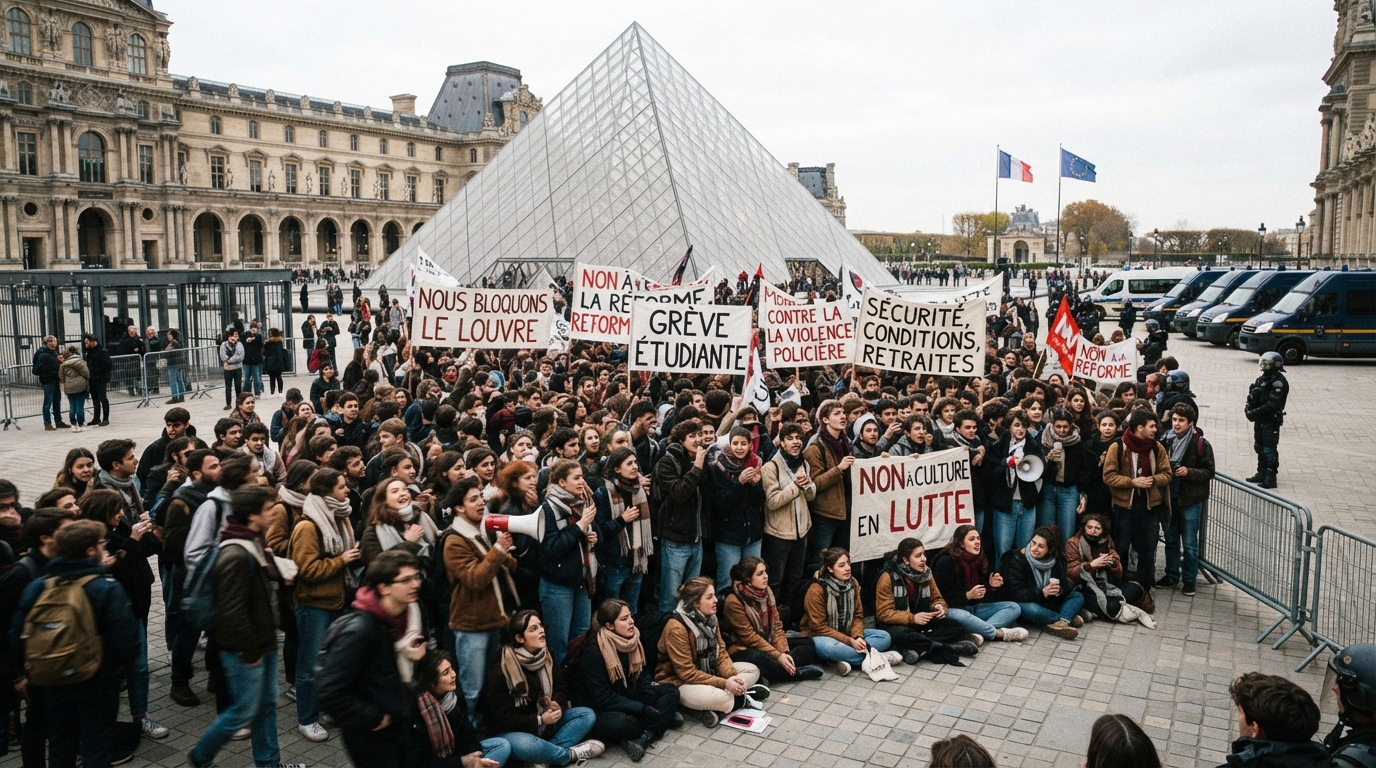
"We are blocking the world's largest museum." Student action halted the work of the Louvre in Paris
In Paris, students blocked the entrance to the Louvre, preventing the museum from opening its doors to visitors at its usual time. Participants in the demonstration supported a nationwide movement of pupils and students and spoke out against police violence.
In the morning, students from art and cultural educational institutions blocked the entrance to the building and hung flyers near it reading: "We proudly announce that we are blocking the world's largest museum."
According to France Info, the Louvre management believes this action has no direct relation to the museum itself, and its venue is being used to draw attention to the protest. Due to the student strike, the institution was temporarily closed.
The new demonstrations are taking place against the backdrop of mass protests that began in France in September over teacher shortages and poor school conditions, which later escalated into rallies against rising prices and the government's economic policies. During demonstrations on October 17, riots and clashes with police occurred in several cities, and the number of detainees approached 2,400.
Amid criticism of law enforcement actions, French Interior Minister Laurent Nuñez submitted his resignation on October 19, but President Emmanuel Macron did not accept it.
The blockade of the Louvre by students on October 19 was not the first time the museum was unable to open to visitors. Previously, however, the closures were most often caused by strikes by its own employees. They protested against working conditions, staff shortages, growing tourist numbers, and management issues. The student blockade became a new reason for the museum's closure against the backdrop of long-standing conflicts surrounding its operations.
In 2001, the Louvre was closed for about a week due to a strike by employees unhappy with their work schedules. Eight years later, staff protested again, this time against plans not to replace retiring civil servants.
In April 2013, employee safety was the cause of the closure. More than 100 workers refused to report for duty due to pickpockets who, according to them, were becoming increasingly aggressive. Some complained of being insulted, pushed, and spat on. That day, a notice about "exceptional circumstances" appeared on the museum's website, and the Louvre, which usually receives about 30,000 people a day, did not open.
Six years later, employees again demanded changes to the organization of work, pointing to the growing workload caused by the influx of tourists. In May 2019, reception and security staff went on strike. They demanded an increase in staff and a limit on the number of visitors. According to them, since 2009, tourist traffic had grown by about 20% annually, while the number of staff had declined.
In 2023, the cause of the closure was no longer just the museum's internal problems. The Louvre found itself part of nationwide protests against pension reform in France. Several dozen employees blocked the entrance under the glass pyramid, demanding the abandonment of plans to raise the retirement age from 62 to 64. The CGT union published an image of an aged "Mona Lisa" with the caption "64 is a no." The action was held on a Monday, as the museum is already closed on Tuesdays, and a nationwide strike was scheduled for the following day.
In late 2025, protests again focused on the Louvre's own problems. This time, employee dissatisfaction mounted following a high-profile robbery in which royal jewels were stolen from the museum. On December 15, about 400 of the approximately 2,100 workers did not report to work and blocked the entrance. The strike was announced on December 8. Employees complained about staff shortages, overcrowded and leaking halls, and also opposed ticket price increases. Amid the accumulated problems, the government instructed an advisor to prepare proposals for reforming the museum by early 2026.
Efforts to settle the conflict in December failed. Strikes continued into January 2026: the Louvre closed for the day on January 12, 19, and 26. Unions stated that the museum was "in crisis." Among the main grievances were not only salaries and staff shortages, but also the management of the institution, security, and the need for repairs.