

Hundreds arrested in France as police clash with protesters
Police have fired tear gas and water cannon during a day of major protests over falling education standards.
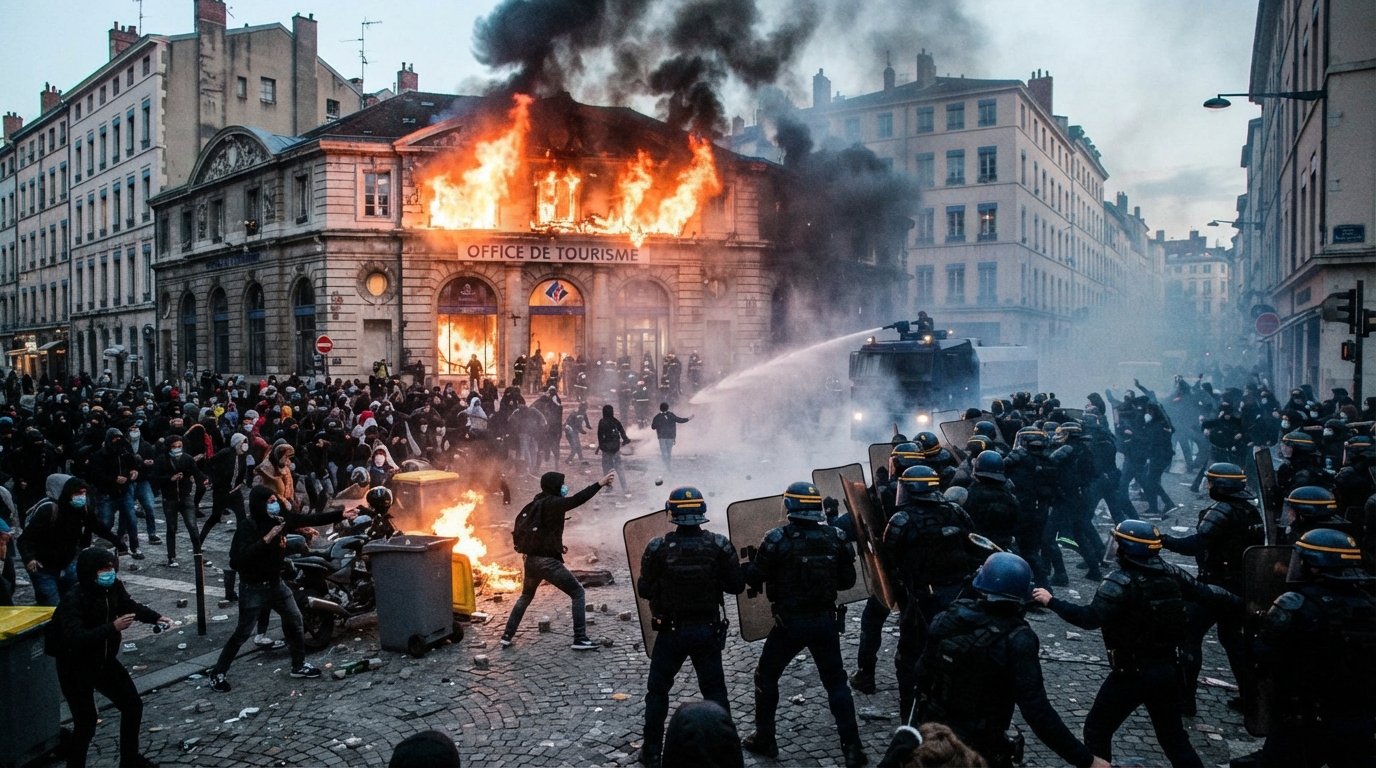
Hundreds arrested in France as police clash with protesters
Demonstrators set fire to Lyon's local tourism office, according to the AFP news agency and local media
Unrest erupted in cities across France on Saturday, the latest day of protests over education standards and the cost of living.
At least 400 people were arrested during what the French government called an "escalation in violence", as an estimated 550,000 people took to the streets.
Although much of the main planned demonstration in Paris passed without incident, there were also major clashes with riot police, who used tear gas and water cannon against crowds.
Buildings were set on fire in the French capital and in Lyon, where a tourist office in a 19th Century building was destroyed.
Looting broke out in several cities, and there were also reports of widespread vandalism aimed at city halls and businesses.
La Barrique bar in Paris was set on fire
In Paris, the main march seemed largely peaceful in the afternoon. A group of young people told the BBC they were "pacifists" who are "just trying to make things change, but nothing is moving".
But as the day went on, some groups started fires in the street and torched vehicles, including in well-known central locations such as the Place de la République.
Shops were looted, at least one restaurant was gutted by fire, and the BBC saw fighting break out among some of the groups.
In Lyon, Mayor Grégory Doucet said the burning of the city's tourist office was "a tragedy" for the city, telling BFMTV "it breaks our hearts because it's a very iconic, well-known historic building".
Local police said "hostile individuals" stopped firefighters from safely dealing with the blaze.
The interior ministry said the protests included "targeted acts of violence" by "hooded individuals" in places including parts of the capital, as well as Marseille, Rennes, Toulouse and Angers.
Damage to buildings was reported across France, including in Grenoble, Avignon, Pau, Montpellier and Valence.
Clothes and food shops were looted in Paris, while an Apple store in Lille was broken into and emptied.
Hundreds of thousands of students have protested in recent weeks over staff shortages and dilapidated facilities in the country's lycées - secondary schools attended by 15 to 18-year-olds.
On Saturday, they were joined by trade union members and other protest groups.
While France is no stranger to protest and disorder, this wave comes as the country enters a period of deep political uncertainty.
French President Emmanuel Macron will leave office next year, and polls suggest April's presidential election could become a contest between the leader of the National Rally, Marine Le Pen, and Jean-Luc Mélenchon of the hard-left La France Insoumise party.
Mélenchon took part in demonstrations in France and later accused police officers of "unleashing" on protesters, while condemning looting and arson.
France's Prime Minister Sébastien Lecornu said his comments were "dangerous and cynical".
He had earlier said police had faced "violence of extreme intensity" and that some groups were using the protests as a "warm-up" for the presidential elections, adding: "No-one will impose their political agenda through violence."
Le Pen said "legitimate demands" voiced by protesters had been "held hostage by the far left", accusing Mélenchon of fuelling the violence.
French President Emmanuel Macron said: "Those who have broken, attacked the prefectures as well as businesses, looted even our town halls, will be prosecuted and punished."
The government has made apparent attempts at concessions, with Education Minister Édouard Geffray promising 3,000 extra supply teachers during a television interview on 8 October.
However, the protests have continued and intensified.