

In France, school protests have grown into a nationwide movement. Video
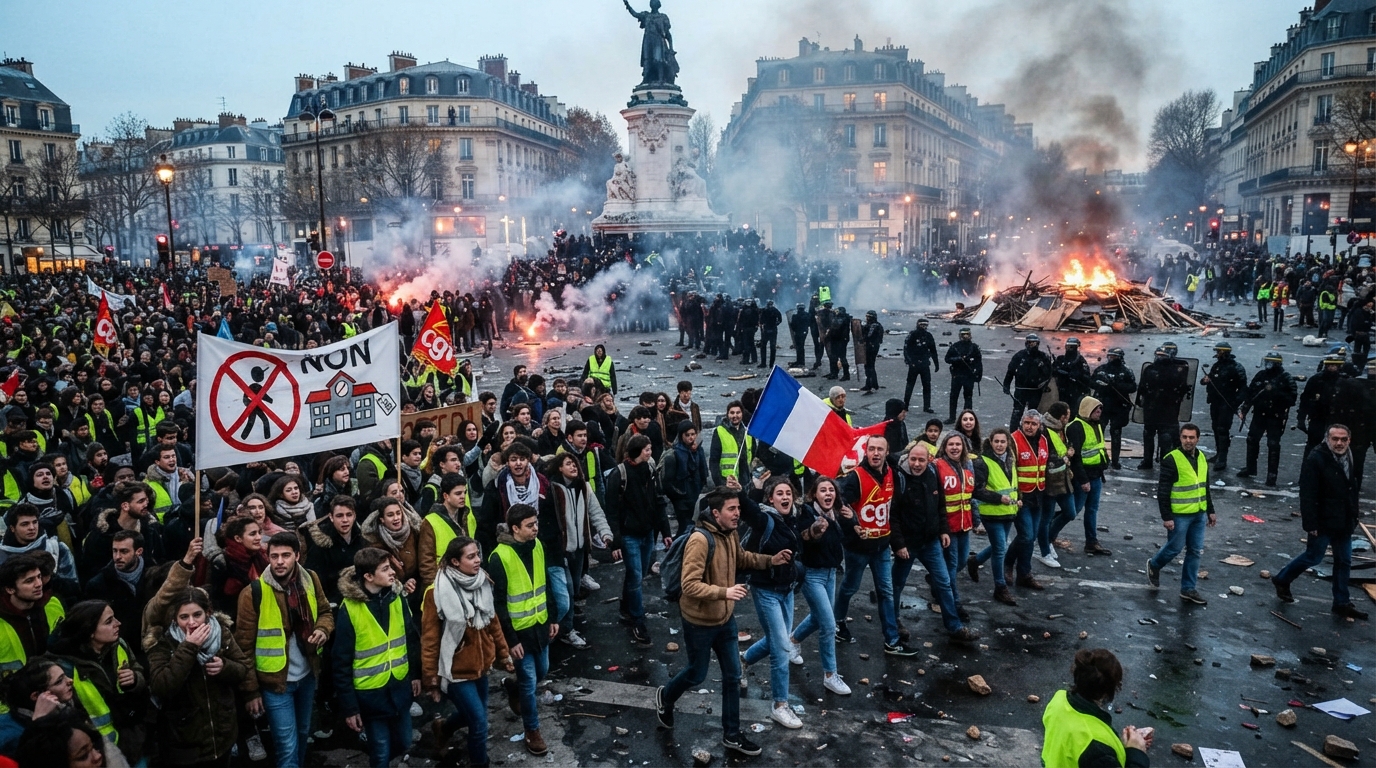
In France, school protests have turned into a nationwide movement. Video
In France, demonstrations that began in September over teacher shortages and poor school conditions have escalated into mass protests against rising prices and the government's economic policies. On Saturday, October 17, hundreds of thousands of people took to the streets. Riots and clashes with police occurred in a number of cities, with the number of detainees approaching 2.4 thousand.
According to the French Ministry of the Interior, 110 demonstrations took place across the country on October 17, involving about 550,000 people, including 110,000 in Paris. Organizers estimated the total number of participants at 800,000. High school students, university students, teachers, trade unions, farmers, climate activists, and representatives of the "Yellow Vests" movement joined forces in the actions.
The first demonstrations took place in September in Créteil, a suburb of Paris. On September 17, teachers at the Lycée Antoine de Saint-Exupéry went on strike over a lack of resources, and the following day, students joined the protest.
In France, lycées are educational institutions for high school students, mostly aged 15 to 18. Students complained about shortages of teachers and support staff, overcrowded classrooms, overloaded schedules, and the poor condition of school buildings. In some classes, there were 32–35 students.
High temperatures in the classrooms created additional difficulties. According to students, in the summer the air in some classrooms heated up to 40 degrees Celsius. High school students also spoke of stress associated with Parcoursup, an online platform through which graduates submit applications for university admission.
Following the demonstrations in Créteil, blockades of educational institutions spread to other areas of the Paris region and then to other parts of the country. University students and teachers' unions joined the high schoolers. Gradually, participants began to speak not only about educational problems, but also about the rising cost of living.
By the end of September, rallies in individual cities were accompanied by arson, the use of pyrotechnics, and clashes with police. On October 1, according to published data, 1,949 people were detained in a single day.
French Prime Minister Sébastien Lecornu stated that the protesters' demands do not justify violence near schools. Government representatives also accused the La France Insoumise (LFI) party, led by Jean-Luc Mélenchon, and its far-left allies of attempting to use the protest movement for political purposes.
Education Minister Édouard Geffray said the protests had fallen under the influence of groups resorting to violence. LFI rejected the accusations, calling the mobilization spontaneous.
The actions of law enforcement agencies sparked separate controversies. Human rights organizations, including Amnesty International and the Human Rights League, criticized the use of force against underage demonstrators. In the town of Lens, a teenager sustained a severe arm injury during clashes. The circumstances of such incidents are being investigated by the General Inspectorate of the French National Police (IGPN).
By early October, the protests had swept through hundreds of educational institutions. It was estimated that between 400 and 500 schools were partially or completely closed on October 5. The following day, Lecornu instructed ministers to prepare initial responses to student demands by the end of the month. Among the issues to be addressed were replacing absent teachers, the length of the school day, and renovating old school buildings.
However, by that point, the demonstrations had already spread beyond the educational system. Dissatisfaction with the government's economic policies was added to the students' demands.
Gradually, the protesters' demands went beyond educational issues. Other segments of the population joined the high school students, dissatisfied with the rising cost of living and the government's economic policies. One of the reasons for criticism was the 2027 draft budget, which provided for a 54 billion euro cut in government spending. Representatives of both left-wing and right-wing political forces opposed these plans.
The expansion of the protests recalled the "Yellow Vests" movement, which emerged in France in 2018 amid discontent over rising fuel prices. Initially, participants demonstrated against increased costs for motorists, but over time their demands spread to other economic policy issues. The movement's name is associated with the high-visibility vests that drivers are required to carry in their cars.
In October 2026, representatives of the "Yellow Vests" called on people to join the school protests. University students, trade unions, farmers, and climate activists also joined the actions. As a result, the demonstrations brought together participants with diverse demands—from improving educational conditions to revising budget policy.
During the October 17 demonstrations, participants demanded improved conditions in schools, measures against rising prices, and a review of plans to cut public spending. A portion of the protesters also called for the resignation of President Emmanuel Macron and the government.
Although many demonstrations passed peacefully, serious unrest broke out in several cities. In Limoges, a fire damaged a historic 19th-century city hall. According to reports of the incident, the building's roof collapsed, and the structure itself suffered significant damage.
In Marseille, rioters ransacked a municipal police station. In other cities, shops and public facilities were damaged.
In Paris, barricades burned at Place de la République, and clashes occurred with police, who used tear gas. Reports also emerged of shop ransackings, damage to vehicles, and bank branches.
The number of detainees grew as new data came in. On Saturday evening, Prime Minister Sébastien Lecornu reported approximately 1,200 detentions. By Sunday morning, Interior Minister Laurent Nuñez spoke of 1,800, and later authorities reported nearly 2,400 detentions nationwide.
Casualty figures also fluctuated. Initially, Nuñez reported more than 500 injured police officers, gendarmes, and firefighters. Later, the CNews television channel cited a figure of 997 injured, seven of whom sustained severe injuries. This information remains preliminary.
During the demonstration in Paris, one of the marchers died. He fell ill on Boulevard Magenta. The police prefecture stated that the death was not related to violence or the actions of law enforcement officers.
On Sunday evening, French President Emmanuel Macron addressed the nation. He stated that the demands of peaceful protesters deserve attention, but riots and attacks on public facilities are unacceptable.
According to Macron, representatives of far-left groups and individuals involved in crimes participated in the unrest. The president expressed support for law enforcement personnel and business owners affected during the riots. He also stated that those responsible must be held accountable and that the damage caused must be reimbursed.
The head of state called on political parties and trade unions to condemn the violence. According to media reports, authorities are also considering expanding the powers of prefects and mayors to ban gatherings if they pose a threat to public safety.
Interior Minister Laurent Nuñez linked the attacks on municipal buildings and police stations to the actions of radical left-wing groups. He rejected criticism that law enforcement agencies were underprepared for mass unrest.
The opposition, in turn, criticized the government's actions. Marine Tondelier, leader of the French Ecologists, demanded Nuñez's resignation, stating that he failed to prepare an adequate action plan. Marine Le Pen, leader of the far-right National Rally party, also criticized the cabinet of ministers. LFI once again rejected allegations of involvement in organizing the riots.
France's draft budget for 2027 provides for a 1.2 billion euro increase in funding for the Ministry of Education, bringing it to 64 billion euros. At the same time, the document envisions the elimination of 1,588 teaching posts. Education Minister Édouard Geffray attributes this to a decline in the student population and asserts that the cuts will not affect lycées. However, trade unions consider the proposed measures insufficient, and participants in the high school and university student movement, according to French media, are demanding an additional 10 billion euros for education.
On October 8, Geffray announced a plan to deploy 3,000 supply teachers to more than 500 lycées where staff shortages are felt particularly acutely. As of October 13, 35% of the planned substitute teachers had been deployed. In addition, about a hundred people were hired on a contract basis.
However, the Snes-FSU union criticized the plan, calling it "very ambitious" and "detached from reality." According to the organization, some teachers were assigned to cover subjects they do not teach.
Trade unions intend to continue the protests. The next nationwide strike is scheduled for November 5.
The actions are taking place against the backdrop of preparations for the 2027 presidential election. Incumbent President Emmanuel Macron, serving his second term, will be ineligible to run for a third.