

Uzbekistan’s services market grows 17% to UZS 908.5 trillion in January-August
Uzbekistan’s market services sector grew by 17% in real terms year on year to UZS 908.5 trillion in January–August 2026, with financial services, telecommunications and education recording the fastest growth.
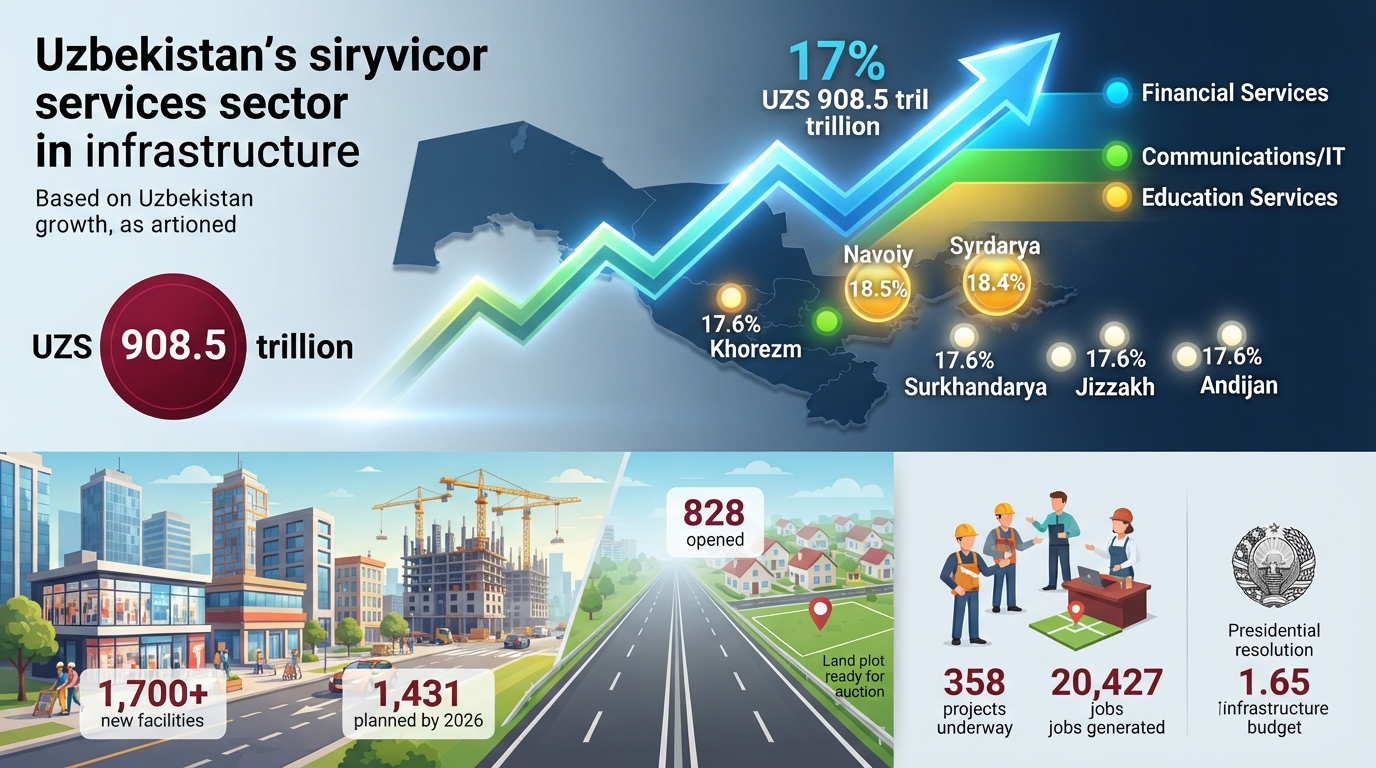
Uzbekistan’s services market expanded by 17% to UZS 908.5 trillion in January-August, according to figures released by the Ministry of Economy and Finance.
Financial services rose by 22.5%, communications and information technology services by 21.2%, and education services by 19.4%.
Among the regions, Navoiy posted the strongest growth at 18.5%, followed by Tashkent at 18.4% and Syrdarya region at 17.7%. Khorezm, Surkhandarya, Jizzakh and Andijan regions each recorded growth of 17.6%.
The government has set a goal for the services market to grow by 14.5% in 2026 overall.
Authorities are also continuing to expand service infrastructure nationwide. More than 1,700 retail and service facilities have opened on central streets, and another 1,431 are planned by the end of 2026.
In addition, 828 service facilities have started operating in New Uzbekistan residential areas and along international highways. Another 245 are expected to open by year-end, while 300 land plots have been offered for auction.
Under a presidential resolution dated February 5, 2026, an extra UZS 1.65 trillion was allocated from the national budget to develop infrastructure along busy streets, in waterfront and roadside areas, and in neighborhoods with strong tourism potential.
A total of 358 projects to build infrastructure for businesses in the services sector are currently underway. Authorities also plan to auction 33.8 hectares of land for these projects. Design and cost-estimate documentation has already been prepared, and construction is in progress.
The projects are expected to create 5,265 new businesses and enable 2,502 existing businesses to expand. They are also projected to generate 20,427 jobs.
The initiatives are being carried out under the Uzbekistan 2030 strategy.