

Uzbekistan’s future will increasingly be shaped in its cities. Op-ed
Cities are not just places where people live and work. They are where many of today’s most complex challenges converge. By adopting integrated approaches to urban development, it is possible to strengthen institutions and enhance their resilience to future changes. Op-ed by Anas Fayyad Karman.
Uzbekistan’s future will increasingly be shaped in its cities. Op-ed
Recent census data show that Uzbekistan is now a majority-urban country, with 54.5% of its population living in urban areas. Even so, urbanization remains uneven — ranging from 100% in Tashkent City to below 40% in Khorezm. At the same time, a young population, including 21.7 million people of working age, and more than 2 million people already moving for work are changing where opportunities are generated and where pressures are experienced.
These developments place cities ever more at the heart of Uzbekistan’s transformation. Cities are no longer just places where people live and work; they are where many of today’s most complex challenges meet, from economic uncertainty and demographic change to climate pressures and social inequalities. But they are also where many solutions can take shape.
For many years, governments and UNDP have helped cities tackle development challenges through targeted, locally focused projects. As urban challenges become more interconnected and complex, there is an opportunity to build on this work by shifting toward more integrated approaches that improve coordination, link local priorities with national ambitions, and give cities a stronger role in shaping their own development paths.
This also means making sure that ambitious national goals are matched by the guidance, capacities and financing needed for implementation at the local level, while enabling cities to mobilize diverse resources and make decisions that turn growth and investment into concrete benefits for their communities.
In addition, new technologies such as Artificial Intelligence (AI) and digital platforms are rapidly reshaping how economies function. This brings a major opportunity, but also a risk. Without smart planning, cities may see value and jobs move elsewhere instead of being created and retained locally. This is not a challenge for tomorrow; it is happening now.
So how can cities truly move ahead and turn these challenges into opportunities? If examined closely, transport is not only a transport issue; it also affects access to jobs, air quality, productivity and inclusion. Likewise, housing is not only about buildings; it is tied to land use, infrastructure, mobility, energy and affordability.
The answer, therefore, lies in moving beyond scattered projects toward integrated systemic approaches. This means viewing these issues as connected parts of a larger system, working together, learning, and adapting. To date, UNDP globally has extensive experience helping cities do exactly that.
Here is a breakdown of how cities can apply this approach:
Understand the System
Start by listening to communities, identifying how challenges are interconnected, and anticipating future trends.
Build Integrated Portfolios
Move beyond isolated projects by developing portfolios of connected actions that allow cities to test solutions, learn what works, and consider financing from the outset.
Mobilize Partnerships and Investment
Bring together government, communities, investors, the private sector and development partners to turn promising solutions into scalable and investable opportunities.
Build Capacity, Learn and Adapt
Strengthen local skills and institutions, continuously learn from implementation, and establish ways of working that sustain collaboration and innovation over time. UNDP can support cities throughout this process, drawing on its experience in systems thinking, portfolio approaches and capacity development.
This is not about reinventing the wheel — it is about bringing global experience to Uzbekistan. Several initiatives are already putting these ideas into practice. These programmes have engaged more than 450 cities and helped train over 1000 city officials. For instance, in Kapan, Armenia, the city used this approach to reimagine tourism as a way to improve community wellbeing and local identity. Kutaisi, Georgia, developed a vision as an eco-smart city, focusing on green innovation and involving its citizens. Ceadîr-Lunga, Moldova, addressed rising energy costs not only through new technology, but also by involving citizens and building local skills for an energy transition.
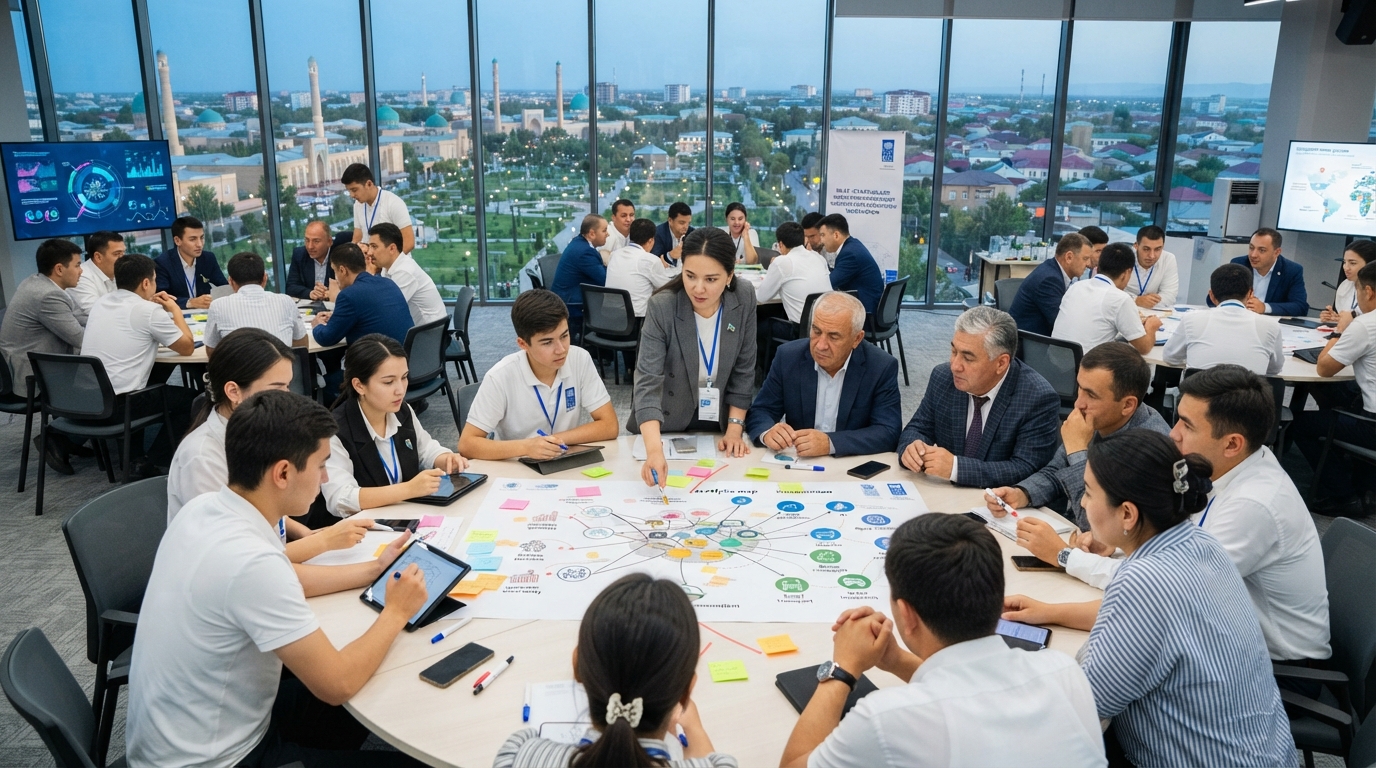
Building on the findings of UNDP’s City Experiment Fund (CEF) and Mayors for Economic Growth (M4EG) initiatives, in July 2026, the City of Namangan and UNDP convened a three-day Portfolio Design work to explore how digital technologies, artificial intelligence and systems thinking can support the city’s long-term urban economic transformation.
Bringing together representatives of municipal and national government, universities, the private sector, development partners and the wider innovation ecosystem, this portfolio design marked the first major milestone in the development of Namangan’s Urban Digital Economy Portfolio.
A key conclusion of the workshop was that Namangan is not starting from zero. The city already has many of the institutional, technological and human capabilities needed to support digital transformation, including advanced digital public services, universities, innovation programmes and strong national policy support.
Participants consistently concluded that the city’s greatest opportunity lies not in building entirely new systems, but in strengthening collaboration, connecting existing capabilities and unlocking greater value from the assets already in place.
By adopting these integrated approaches, cities gain a great deal. They obtain a clear, shared vision for the future, ensure everyone works together, and continuously test new solutions. Most importantly, their institutions become better prepared for future change and uncertainty.
This creates a pipeline of opportunities that attract investment and builds a strong foundation for lasting economic transformation.
Ultimately, this enables cities to stop merely reacting to change and instead become active shapers of their own economic and social futures. It is about building cities that are not only resilient, but thriving, innovative, and future-ready.