

“Uzbekistan without Bureaucracy”: the best proposals for eliminating redundant obstacles will be rewarded
The "Bureaucracy-free Uzbekistan" platform has been launched. Through it, citizens and entrepreneurs can report excessive bureaucratic processes in government agencies and propose solutions to them. Authors of the top 50 proposals submitted by November 20 will receive a cash prize of up to 2 million soums. What else is known?
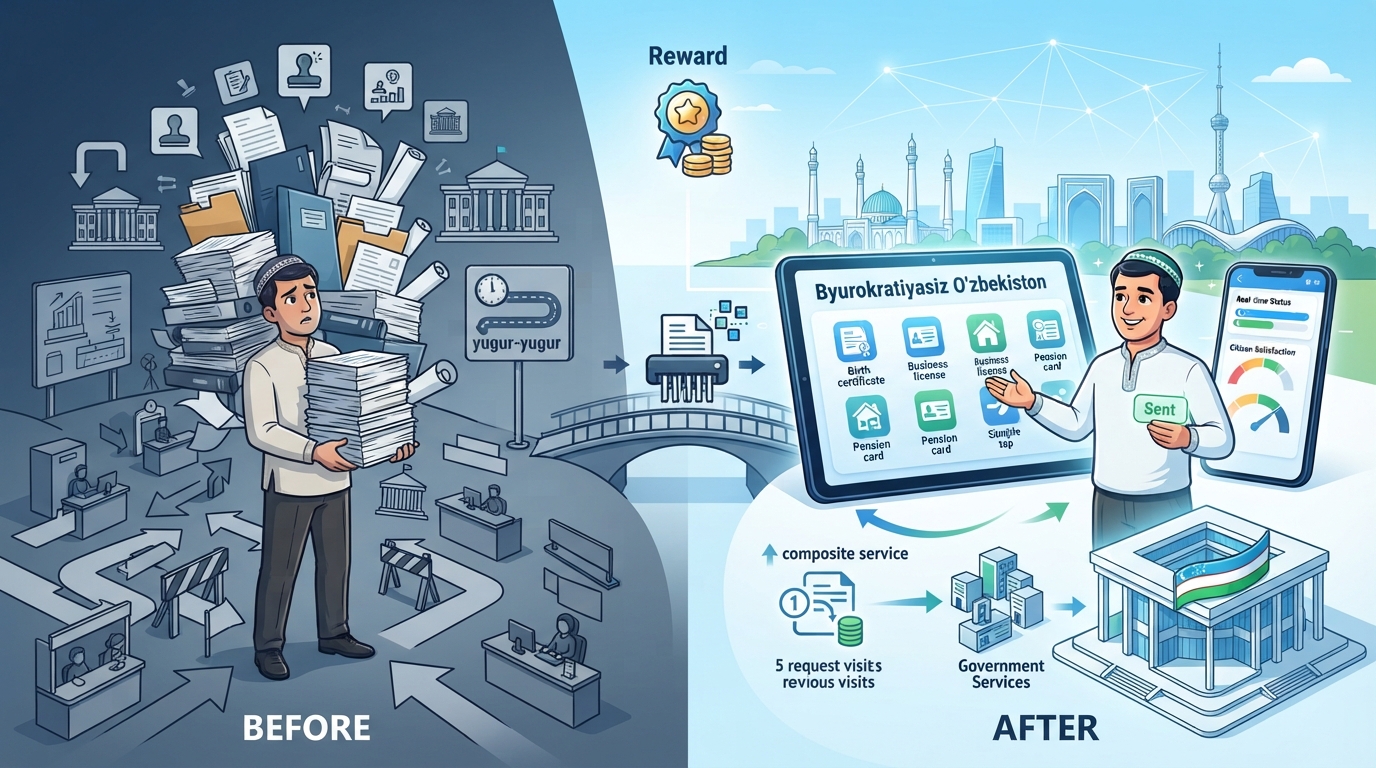
“Uzbekistan without Bureaucracy”: the best proposals for eliminating excessive obstacles will be rewarded
Citizens and entrepreneurs can receive a cash reward of up to 2 million soums if they report problems regarding excessive bureaucratic processes in government agencies and present proposals to resolve them. This was announced at a press conference on the topic “Uzbekistan without Bureaucracy” held in Tashkent on September 21, Gazeta correspondent reports.
According to Tohirjon Safarov, Deputy Director of the Agency for Strategic Development and Reforms, the “Eliminating Bureaucracy — 2030” program was developed by the president's decree dated November 28, 2025.
According to Safarov, within the framework of this program in cooperation with the UAE, it is aimed to reduce the functions of state bodies by 30 percent, optimize requirements for business by up to 20 percent, and increase the share of electronic public services to over 90 percent. To coordinate the program, a Project Office has been established under the Agency for Strategic Development and Reforms.
The Agency representative said that today there are 5,650 functions in state bodies, more than 42,000 mandatory requirements regulating business activities, and 1,041 public services. It was also noted that excessive procedures, red tape, and duplicate requirements still persist in the system. This indicates the need to reduce excessive requirements and documents, digitalize services, and reduce the human factor. In this process, studying the real experience of citizens and entrepreneurs, the problems they face, and their opinions is of great importance.
For this reason, the digital platform “Uzbekistan without Bureaucracy” was launched. Through it, it is planned to submit and review proposals for eliminating bureaucracy, as well as to evaluate the effectiveness of the activities of state bodies.
“A citizen should make as little effort as possible to receive a public service, and a state body should provide these services quickly and with high quality, using the information it has effectively,” says the deputy director of the agency.
He noted that within the framework of the program, it is planned to transfer 95 percent of 1,043 public services to online format by 2030. Currently, 227 services are provided in the traditional way.
In addition, it is also aimed to increase composite services. That is, if a citizen has to apply to three or four agencies to solve one issue, it is planned to combine these processes and have the agencies themselves obtain the necessary information.
“In eliminating bureaucracy, we aimed not only to simplify a single service, but to solve the citizen's problem from beginning to end,” says Safarov.
According to him, the effect of the reform should be measured not by internal reports, but by the real result created for the citizen and entrepreneur.
“How much of the citizen's time was saved as a result of the changes made, what expenses of the entrepreneur were reduced, and how much the satisfaction level of the service user increased — this should be the main question,” he says.
Safarov noted that starting this year, the national rating “Eliminating Bureaucracy” has been introduced. By the end of the year, the activities of 72 state agencies and ministries to reduce bureaucracy will be evaluated.
In this, the same three criteria will be taken into account — how much of the citizen's time was saved, the reduction of the entrepreneur's expenses, and the satisfaction level of the service user.
To reduce bureaucracy between state agencies, a single digital platform for strategic planning aimed at digitalizing G2G — “government-to-government” (i.e., mutual information exchange between state agencies) relations was also developed. Through it, the processes of developing a strategic document, calculating costs, financing, monitoring execution, and evaluating the impact of the result on humans will be combined into a single system.
“We are trying to turn paper-based red tape and approval processes that last for weeks into an instant by transferring them to a digital system,” says Safarov.
For the practical part of the “Uzbekistan without Bureaucracy” initiative, the platform murojaat.byurokratiyasiz2030.uz was developed.
Sirojiddin Turabekov explained that through the platform, citizens and entrepreneurs can submit proposals on repetitive, excessive, or digitalizable processes they encounter in relations with state agencies.
Each proposal must include a clear description of the problem, its consequence or loss of time and resources, a practical solution, and, if possible, supporting evidence.
According to him, this platform differs from appeals aimed at solving a personal problem in the People's Reception or the ordinary appeal portal.
“Our platform is intended to propose processes that are systemic, not aimed at solving the problem of only one person, but capable of offering a solution for the whole society or a specific segment,” says Turabekov.
On the platform, proposals can be sent openly or anonymously. Turabekov said that this opportunity was also created for citizens who are aware of a problem in a state agency but are concerned about revealing their identity.
“A citizen knows that there is a problem in the agency where they work, but if they show their identity, it may later cause inconvenience in relations with their leadership. Therefore, accepting proposals anonymously has also been established,” he says.
Turabekov informed that proposals are initially sorted by the Project Office. Appeals unrelated to the topic or not meeting the program requirements are filtered out. After that, proposals related to systemic bureaucratic problems are sent to sector experts.
“We have established cooperation with organizations and experts in five directions,” he says.
Proposals related to entrepreneurship are evaluated by the Chamber of Commerce and Industry or the Business Ombudsman. On issues affecting citizens' lives, the “Yuksalish” Nationwide Movement or the Development Strategy Center participates as an expert. The Ministry of Digital Technologies evaluates the possibility of digitalizing the proposal through my.gov.uz. At the final stage, the compliance of the proposal with current legislation is reviewed by the Ministry of Justice.
According to him, it is aimed to identify and optimize at least 1,000 processes in 2026.
“We plan to identify and optimize at least 1,000 processes. This initiative will continue every year until 2030,” says Turabekov.
Citizens must send their problems and proposals to the portal from September 21 to November 20.
Safarov noted that the best 50 proposals among those received from citizens and entrepreneurs will be selected. Their authors will be awarded a cash prize of up to 2 million soums. In the first stage, 100 million soums have been allocated for this purpose.
“For now, we have allocated 100 million soums. In general, our goal is to allocate 3 million dollars by 2030. We are working on this,” says Safarov.
An author wishing to receive a reward must leave contact information on the platform. This will be used to identify the author and verify that the proposal indeed belongs to them.
Aziza Umarova emphasized the importance of spreading the initiative across the entire republic.
“We want to cover the entire republic through this initiative. We would be very glad to receive proposals not only from Tashkent city or regional centers, but also from residents living in remote areas,” she says.
According to her, although part of public services has been digitalized, the most complex issues often require the participation of several agencies.
“Public services belonging to a single agency have already been regulated. But all the most difficult issues depend on four or five agencies. For example, alimony, benefits, or disability issues. Therefore, we must place the emphasis precisely on composite public services,” says Umarova.
She said that to explain the initiative to the population in simple language, the phrase “yugur-yugur” (running around) can be used.
“People often compare bureaucracy with the phrase 'yugur-yugur'. This is an understandable phrase for the people. We are putting forward the hypothesis that we can attract the attention of more people with a simple, humor-based approach like 'we will reduce running around',” she says.
At the press conference, clarification was requested regarding the program being implemented in cooperation with the United Arab Emirates.
Umarova said that the UAE has an interesting experience for Uzbekistan in digitalizing public services and systematizing the functions of state bodies.
“Most importantly, all public services in the UAE have already gone online. This state serves as an example for many,” she says.
She noted that there is a registry called Khadamati in the UAE.
“With them, each function is established transparently and effectively, linked to a specific organization. For example, 68 agencies provide services in a single-window format. We, on the other hand, are thinking of combining four or five agencies to provide services. If we learn from advanced countries, we can apply this experience to ourselves and expand our imagination without spending years,” says Umarova.
At the event, journalists asked a question about how much the establishment of new ministries, agencies, and positions in public administration affects the increase of bureaucracy.
Oybek Khidirov said that currently, along with the state organizations themselves, their tasks and functions are also being inventoried.
“Tasks and functions that are repetitive, outdated, and seen as bureaucratic obstacles are also being re-inventoried, and measures will be taken to unify and reduce them,” he says.
Khidirov noted that in this process, forming a single registry of functions of state organizations is also one of the main tasks.
“Why does a new state organization arise? Because there is no single list of functions and tasks. If a single list of functions is formed, the issue of making changes in state organizations will be raised based on this,” says the representative of the Ministry of Justice.
According to him, before a new organization is established, it must be determined which state body currently performs the task it will carry out.
“If one task or function is present in several state organizations, changes will occur in the state organization by reducing these tasks and functions, and this function will be performed by only one state organization,” says Khidirov.
According to him, such an approach is aimed at preventing the tasks of new organizations from duplicating the functions of already existing state bodies.