

Uzbekistan to monitor working conditions of cotton pickers from 25 September
Uzbekistan will begin monitoring the working conditions of cotton pickers from 25 September. Monitoring teams will visit randomly selected farms, check employment contracts and wage payments and investigate reports of possible violations of workers' rights.
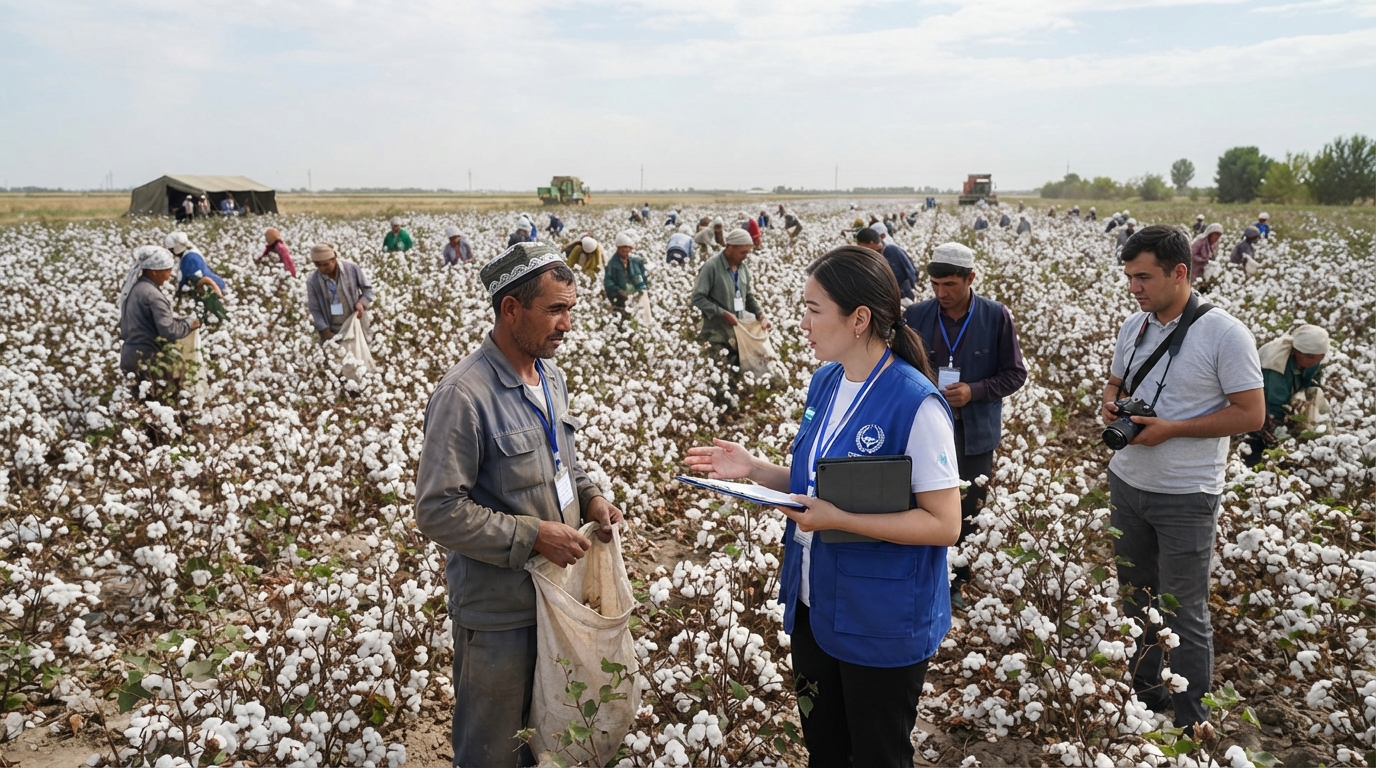
Uzbekistan will begin monitoring the working conditions of cotton pickers on 25 September
National monitoring of cotton pickers’ working conditions for the 2026 season will take place from 25 September to 31 October. The purpose is to prevent child labor and forced labor in the fields. The Federation of Trade Unions of Uzbekistan said the monitoring was launched last week.
The monitoring teams consist of 65 specialists, five from each region. They include sectoral trade union representatives and the federation’s labor inspectors, along with members of the Chamber of Commerce and Industry and the National Association of Non-Governmental Non-Profit Organizations.
Every Monday and Saturday at 7:00, team leaders receive random GPS coordinates for up to three sites in their region. They depart for inspections at 9:00. Data and photo reports are sent to the federation every day.
Since 15 September, the federation and its regional branches have set up round-the-clock duty services for the entire season. Workers can report violations of their labor rights by calling the short number 1092, through the Federation of Trade Unions’ website or its Telegram bot.
Across Uzbekistan, 200 banners have already been installed, and another 10,000 posters are being prepared. In addition, 200,000 leaflets with information on workers’ rights will be distributed among cotton pickers.
“The current situation cannot even be compared with 2020, let alone with the situation a decade ago. Previously, there was no administrative or criminal liability for forced labor. Now, the Administrative Code has been strengthened, and a separate article has been added to the Criminal Code,” deputy chairman of the Federation of Trade Unions Bakhtiyor Makhmadaliev said.
He said the Federation of Trade Unions has not found cases of child labor or forced labor in its monitoring in recent years. The main issues identified are late wage payments, work without contracts and poor working conditions. Monitoring continues in part because international organizations place more trust in results obtained by non-governmental organizations.
Katerina Gorbunova, a representative of the Better Cotton Initiative program in Uzbekistan, said such monitoring would only become unnecessary once mechanization is introduced. The organization certifies more than 20% of the world’s cotton and has carried out its own monitoring of working conditions in Uzbekistan since 2022.
“Take large farms in the United States or Brazil: a 10,000-hectare farm may have just three workers, so monitoring simply does not make sense. But when the same 10,000 hectares require 5,000 temporary workers, it is a completely different situation,” she explained.
According to Gorbunova, a large share of the population is involved in manual cotton picking during the cotton season. Three or four years ago, about 2 million people were mobilized each year to pick cotton, most of them working informally.
Informal employment is widespread in agriculture around the world, not only in Uzbekistan. The sector generally carries greater labor-rights risks than any other. For that reason, Gorbunova sees monitoring not as a punitive measure, but as support for workers and a way to educate farmers. As employers, farmers generally have limited knowledge of labor law, and monitoring gradually helps them learn the relevant requirements.
Last year’s monitoring results show the kinds of violations cotton pickers face. The Federation of Trade Unions found no cases of child labor or forced labor in 2025. At the same time, inspectors recorded:
166 cases of delayed wage payments, affecting 8,752 cotton pickers;
227 cases of work without an employment contract, affecting 9,075 people;
1,222 cotton pickers working at 24 farms and clusters without adequate working and rest conditions.
All identified wage arrears were fully repaid, Makhmadaliev said in response to Gazeta’s question about how such disputes are resolved.
“Regarding wage payments, it was established that 8,752 cotton pickers had not received their money on time. Our inspectors worked with the heads of the farms to resolve the issue, and the arrears were fully repaid. If a violation is not resolved on site, the materials are submitted to the State Labor Inspectorate for fines. If this also fails to produce a result, the case is referred to the prosecutor’s office, which oversees compliance with the law,” he said.
Minimum working-condition requirements are approved every August by the Republican Tripartite Commission on Social and Labor Issues, which includes representatives of the government, trade unions and employers. Under these requirements, field camps must have toilets, showers, hot meals and clean drinking water.
The State Labor Inspectorate under the Ministry of Employment and Poverty Reduction also carried out its own inspections during the previous season. Inspectors visited 986 farms and fined 116 officials a total of 397.44 million soums for non-payment of wages. The inspectorate’s hotline 1176 and Telegram bot received 222 complaints about delayed payments. As a result, 1.785 billion soums in unpaid wages was recovered for cotton pickers.
The overall results of the 2026 monitoring season will be presented in December.