

Uzbekistan to invest $8 million Korean grant in digital water and concrete canals
Uzbekistan and the Republic of Korea are preparing a major project to modernize the water resources management system in agriculture. In the Bayaut district of the Syrdarya region, plans include not only reconstructing the irrigation infrastructure but also introducing digital control over the movement and use of water. The project will be implemented jointly with the Korea Rural Community Corporation (KRC) within the framework of the Korean Official Development Assistance (ODA) Program […]
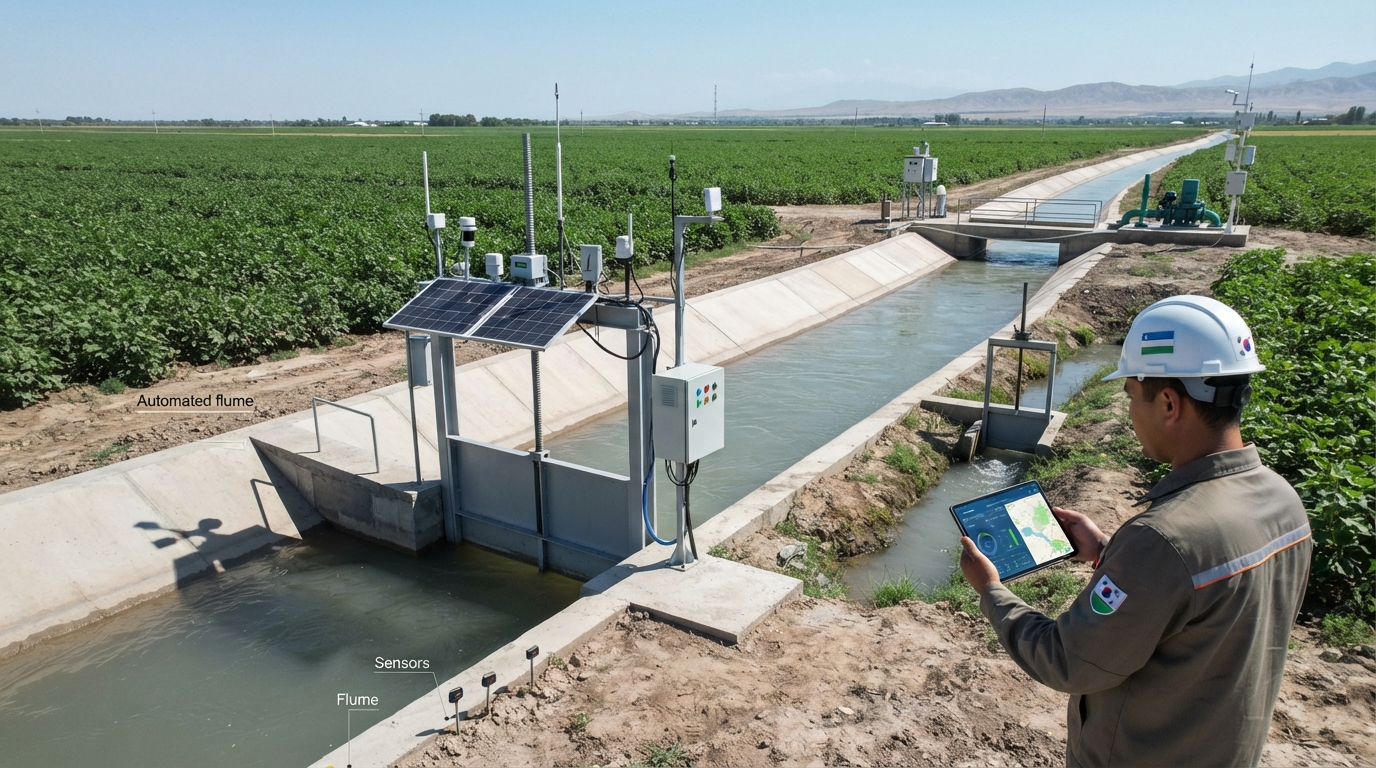
Uzbekistan will direct an $8 million Korean grant toward the digitalization of water management and concrete canals
Uzbekistan and the Republic of Korea are preparing a large-scale project to upgrade the agricultural water resource management system. In the Bayaut district of the Syrdarya region, they intend not only to reconstruct the irrigation infrastructure but also to introduce digital control over the movement and use of water.
The project will be implemented jointly with the Korea Rural Community Corporation (KRC) under the Korean Official Development Assistance (ODA) program. As reported by Shukhrat Suyunov, head of the information service of the Ministry of Water Resources, the total amount of grant funding will be $8 million.
Designed for 48 months, the project is planned for implementation in 2027–2030. Its main goal is to develop a Master Plan for the sustainable use and integrated management of water resources in agriculture, while simultaneously testing modern technologies directly in the Bayaut district.
The project is not limited to the physical reconstruction of canals. It provides for the introduction of digital devices for water resource accounting and management, as well as the automation of hydraulic structures. The solutions obtained in the Bayaut district are then planned to be scaled to other regions of Uzbekistan.
The next step in this modernization could be the creation of a unified digital platform that will consolidate data on the status of the entire water management infrastructure.
In the future, information from reservoirs, water hubs, canals, pumping stations, gauging stations, and land reclamation observation wells could be gathered into a single system. This will allow for a transition from fragmented accounting of individual facilities to comprehensive monitoring of water resources.
Additional opportunities are provided by the use of artificial intelligence. By analyzing accumulated data, such systems could potentially forecast agricultural water demand, identify changes in water flow, detect anomalous losses, and signal malfunctions of hydraulic structures in advance.
For a country with a growing strain on water resources, this means a transition from dealing with the consequences of water scarcity to more precise planning and management of the resource itself.