

Uzbekistan resumes upper-air weather observations after nearly 30 years
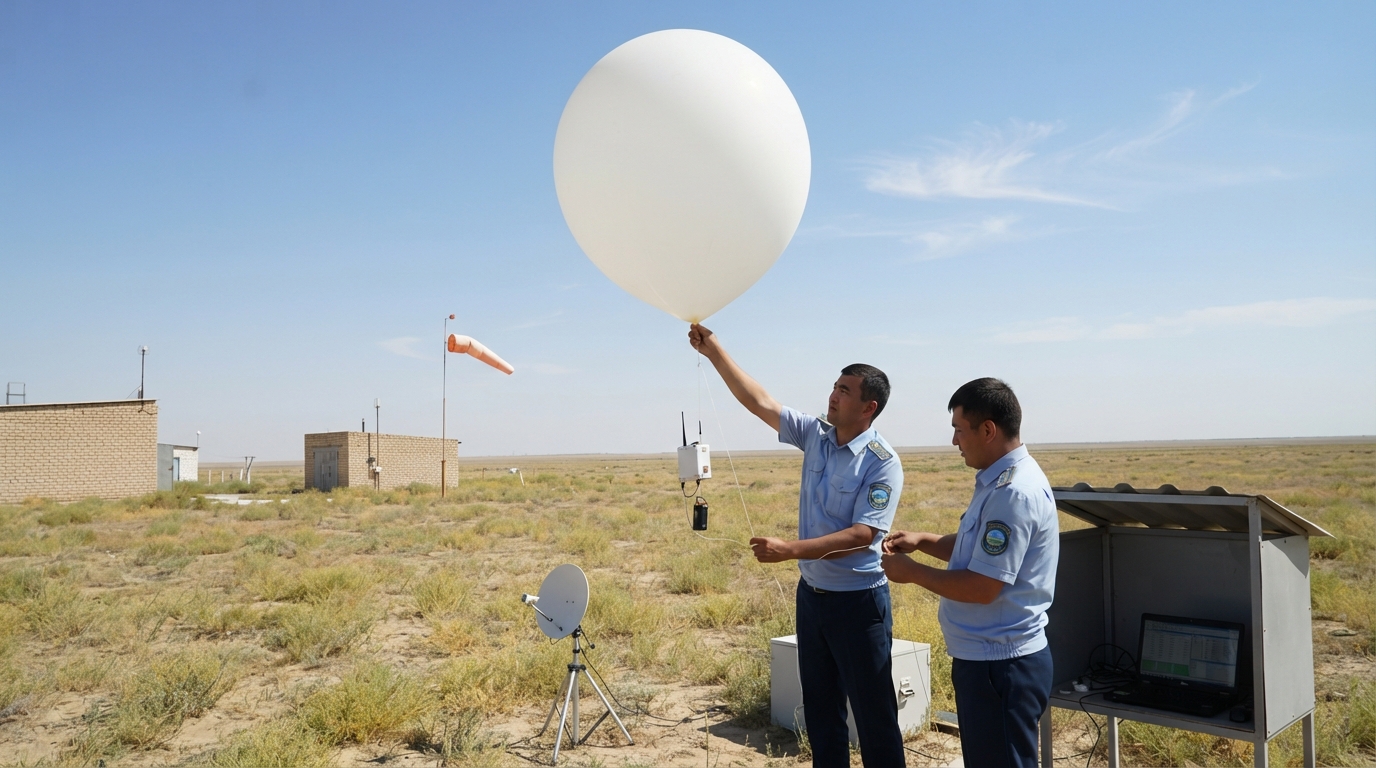
Uzbekistan has restarted upper-air atmospheric observations at two sites within its national meteorological network, marking an end to a nearly 30-year pause. New radiosounding equipment has been installed in the Tashkent and Bukhara regions to enhance weather prediction and climate risk evaluation.
The United Nations Development Programme (UNDP), with financial backing from the Green Climate Fund (GCF), has outfitted the Mayskaya station in Tashkent Region and the Yakkatut station in Bukhara Region with contemporary atmospheric radiosounding technology.
Radiosounding entails releasing a radiosonde into the atmosphere via a balloon filled with helium or hydrogen. As the balloon ascends, the device records air temperature, humidity, atmospheric pressure, and wind attributes at varying elevations, relaying this information to a ground station. These observations are typically performed twice daily and are an integral part of the World Meteorological Organization’s (WMO) Global Observing System.
Upper-air data are crucial for analyzing atmospheric phenomena and boosting the precision of weather forecasts. They assist meteorologists in gauging the probability of heavy rainfall and strong winds, while also contributing to aviation safety and climate studies.
The reintroduction of radiosounding at the Mayskaya and Yakkatut stations reinstates a vital element of Uzbekistan’s national meteorological observation network that had been dormant for almost three decades. This undertaking is part of a wider initiative to update Uzhydromet's observation network and bolster its capabilities for hydrometeorological modeling and climate risk assessment.
The modernization scheme also encompasses the deployment of automatic weather stations, advanced X-band weather radars, and electromagnetic apparatus for measuring water velocity and discharge. Furthermore, a multi-module platform for climate risk assessment is under development.
More precise and prompt weather data are anticipated to enable authorities to alert residents about dangerous hydrometeorological events, refine agricultural planning, elevate the safety of transport infrastructure, and fortify emergency preparedness.
As climate change intensifies the frequency and severity of weather-related hazards, robust meteorological observation systems are becoming progressively more significant for Uzbekistan’s climate resilience and for supporting the WMO’s Early Warnings for All initiative.
Previously in August, Uzbekistan also carried out its inaugural test launch of an aerological balloon in Bukhara Region. This balloon carried a modern radiosonde engineered to record atmospheric temperature, relative humidity, pressure, and wind characteristics at various altitudes in real time.