

Uzbekistan presents results of transition to a green economy
The Ministry of Economy and Finance of Uzbekistan has announced the results of reforms for 2022–2026 to transition to a green economy, including certificates, carbon markets, and international agreements.
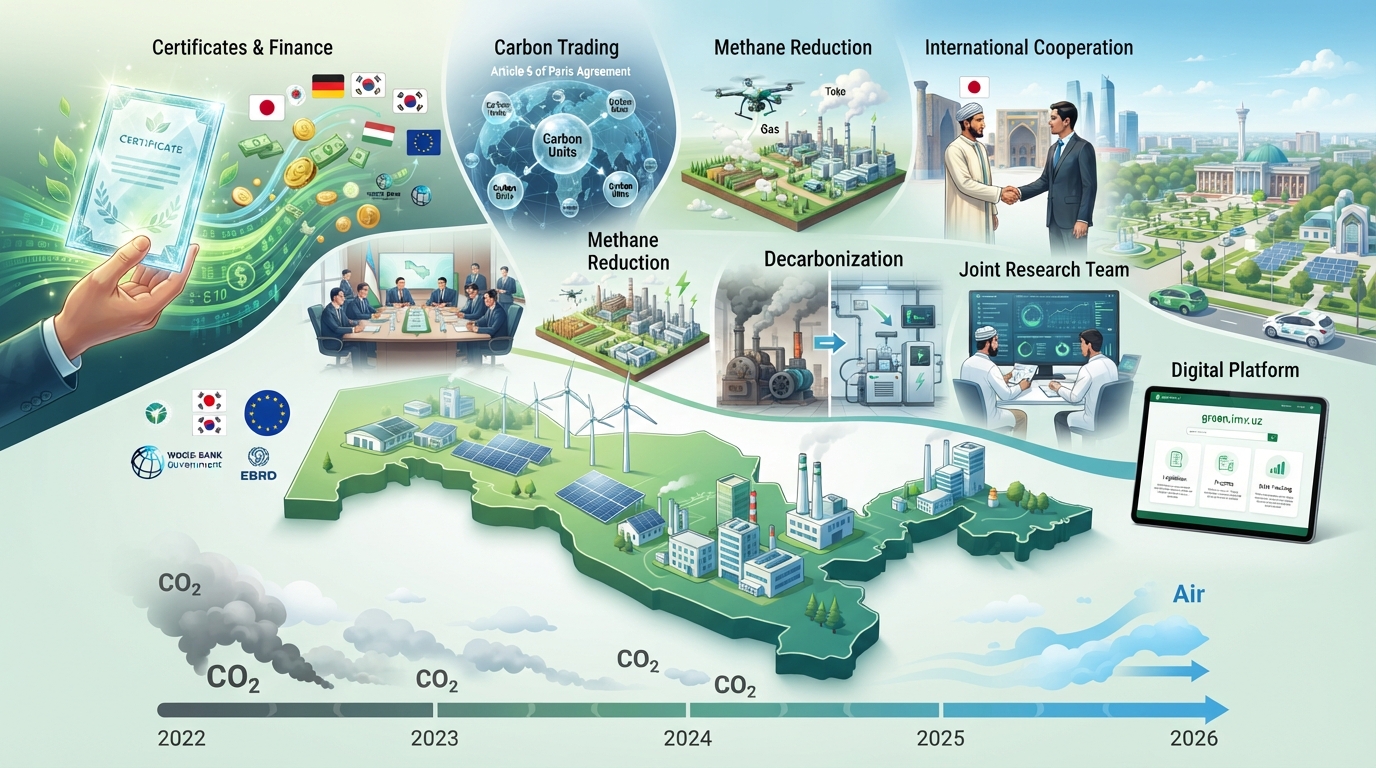
The Ministry of Economy and Finance of Uzbekistan has announced the results of reforms aimed at transitioning the country to a green economy between 2022 and 2026. These changes include legislative changes, international agreements, and the attraction of financing to combat climate change.
**Legal Framework for Reforms**
The basis for these changes is Presidential Resolution No. PP-436 of December 2, 2022, which approved a program for transitioning to a green economy and ensuring green growth through 2030. The document also includes a concept for industrial transition to a green economy and energy conservation, an action plan, and targets for fuel and energy resource savings for 2022–2026. It is planned to reduce the energy intensity of production by 20% by 2026 compared to 2022. In addition, the composition of the Interdepartmental Council for Coordinating Measures for the Transition to a Green Economy was updated, and a Donor Coordination Group was approved.
Green Energy Certificates
Since May 12, 2023, Uzbekistan has been implementing a system of "green energy certificates," introduced by Presidential Decree No. PP-156. These certificates confirm the production of products using renewable energy sources. Energy producers sell the certificates to end consumers, which guarantees the "clean" origin of the energy, facilitates increased exports (such certificates are mandatory in the European Union), and attracts "green" investments and loans from international financial institutions. To date, more than 446,000 certificates have been issued.
Methane Reduction Commitment
In May 2022, Uzbekistan joined the Global Methane Emissions Reduction Commitment, initiated by the Ministry of Economy and Finance. As part of this commitment, participating countries voluntarily agreed to reduce global methane emissions by at least 30% by 2030 compared to 2020 levels. To implement this initiative, the European Bank for Reconstruction and Development (EBRD) provided US$1 million in technical assistance to develop a national methane emissions reduction program.
Cooperation with the World Bank on Carbon Trading
An innovative project for international trading of greenhouse gas emission reduction units (GHGCUs) is being implemented jointly with the World Bank in accordance with Article 6 of the Paris Agreement. This project marks the first carbon finance transaction in Central Asia and the first World Bank policy lending program in this area. With financial support from the Carbon Asset Transformation Fund (TCAF), a World Bank trust fund that supports countries' efforts to price carbon and attract private investment in low-carbon technologies, the iCRAFT project is mobilizing US$46.2 million for 2024–2028. To date, the program has reduced greenhouse gas emissions by 10 million tonnes of CO₂ equivalent, attracting $15 million ($7.5 million each in 2024 and 2025).
The emission reductions generated by energy tariff reforms are traded through two components: the Emissions Reduction Purchase Agreement (ERPA) simulates carbon trading with credits returned to Uzbekistan and a $20 million grant, while the Mitigation Results Purchase Agreement (MOPA) provides a full, irrevocable transfer of emissions reductions to the World Bank, with a $25 million grant.
**Partnership with Japan**
The governments of Uzbekistan and Japan have agreed to launch a Joint Crediting Mechanism (JCM). This Japanese cooperation mechanism finances up to 50% of projects implementing modern technologies in developing countries to reduce greenhouse gas emissions. A memorandum of cooperation was signed in October 2022, and the first official meeting of the joint JCM council was held in February 2025, approving the rules and guidelines for project implementation.
Long-Term Decarbonization Strategy
A project has been launched in partnership with the World Bank and the EBRD to develop a long-term strategy for decarbonizing the economy and transitioning to a green development model. As part of this project, an investment plan is being developed, outlining key activities and projects by sector, as well as the volume of capital investment required to achieve carbon neutrality. The draft presidential resolution "On Approving the Strategy for Low-Carbon Development and Achieving Carbon Neutrality in the Republic of Uzbekistan until 2055," prepared as part of the project, is being coordinated with the relevant ministries and agencies.
**Law on Limiting Greenhouse Gas Emissions**
On July 7, 2025, Law No. ZRU-1073 approved the Law "On Limiting Greenhouse Gas Emissions." It provides for the accounting of greenhouse gas emissions, the maintenance of a state inventory and a register of carbon units, the establishment of emission reduction targets by industry, and mechanisms for state support for relevant activities.
**Private Sector Support and a Digital Platform**
The "Private Sector Assistance and Policy Advisory in Uzbekistan" project, costing €12 million and scheduled for 2023–2028, is being implemented jointly with the German Cooperation Organization. This project includes training 80 employees of ministries and agencies, including 30 women, in green industrial policy, assisting relevant ministries in developing four strategic documents, and supporting 25 small and medium-sized enterprises, including three women-led enterprises, in reducing their CO₂ emissions by at least 10%.
An online green economy platform, green.imv.uz, has been created, bringing together information on the legislative framework, ongoing and planned activities, best international practices, and other aspects of green growth.
**International Coalitions and Assessments**
In 2023, the Ministry of Economy and Finance joined the "Climate Action" coalition of finance ministers, which operates on the basis of the Helsinki Principles: aligning policies with the Paris Agreement commitments, sharing experiences on climate change, taking measures to organize effective carbon trading, incorporating climate factors into macroeconomic policies and public procurement, attracting private financing, and participating in the formation of Nationally Determined Contributions (NDCs).
In collaboration with the World Bank, the Climate Change and Development Assessment (CCDR) project was implemented and published, assessing the impact of climate change on the economy and facilitating the attraction of accessible international green finance.
**Carbon Trading Regulation and Nationally Determined Contributions**
Cabinet of Ministers Resolution No. 117 of March 7, 2024, approved a temporary regulation on the implementation of international greenhouse gas trading projects. It establishes the procedure for organizing such projects and is valid until the national procedure for implementing the sustainable development support mechanism under Article 6 of the Paris Agreement (Paris, December 12, 2015) is approved.
Presidential Resolution No. PP-213 of June 5, 2024, approved a draft resolution on measures to implement a national transparency system for Uzbekistan's transition to a green economy, covering all levels of greenhouse gas emissions. The system allows for the evaluation of measures and results towards achieving nationally determined contributions and serves to strengthen the trust of donors and investors.
In accordance with its obligations under the Paris Agreement, Uzbekistan's Nationally Determined Contributions (NDC 1 and NDC 2) have been developed and submitted to the UN Framework Convention on Climate Change. In 2025, together with the Ministry of Ecology, an updated version (NDC 3.0) was prepared and submitted.
**Financing and International Recognition**
Uzbekistan applied to participate in the Climate Investment Funds (CIF) industrial decarbonization program and was among the six countries with the best results, opening the door to a $250 million soft loan.
Presidential Decree No. UP-110 adopted the decree "On measures for participation in the international carbon unit market," which was used as the basis for a draft Cabinet of Ministers resolution on improving the greenhouse gas inventory.
An agreement was reached for the Korean development agency KOICA to provide a grant of US$8.5 million in 2026–2030 for a project to support Uzbekistan's implementation of the Paris Agreement and support joint actions with the Republic of Korea under Article 6 of the agreement.
As part of a project to promote Uzbekistan's decarbonization strategy and cooperation on the transition to a green economy, US$200 million in loan funds have been secured. Local banks are providing green loans to businesses through the third phase of the Green Economy Financing Facility (GEFF). An agreement was reached with EBRD representatives to potentially increase the project's loan funds to US$300 million.
A draft decree approving a national program to improve the green financing system is being developed and coordinated with ministries and agencies. This decree provides for the formation of a National Green Economy Fund under the Green Economy Project Center, which is being established within the Ministry of Economy and Finance.
**International Exhibitions and Bilateral Cooperation**
At the international exhibition "Eco Expo Central Asia 2025" held in Tashkent, the Ministry of Economy and Finance organized a pavilion on "Green Economy" and "Green Finance." Representatives from the World Bank, the EBRD, the Asian Development Bank, the German Society for International Cooperation, the National Agency for Energy Efficiency, the Mortgage Refinancing Company, and the commercial banks SQB and Agrobank participated. Following the exhibition, the Ministry won first place among participating agencies for the best pavilion.
On September 15, 2024, following negotiations between Uzbekistan and Germany, a memorandum of understanding was signed between the Ministry of Economy and Finance of Uzbekistan and the German Federal Ministry for Economic Affairs and Climate Protection on cooperation under Article 6 of the Paris Agreement, aimed at reducing greenhouse gas emissions and strengthening adaptation capacity to the effects of climate change.
At the Ministry's initiative, a draft agreement on cooperation on climate change was developed with relevant agencies of the Republic of Korea. As a result, a framework agreement between the governments of the two countries was signed in Tashkent in June 2023, approved by Presidential Resolution No. PP-339 of October 19, 2023. The agreement aims to develop cooperation in combating climate change, implement advanced Korean technologies, organize emissions trading, and advance cooperation in the transition to a climate-resilient and low-carbon economy.
During the official visit of the President of Uzbekistan to Hungary on May 19–20, 2025, a framework agreement on cooperation between the governments of Uzbekistan and Hungary within the framework of the Paris Agreement was signed on May 20.