

Uzbekistan participated in the London Design Festival for the first time. What made the debut memorable? Gazeta report
The Art and Culture Development Foundation supported a public program dedicated to traditional crafts and live performance at the London Design Festival. How Yulduz Muhiddinova's suzani masterclass and singer Laylo's performance went at the V&A Museum — in Gazeta's report.
Uzbekistan participated in the London Design Festival for the first time. What made the debut memorable? Gazeta report
From September 12 to 20, one of the largest international design festivals, the London Design Festival, took place in the capital of Great Britain. This year, Uzbekistan participated in it for the first time: the Art and Culture Development Foundation (ACDF) supported a public program dedicated to traditional crafts and live performance.
Events featuring Uzbek singers and creators were organized at the Victoria and Albert Museum (V&A), which is considered one of the world's largest museums of applied art and design.
The Gazeta correspondent tells the story of how this debut went.
The London Design Festival (LDF) was founded in 2003 by designer and co-founder of the Newell and Sorrell design agency John Sorrell and curator and design industry expert Ben Evans. The festival pursues two goals — to bring together the leading specialists of the industry and to strengthen London's status as the world capital of design.
It is not held in a single venue but spreads across the entire city, covering major cultural institutions in its program, including the multi-stage Barbican Centre art hub, Somerset House — an 18th-century neoclassical palace located on the banks of the Thames where the London Design Biennale is held — and the Victoria and Albert Museum (V&A). It was at this very museum that Uzbekistan made its debut at the festival.
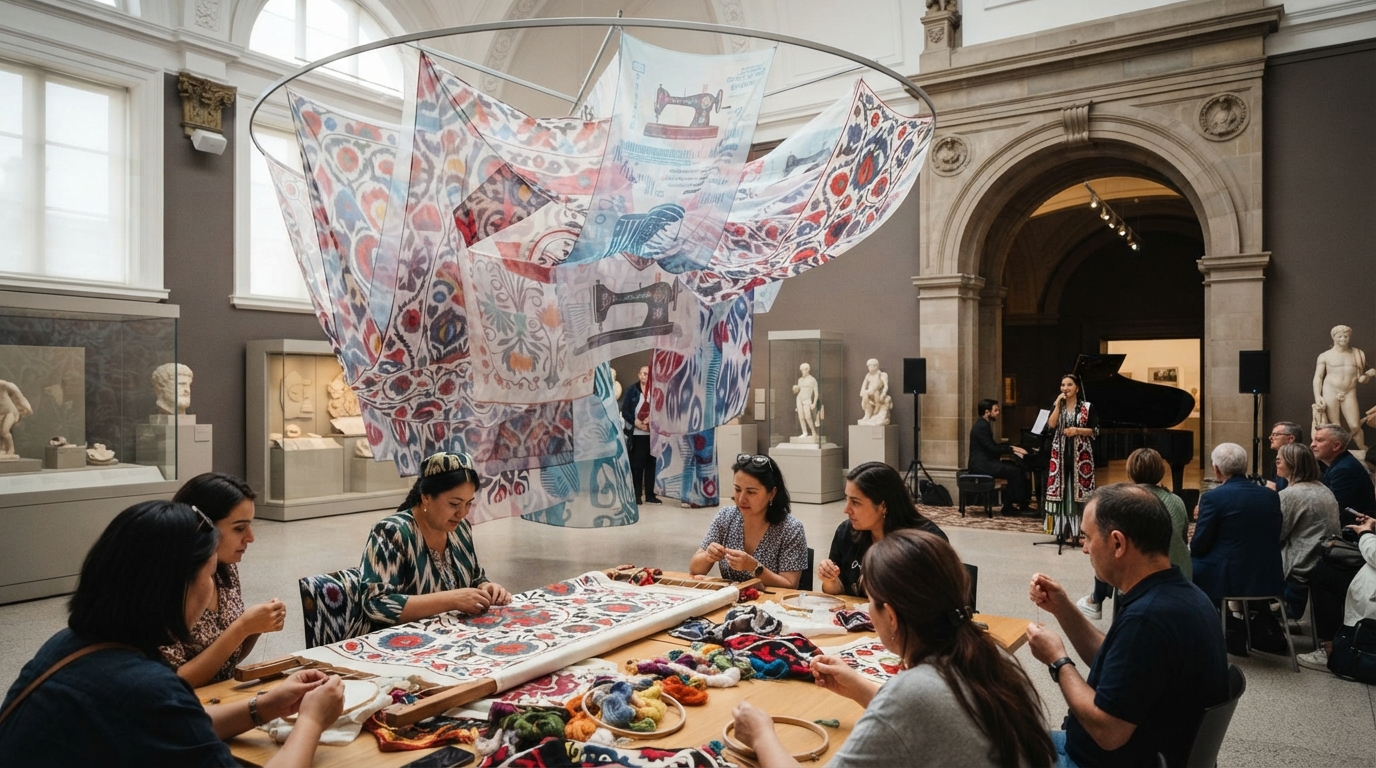
The public program, organized in cooperation between ACDF and the V&A, began on September 16 with the Suzani Demonstration workshop. It was led by traditional suzani master Yulduz Muhiddinova. She told visitors about the styles and visual language of suzani and helped them embroider their own works.
According to the suzani master, she was pleased that the museum treats the exhibits brought from Uzbekistan — namely, the suzani and other embroidery samples kept in the collection — with great care. According to her, the V&A Museum is interested in studying Uzbek applied art.
The program continued on September 18 with the Friday Late: Awakenings evening event. Usually, it is held once a month and is dedicated to a specific theme. This time, the theme was determined by the festival itself and the cooperation between the museum and the foundation — visitors were presented with programs that combine modern technologies and traditional art.
As part of the evening, Yulduz Muhiddinova conducted two master classes (workshops) on suzani embroidery. As the final part of the event, singer Laylo performed live twice. She sang in English songs from her album Roots, which was presented in November 2025 with the support of the Center for Contemporary Art Tashkent (CCA Tashkent).
In her musical work, Laylo addresses themes such as the experience of growing up in a young independent country, changes in society, mixed national identity, and the role of women in society.
"When a complex topic is presented in the language of art, it becomes much easier to accept. We begin to reflect on things that are perceived as painful or sharp in ordinary life. For me, this is a way of gently changing views (activism)," says the singer.
Although Uzbek folk instruments were used in the Roots album, in London the compositions were performed to piano accompaniment.
"I really wanted to bring a whole orchestra here to show how rich and diverse our music is. I hope we will come here many more times with our creative works," says Laylo.
Both events were held to support the installation project Sender Unknown by Uzbek artist Aziza Qodiri. This work was created as part of the V&A Jameel program, dedicated to the 20th anniversary of the Jameel Gallery of Islamic Art at the V&A Museum, commissioned by the museum and with additional support from the Sarikhani family.
The Sender Unknown installation consists of two opposing suzanis suspended in the air and stretched along curved metals. They seem to loop around several columns of the gallery and hang suspended above the display cases.
On the fabrics, traditional suzani patterns sit alongside contemporary subjects. One of the fragments depicts women behind sewing machines, which is a reference to the labor of seamstresses.
The artist notes that this work is the result of her many years of research into suzani and artificial intelligence, representing an attempt to understand how modern technologies affect the preservation and loss of cultural memory. Qodiri compares artificial intelligence and suzani: she likens the data set to a modern archive, and traditional embroidery to the symbolic knowledge of women passed down from generation to generation.
According to her, when a human creates something new, they process acquired ideas through their own experience, whereas artificial intelligence does not have such experience. It only generalizes and "homogenizes" data. Aziza Qodiri notes that as a result of this, many details are lost, and over time, the culture itself may be forgotten.
To prevent this, the artist trains artificial intelligence models and then "returns the result to the craftswomen." In her approach, technology becomes not a tool that makes people forget tradition, but one that preserves it.