

Uzbekistan introduces competition impact assessments for state business support
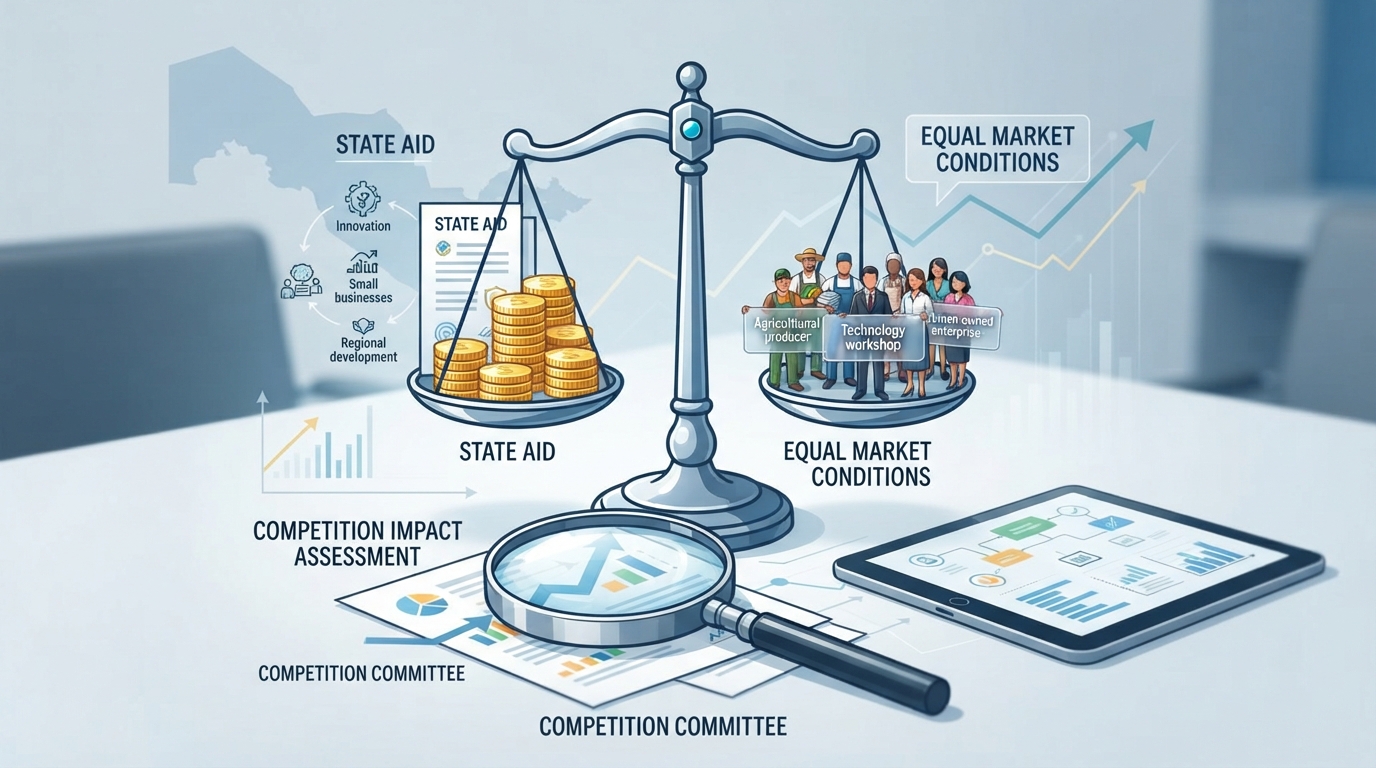
Uzbekistan has introduced competition impact assessments for state support to businesses under a new regulation approved by the Cabinet of Ministers on September 4. The regulation sets out procedures for evaluating state assistance granted to companies operating in commodity and financial markets and introduces an “all or none” principle. Under this approach, businesses operating under equal conditions and meeting the established criteria must either receive support on equal terms or receive no assistance.
State aid may not be selectively granted to individual businesses through special procedures when other market participants are operating under the same conditions and meet the relevant requirements. The Committee for the Development of Competition and Consumer Protection will be in charge of assessing how proposed support measures affect the competitive environment.
According to the regulation, state support may be provided for a number of purposes, including improving the socioeconomic development of individual regions or sectors of Uzbekistan’s economy, backing innovative projects, creating jobs and implementing socially significant projects. Assistance may also be offered for research and development, environmental protection and improvements to environmental conditions, as well as support for small and medium-sized businesses and women entrepreneurs.
State support may be applied in specific cases where market mechanisms are deemed inefficient or where intervention is needed to create equal conditions for market participants. However, authorities must show that the intended outcome cannot be achieved through other measures that would have a smaller effect on competition. The size and duration of assistance must be proportionate to its goal and limited to the minimum necessary. The regulation also requires steps to prevent excessive compensation for recipients.
Support must have a stimulating effect by funding activities that would not otherwise have been carried out without state assistance. The mechanism for distributing support must also be transparent and competitive. The Competition Committee will examine draft regulations that provide for state support to businesses together with their regulatory impact assessment reports. The documents submitted for review must include information on the number of participants in the relevant commodity or financial markets whose interests could be affected by the proposed measure.
Authorities must also calculate the possible effects of providing assistance to all eligible market participants or refusing to provide it. When support is proposed for one or several businesses, the assessment must look at its potential impact on competing companies.
The documentation must also contain information on demand for goods and services affected by the assistance, along with the documents and analysis used as the basis for drafting the proposed measure. The Competition Committee will have 10 working days to assess the potential impact on competition. After the review, it will issue a conclusion saying whether the proposed state support is appropriate, needs revision or is considered inappropriate.
The committee may rely on both official and unofficial information when carrying out its assessment. Official sources may include statistical data, information from government agencies, forecasts in scientific and analytical materials, results of government-run social surveys, official publications on websites and social media, judicial practice and regulatory legal acts.
Unofficial sources may include commercial information, public surveys, information from unofficial online resources and requests submitted by individuals and legal entities. The committee may also take into account assessments from independent experts and specialists. Once completed, the Competition Committee’s conclusion and the corresponding draft regulatory legal act will be sent to the Ministry of Justice. The conclusion must also accompany the draft when it is submitted to the Oliy Majlis, Cabinet of Ministers or Presidential Administration.
The regulation includes exemptions from the assessment requirement in certain cases. Competition impact assessments will not be required for draft measures developed to prevent or mitigate emergency situations, including outbreaks of infectious and parasitic diseases.
Assessments will also not be required when state assistance is made available to all businesses operating in a particular area.