

Uzbekistan has started importing less gasoline and at higher prices. What is happening with imports and prices
Uzbekistan increased its gasoline imports by 41.2% from January to August, reaching 721.5 million liters. However, in August, supplies fell fourfold year-on-year, while the average import cost rose to nearly $995 per 1,000 liters. 2 In Tashkent, the price of AI-92 has increased by approximately 20–40% over the year, and AI-95 by 30–44%.
Uzbekistan has started importing less gasoline and at a higher price. What is happening with imports and costs
In January–August, Uzbekistan imported 721.5 million liters of gasoline — 41.2% more than in the same period last year (511 million), according to Customs Committee data analyzed by Gazeta.
At the same time, the cost of deliveries grew even faster — by 48.6%, from 294.3 million to 437.4 million dollars.
As a result, gasoline accounted for almost 42% of the total cost of petroleum product imports ($1.04 billion) compared to 32.6% a year earlier.
The average import price for the eight months was about 506 dollars per 1000 liters compared to 576 dollars for the same period last year, meaning it increased by 5.3%. But this cumulative figure smooths out the sharp price increase in recent months.
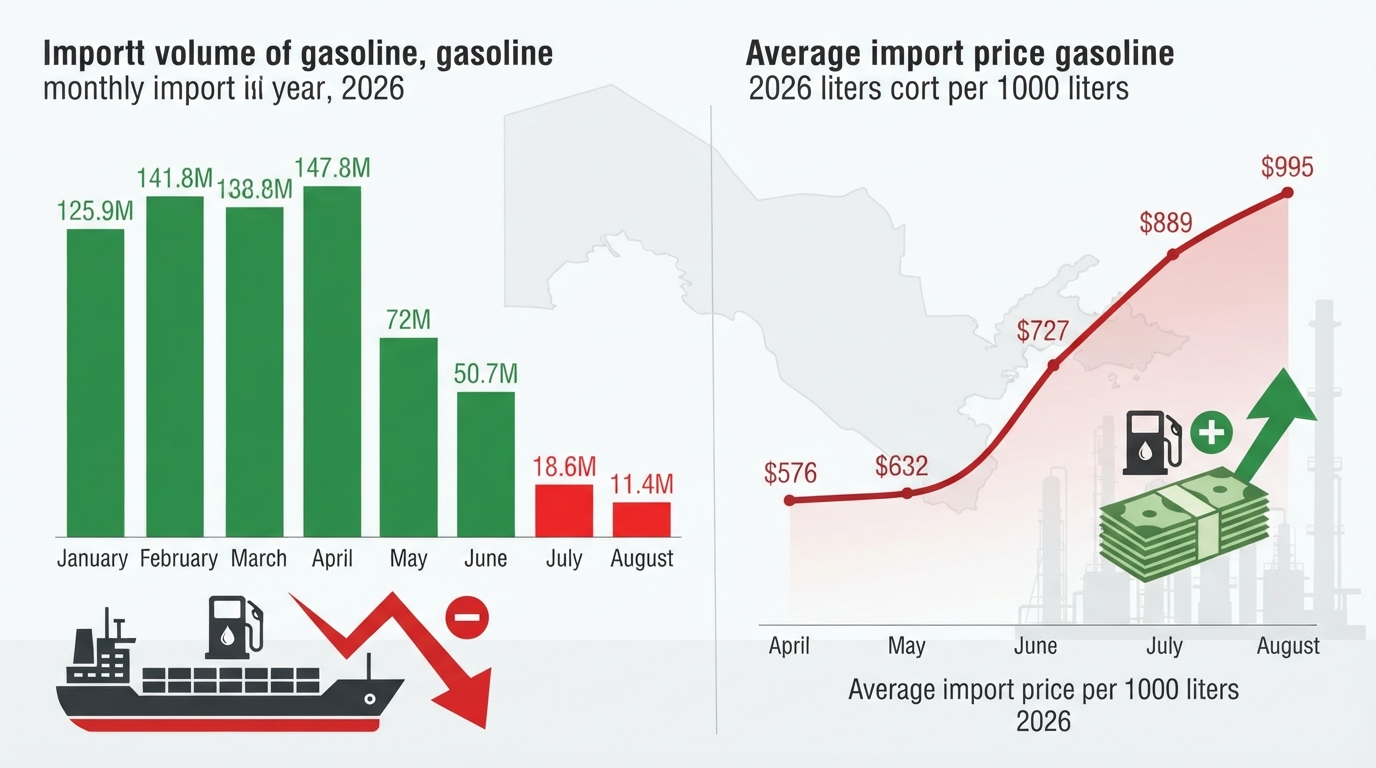
In April, the average cost was 576 dollars per 1000 liters, in May — 632 dollars, in June — 727 dollars, in July — 889 dollars, and in August — almost 995 dollars. Thus, in just four months, it grew by about 73%.
The most noticeable reduction in deliveries occurred in July and August.
In January 2026, Uzbekistan imported about 125.9 million liters of gasoline, in February — 153.3 million, in March — 149 million, and in April — 141.8 million liters. Then volumes began to decline rapidly: to 72 million liters in May, 50.7 million in June, 18.6 million in July, and 11.4 million liters in August.
For comparison, in August last year, imports amounted to 49.3 million liters. Thus, in annual terms, deliveries decreased by 76.8%, or more than fourfold.
In monetary terms, August gasoline imports amounted to 11.4 million dollars, which is 61.4% less than a year earlier. The cost of deliveries decreased significantly less than the physical volume due to a 66.6% increase in the average import price compared to last year's level.
Over July–August, Uzbekistan imported only about 30 million liters of gasoline compared to 112.9 million liters a year earlier — a 3.8-fold decrease. The average import cost for this period, on the contrary, rose from approximately 575 to 929 dollars per 1000 liters.
Motor gasoline production in January–July increased by 8.9% — to 731.9 thousand tons compared to 672.1 thousand tons for the same period last year. Data for August has not yet been published.
In July, oil refineries produced about 117.7 thousand tons of gasoline — 5.1% more than in June. The growth compared to July last year was about 27.4%.
For comparison, in May production fell to 84.7 thousand tons, after which it recovered to 112 thousand tons in June. Thus, growth continues for the second consecutive month.
The reduction in imports during the summer is occurring simultaneously with rising prices on the domestic market.
According to the National Statistics Committee, in August, gasoline in Uzbekistan became more expensive on average by 1.9% over the month and by 20.2% over the year.
Gasoline in August became more expensive on average by 1.9% over the month and by 20.2% over the year (but last year the average price also included the cost of AI-80, so without it, the growth may be more significant). The price of AI-92 rose by 1.1%, AI-95 — by 4.9%, AI-98 and AI-100 — by 6.7%.
It is not yet possible to compare the annual dynamics separately by gasoline grades, as the National Statistics Committee began publishing such a breakdown only from January 2026.
But since the beginning of the year, prices for AI-92 have risen by about 10.3%, AI-95 — by 20.7%, AI-98 and AI-100 — by 24.4%.
At UNG Petro, a liter of Uzbek-produced AI-92 cost 11.7 thousand soums, imported AI-92 — 13.5 thousand soums. AI-95 was sold at 17 thousand soums, AI-100 — at 24.5 thousand soums per liter. The price of diesel fuel was 15 thousand soums.
At other gas stations in the capital, AI-92 cost from approximately 11.2 thousand to 13.8 thousand soums per liter. Prices for AI-95 were in the range of 14.5 thousand to 20.6 thousand soums.
Compared to September 2025, gasoline at Tashkent gas stations has become noticeably more expensive. The lower price limit for imported AI-92 rose by about 24% — from 10.5 thousand to 13 thousand soums per liter, the upper limit — by 31%, from 13.7 thousand to 18 thousand soums. For AI-95, the increase was about 16–34%: the range shifted from 12.5–15.4 thousand to 14.5–20.6 thousand soums. Diesel became more expensive by about 20–35%.
At some chains, the growth was even more noticeable. At Carvon, imported AI-92 became 20.5% more expensive over the year — from 11.2 thousand to 13.5 thousand soums, AI-95 — by 30.8%, from 13 thousand to 17 thousand, diesel — by 20%, from 12.5 thousand to 15 thousand soums per liter.
At INTRANS SERVIS, imported AI-92 rose in price by 41.6% — from 11.3 thousand to 16 thousand soums, AI-95 — by 44.4%, from 13.5 thousand to 19.5 thousand. At POYTAHT OIL, the growth was 23% and 29.6% respectively.
At Lukoil gas stations in Karasu, imported AI-92 became 19.7% more expensive, AI-95 — by 28.6%, AI-100 — by 34%.
, that Uzbekistan produces more than 1.2 million tons of petroleum products, and another 600–700 thousand tons are imported by private entrepreneurs. According to him, the available stocks at that time were sufficient for the next two to three months.
At the end of August, the Ministry of Energy also reported that Uzbekistan is interested in diversifying its sources of supply for gasoline, diesel fuel, aviation kerosene, and other petroleum products. In particular, long-term supplies of oil and finished fuel, as well as joint production of petroleum products, are being discussed with Azerbaijan.
The rise in the import cost of gasoline coincided with a fuel shortage in Russia. Since April 1, a ban on gasoline exports has been in effect there, and since June 1 — on aviation fuel. At the same time, the restrictions should not apply to supplies under intergovernmental agreements, including to Uzbekistan.
The fuel shortage in Russia is linked, among other things, to Ukrainian drone strikes on oil infrastructure. Against this background, the country itself increased purchases of gasoline abroad, and negotiations with Kazakhstan on the purchase of 50 thousand tons of fuel were also reported.
Problems in the Russian fuel market have also affected Central Asia. In July, the Ministry of Energy of Kyrgyzstan appealed to Belarus, Uzbekistan, Kazakhstan, and other countries to assist in maintaining stable supplies. According to statistics, about 98.5% of the gasoline imported by Kyrgyzstan comes from Russia.
For Uzbekistan, the Russian direction is also traditionally of great importance. At the beginning of 2023, almost all imported gasoline came from Russia. What share Russia accounts for now is not specified in open data.