

Uzbekistan has ranked among the world leaders in introducing "green" navigation on digital maps
Uzbekistan, alongside the US, Germany, and South Korea, has become one of the first countries where daily pedestrian navigation on digital maps is being adapted to extreme heat, writes the international technology publication Techloy.
Uzbekistan has joined the ranks of world leaders in introducing "green" navigation on digital maps
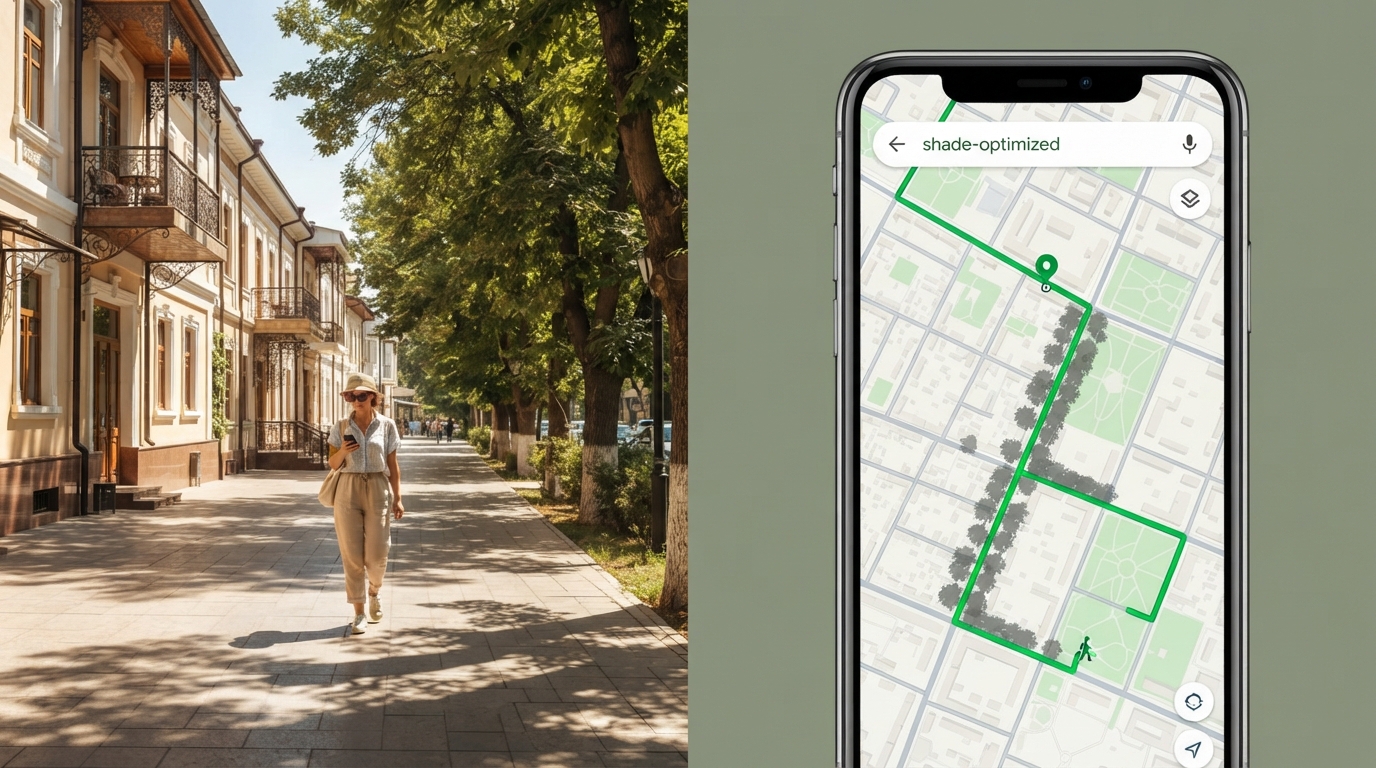
Uzbekistan, along with the USA, Germany, and South Korea, has become one of the first countries where the adaptation of daily pedestrian navigation on digital maps to extreme heat has begun, writes the international technology publication Techloy. In August, Yandex Maps launched "green" routes in Tashkent on a trial basis. These routes allow users to choose a shadower path and spend less time under direct sunlight.
It is noted that Tashkent became the first city in Central Asia and the CIS region to have such a feature in a public mapping service. Furthermore, this is the first territory to launch this function among the 30 countries where Yandex Maps operates.
A comfortable route is an important part of the urban environment
Techloy notes that interest in technologies that help make moving around the city in hot weather more comfortable is growing worldwide. Shade is becoming an important factor of the urban environment, similar to transport accessibility or air quality. In the spring and summer of 2026, similar solutions began to be introduced in several countries simultaneously.
In particular, Arizona State University launched the Cool Routes research project on its campus, which helps find cooler routes. The National Shade Map also operates in the US, a service that shows the level of shadiness of streets in hundreds of cities, but does not build routes itself. In Germany, the Heat Adaptation for Vulnerable Population Groups (HEAL) project is being developed. It is primarily designed for people who are particularly sensitive to heat. In South Korea, a student from Seoul National University launched a local app called Geuneullo. The app suggests the shadiest pedestrian routes to users.
Interest in such solutions is further intensifying against the backdrop of periods of extreme hot weather. According to the Copernicus Climate Change Service, in June-July 2026, the average temperature in Western Europe reached 21.62°C. This is almost 2.8°C above the norm, exceeding the previous record set in 2022. In Spain, Portugal, and France, air temperatures rose above 40°C several times.
How did Tashkent become part of the global trend?
In August, a new type of route — "green" routes — appeared on Yandex Maps specifically for the residents of Tashkent. For a city with a hot continental climate where summer temperatures regularly exceed 35–40°C, such a function can make walking much more comfortable and complement other heat adaptation measures, such as urban greening and public transport development.
The technology of "green" routes is based on a machine learning algorithm that analyzes satellite imagery. Techloy notes that among the three main approaches to so-called "shade routing" — geometric, biophysical, and satellite-data-based methods — Yandex Maps uses the satellite method. This method allows identifying tree canopies through multispectral images and assessing which part of the pedestrian route passes under the shade of trees.
In this process, a route is not designated as "green" based solely on the share of the total shaded area. An individual section of the route is considered by the service as a green zone only if trees cover at least 60 percent of its length. The algorithm also takes into account how evenly the shade is distributed along the path, how long a person will have to walk under the open sun, and the air temperature typical for the corresponding day and time in Tashkent.
The appearance of "green" routes in Tashkent shows that technologies aimed at adapting to climate characteristics are gradually moving beyond the level of research or social initiatives and entering the ranks of mass services that make the daily lives of thousands of people more comfortable and easier.