

Uzbekistan expands digital monitoring of household waste collection
Uzbekistan is developing a digital monitoring system that will allow residents to track garbage collection trucks serving their neighborhoods and receive notifications when the vehicles are approaching.
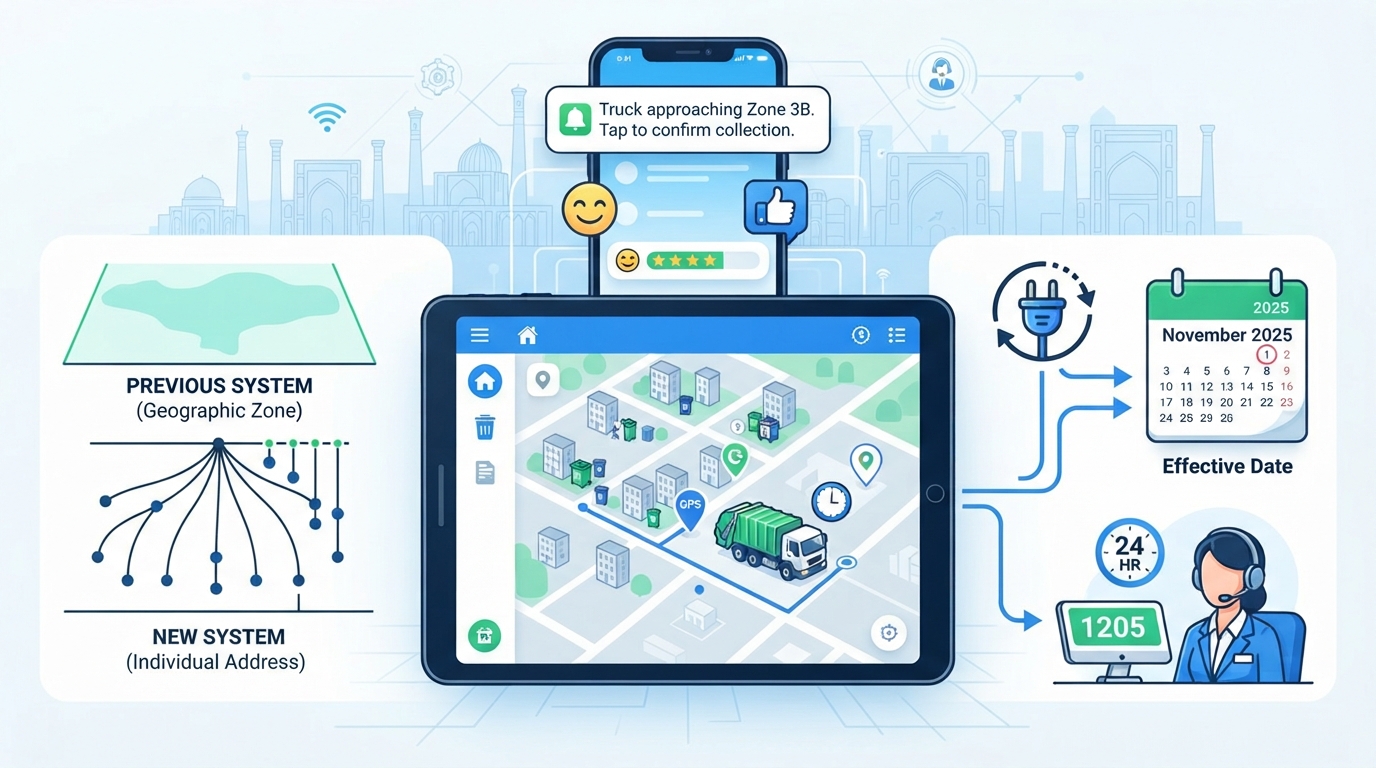
Uzbekistan is broadening digital oversight of household waste collection
The system is being advanced as part of the expansion of Toza makon, a unified billing platform for household waste collection services. It will also give authorities the ability to check whether sanitation companies are following approved routes and schedules, while allowing residents to evaluate the quality of the services they receive.
The current Toza makon system already lets residents pay for waste collection online, review charges and unpaid debts, monitor payments, and access their personal accounts through a mobile application. The platform is connected to the information systems of government agencies and organizations.
In the next stage of development, online monitoring will record when garbage trucks enter the areas they serve and whether they keep to their timetables. Residents will later be able to track the vehicles through the mobile application and a Telegram bot, and receive notifications when a truck is nearing.
The billing system is also set to shift toward more exact accounting of services delivered. Rather than depending mainly on geographic service zones, it will record services by individual residential addresses and waste collection points.
Since November 2025, a mechanism has been in effect to impose electricity supply restrictions in cases of unpaid household waste collection bills, under Law No. ZRU-1044.
A 24-hour call center has been set up under the relevant agency to respond to residents’ questions. It can be reached at the short number 1205. The agency says complaints and other inquiries are processed quickly, and where possible on the same day they are received.
Residents are also entitled to a recalculation of their waste collection fees for periods when the service was not provided in line with established procedures. This is set out in Cabinet of Ministers Resolution No. 95.