

Uzbekistan and the Eastern Economic Forum: From a Sports Regatta to New Transport and Business Ties with the Far East
The 11th Eastern Economic Forum will be held in Vladivostok from September 1–4. Uzbekistan will once again be represented on the sports program, but the republic's interest in the Far East extends far beyond the competition. In recent years, business, tourism, educational, and humanitarian contacts between Uzbekistan and Primorsky Krai have noticeably intensified, and the introduction of direct flights has linked Vladivostok with Samarkand and Bukhara. Uzbekistan […]
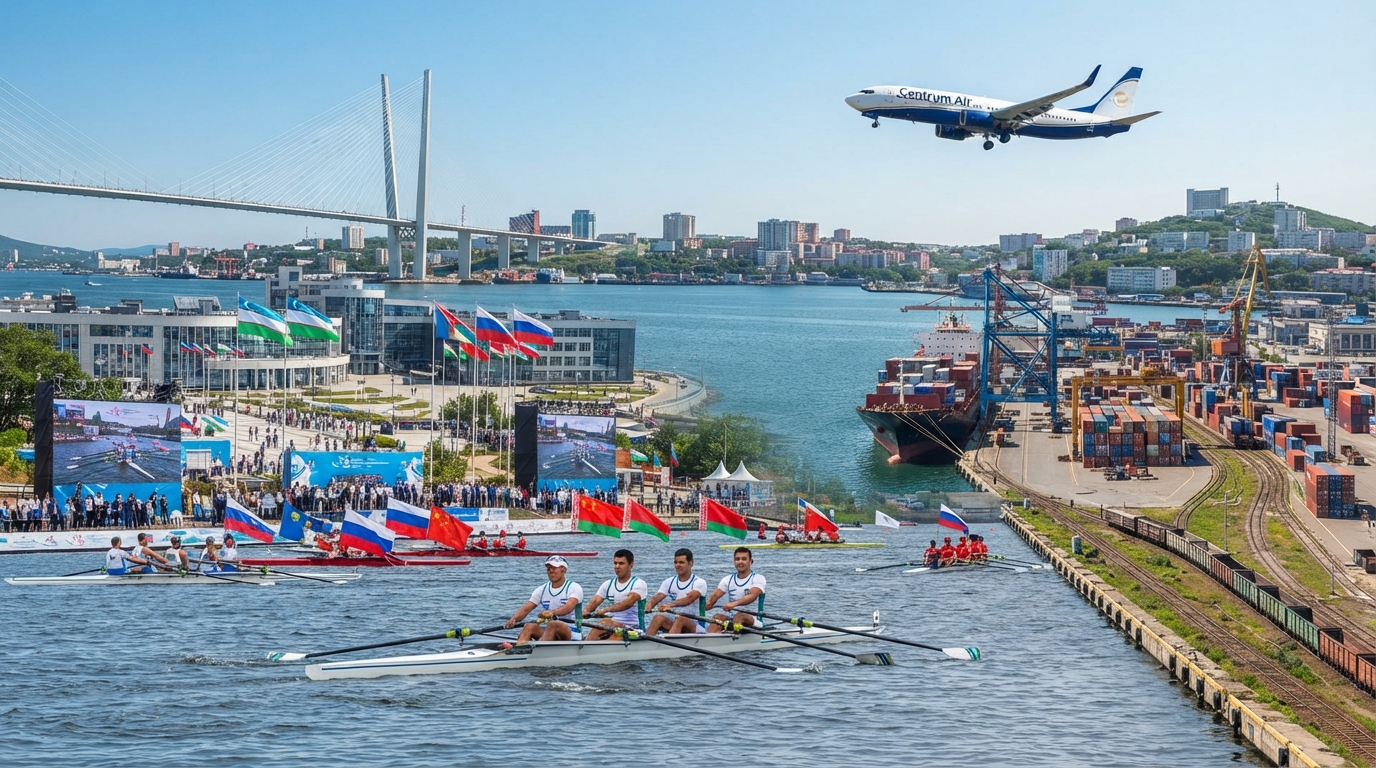
Uzbekistan and the EEF: From Sports Competitions to Strengthening Transport and Business Ties with the Far East
The 11th Eastern Economic Forum (EEF) will be held in Vladivostok from September 1 to 4. Uzbekistan will once again participate in the sports program, but the country's interest in the Far East extends far beyond sporting events. In recent years, there has been a noticeable increase in business, tourism, educational, and humanitarian contacts between Uzbekistan and Primorsky Krai, and the opening of direct flights has linked Vladivostok with Samarkand and Bukhara.
Uzbekistan's Long-Term Participation in the EEF
Uzbekistan has been a participant in the Eastern Economic Forum for several years. One of the most notable areas of cooperation has been sports collaboration, in particular the International Vladivostok Regatta.
Uzbek athletes participated in the regatta for the first time in 2023. In 2024, representatives from Uzbekistan were among the medalists at the competition, along with athletes from China, Cuba, and Kazakhstan.
In 2025, Uzbekistan was again among the participants in the International Vladivostok Regatta, where athletes from 10 countries, including Uzbekistan, Kazakhstan, Belarus, China, Cuba, Iran, Pakistan, and Armenia, competed for the main trophy.
Thus, the participation of Uzbek athletes in Vladivostok has become a regular feature of the forum's international program.
**What to Expect in 2026**
This year, Uzbekistan is again among the participating countries in the EEF sports program.
According to the organizers, the forum's sporting events will bring together more than 3,000 athletes from six countries: Russia, Belarus, Uzbekistan, Kazakhstan, China, and North Korea. The key events will be sailing and rowing competitions.
Uzbek athletes will participate in the International Vladivostok Regatta, whose program includes coastal rowing competitions in singles, doubles, and quads, as well as indoor rowing.
The 2026 EEF sports program also includes international sailing competitions, the Far Eastern Cup, the Roscongress Cup, the Parade of Sails, and a mass track and field race.
Thus, for Uzbekistan, the EEF remains not only an economic forum but also an important platform for international sports and humanitarian ties.
**Primorye as a key partner for Uzbekistan**
Ties between Uzbekistan and Primorsky Krai have significantly expanded in recent years.
In July 2025, an Uzbek delegation led by Ambassador Botirjon Asadov visited the Chamber of Commerce and Industry of Primorsky Krai. The meeting discussed prospects for increasing trade turnover, implementing joint investment projects, and establishing wholesale distribution centers. Particular attention was paid to exploring new logistics routes and financial settlement mechanisms.
The Primorsky Krai side also emphasized Uzbekistan's importance to the Russian Far East and the prospects for expanding economic ties. Areas of cooperation included trade, investment, small and medium-sized businesses, labor migration, and cultural and educational exchanges.
Cooperation is also actively developing in the tourism sector. In 2025, entrepreneurs from Primorsky Krai visited Uzbekistan, where they visited businesses in Tashkent, Samarkand, and Bukhara, and held talks on mutual trade issues.
Furthermore, the parties agreed to develop a program to increase tourist flow between Uzbekistan and Primorsky Krai for 2025–2026.
**Vladivostok is getting closer to Uzbekistan**
One of the most visible results of this cooperation has been the development of direct air service.
On June 23, 2025, Centrum Air launched its first direct flight between Samarkand and Vladivostok. This flight marked the first direct air connection between the two cities, opening an additional route for business, tourism, and humanitarian travel.
In the fall of that year, another route was launched: Vladivostok-Bukhara. Direct flights between these cities began operating weekly on November 6, 2025.
This is an important step in developing relations: cooperation between Uzbekistan and the Russian Far East is now not limited to official meetings but is supported by direct transport infrastructure.
**The Attractiveness of Vladivostok for Uzbekistan**
For landlocked Uzbekistan, the Russian Far East is primarily of interest as a gateway to the Asia-Pacific region.
Vladivostok is a major transport and port hub for Russia. Multimodal routes connect the Russian market with countries in East and Southeast Asia.
Uzbekistan is already considering routes through Kazakhstan, Russia, and the Far Eastern ports of Nakhodka and Vladivostok as options for international transport corridors.
Vladivostok itself, in turn, actively interacts with Asian markets. For example, container shipments from China, Vietnam, Japan, South Korea, and Southeast Asian countries to Russia and the CIS countries are handled through the Vladivostok Commercial Seaport.
Therefore, cooperation with Primorye could potentially be significant for Uzbekistan in several areas: logistics, trade with the Russian Far East, access to Asian markets, tourism, and business ties.
**Key EEF Topics of Interest to Uzbekistan**
The EEF 2026 business program includes over 70 sessions, grouped into five main areas: developing life and work in the Far East, attracting private investment, international cooperation, technology, and logistics.
Several of these areas are particularly relevant for Uzbekistan:
* **Logistics and infrastructure.** This is one of the most obvious areas: developing transport corridors and utilizing Far Eastern infrastructure could expand Uzbekistan's opportunities for trade with Russia and the Asia-Pacific region.
* **International Economic Cooperation.** The EEF traditionally provides a platform for direct contacts between businesses and regions. For Uzbekistan, this is an opportunity to seek partners not only at the federal level in Russia but also directly in the Far Eastern regions.
* **Investments and Industrial Cooperation.** In 2025, the Primorsky Krai Chamber of Commerce and Industry and the Uzbek side separately discussed joint investment projects and the development of wholesale distribution infrastructure.
* **Technology and Digitalization.** A separate track at EEF 2026 is dedicated to present and future technologies, which aligns with Uzbekistan's interest in the digital economy, technological entrepreneurship, and infrastructure modernization. * **Tourism.** Direct flights between Vladivostok and Samarkand and Vladivostok and Bukhara have already created a practical basis for increasing tourism exchange between the regions.
**Scope of the EEF 2026**
The Eastern Economic Forum remains one of Russia's largest platforms for discussing the development of the Russian Far East, investment, and international cooperation.
This year's business program includes over 70 sessions and five thematic tracks.
The forum's scale is well illustrated by last year's statistics: following the EEF 2025, 358 agreements worth 6 trillion 58.2 billion rubles were signed.
Therefore, for Uzbekistan, participation in the forum is an opportunity to be part of a platform where Russian regions, large businesses, investors, and representatives of Asian countries meet simultaneously.
**Importance for Uzbekistan**
Currently, the most officially confirmed format for Uzbekistan's participation in the EEF 2026 remains the sports program. However, the nature of relations with Primorsky Krai indicates a much broader interest between the parties, extending beyond sports.
Over the past two years, direct flights have been launched, business contacts have intensified, tourism and humanitarian exchanges are developing, and investment and logistics projects are being discussed. Against this backdrop, the EEF could become a platform for further expanding these ties.
In other words, for Uzbekistan, Vladivostok is no longer simply the easternmost point on the Russian map, but a potential transport, tourism, and business bridge between Central Asia and the Asia-Pacific region.