

Uzbek platform for world renewable energy champions
According to Abduaziz Khidirov, a master's student at the Academy of Public Administration under the President, Uzbekistan is becoming a platform for cooperation among major international players in the field of renewable energy. Saudi Arabia's Acwa and South Korea's Korea Western Power Co., Ltd. (KOWEPO) have agreed to jointly explore opportunities for implementing projects in the field of renewable energy sources (RES), energy storage, and related infrastructure. The companies signed a Memorandum of Understanding on 25 […]
Uzbek Platform for Global RES Champions
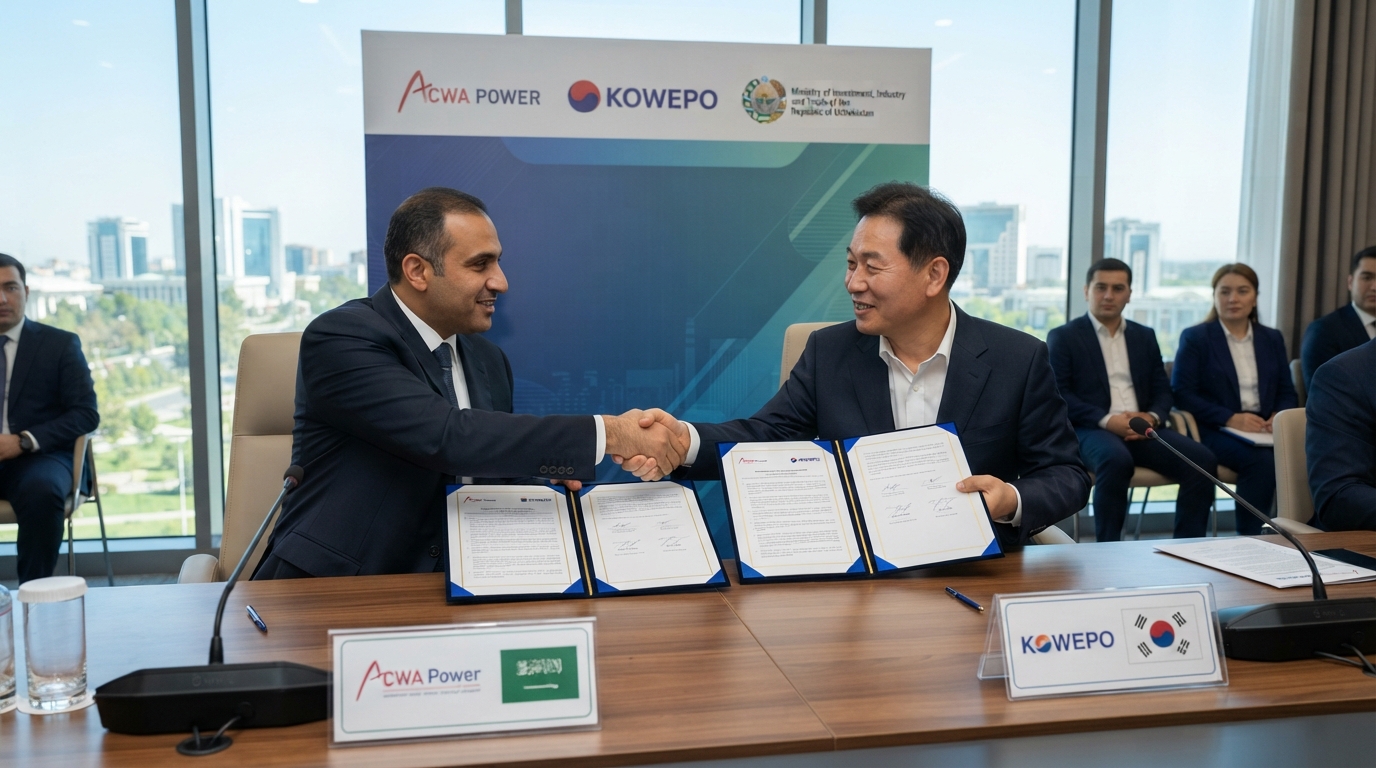
According to Abduaziz Khidirov, a master's student at the Academy of Public Administration under the President, Uzbekistan is turning into a platform for cooperation among major international players in the field of renewable energy. Saudi Acwa and South Korean Korea Western Power Co., Ltd. (KOWEPO) have agreed to jointly explore opportunities for implementing projects in the field of RES, energy storage, and related infrastructure.
The companies signed a Memorandum of Understanding on August 25, 2026, in Tashkent. The document sets a framework for the joint search and evaluation of potential projects in Uzbekistan. At the same time, specific projects have not yet been approved: their implementation will depend on further evaluation, internal approvals, and the conclusion of final agreements.
For Uzbekistan, this partnership is primarily interesting due to the combination of the already accumulated experience of the two companies. Acwa has been operating in the Uzbek market since 2019. According to the company and the Ministry of Investment, Industry and Trade, its portfolio in the country includes 19 projects with cumulative investments of up to $15 billion and a capacity of up to 10 GW. The projects cover solar and wind generation, energy storage systems, green hydrogen, traditional generation, and grid infrastructure.
Acwa's portfolio includes, among others, large-scale solar and wind energy projects with battery storage. For example, the Sazagan 1 and 2 projects in the Samarkand region provide for 500 MW of solar generation and 334 MW of BESS systems each.
KOWEPO, in turn, views the agreement as a chance to expand its presence in the Central Asian market. According to the company, its overseas experience in the Middle East includes projects with a total capacity of about 3.5 GW in the RES sector and 877 MW of gas generation.
A separate area of cooperation is attracting Korean financial institutions. Acwa and KOWEPO intend to explore opportunities for their participation in financing potential projects in Uzbekistan. Thus, the new partnership could combine Acwa's experience in implementing major energy projects in the country with the technological and financial capabilities of the South Korean side.
For Uzbekistan, this means the emergence of another international alliance centered around the development of RES, storage systems, and energy infrastructure. However, its real scale will depend not on the signed memorandum, but on which projects the parties can bring from the negotiation stage to financial close and construction.