

Under the roof of one's own home
What is behind the mass departure of Uzbek citizens from Russia?
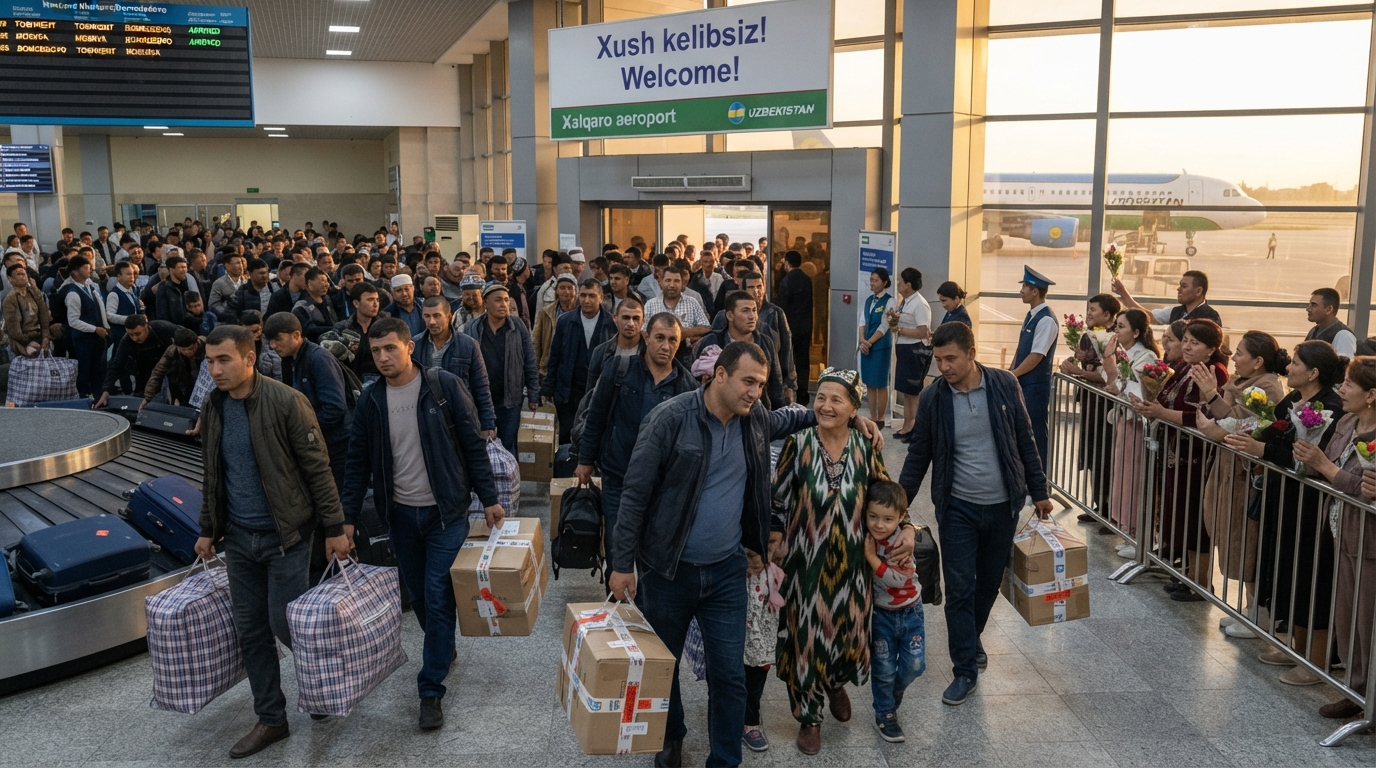
Under One Roof with Home
In ten days, nearly 100,000 Uzbeks returned home from Russia. Experts attribute this both to the tightening of migration policy and the depreciation of the ruble, which has made working in the Russian Federation less profitable.
On September 9, the Migration Agency under the Government of Uzbekistan reported that from August 25 to September 5, 96,415 labor migrants returned home from Russia. This required urgent assistance from the agency itself, the Ministry of Foreign Affairs, the Ministry of Internal Affairs, and other departments. The report states that this number of Uzbek citizens returned to the country in 10 days, although the time period specified in the same report covers 12 days. It turns out that approximately 8,000 migrants returned to Uzbekistan daily, which indicates a very large scale of return migration. Assistance to former migrants includes resolving legal and labor issues, as well as supporting those in difficult situations, including finding a new job or returning home. The very fact that such assistance was needed shows that the situation was not entirely ordinary.
Various reasons for such a massive outflow of Uzbek labor migrants from Russia have been cited in expert commentary. The two main versions are a decrease in the income of labor migrants and the tightening of the Russian Federation's migration policy. In favor of the first version, data is cited on a 10% drop in the ruble exchange rate against the Uzbek sum since the beginning of July, which reduced the income of Uzbeks working in Russia, as well as an increase in state fees. The latter, in turn, was a consequence of the tightening of migration legislation, so both reasons are closely linked. Upon closer analysis, it becomes clear that fluctuations in the ruble exchange rate since the beginning of the Special Military Operation are far from the first, and are unlikely to have caused the mass return of migrants home on their own. Especially since finding a job in Uzbekistan with a comparable level of income, even taking into account the decline in earnings in Russia, will not be easy.
The version involving the state fees, which were increased from July 26, looks more convincing. However, they primarily affect those who apply for long-term residence documents in Russia. For instance, the fee for acquiring citizenship rose from 4.2 to 50 thousand rubles, for obtaining a residence permit — from 6 to 30 thousand rubles, and for a temporary residence permit — from 1.9 to 15 thousand rubles. But this increase does not affect the absolute majority of Uzbek migrants. The rules for obtaining citizenship have recently become much stricter, and it would not be easy for them to qualify for it.
What could have really affected migrants is the introduction of fees for employers, for whom hiring each foreign worker will now cost 15 thousand rubles. This could indeed become a weighty argument in favor of hiring local workers, for whom no fees need to be paid. At the same time, however, there have been no recent reports of mass rejections of Central Asian labor migrants by construction or other enterprises.
The same law introduces a norm requiring labor migrants to support themselves and their dependent family members at a level not lower than the subsistence minimum. If a salary is paid under a gray scheme and the tax service does not see payments to the foreigner, their patent will not be issued or will be revoked. If the foreigner has no other grounds for staying in the country, they are obliged to leave Russia with their dependents within 15 days. In this way, the Russian state plans to move away from gray salaries for migrants who arrive with minor children who have the right to education (subject to passing exams) and medical care. Previously, such foreigners, while receiving gray salaries, could send their children to schools and kindergartens without paying taxes to the budget. At the same time, the new rules come into force on January 1 and could hardly have caused the outflow of migrants several months prior.
What is the matter then?
In mid-August, the Central Bank of Uzbekistan reported that, according to its data, 1.4 million citizens of the country work abroad, including 834.2 thousand (60%) in Russia. Another 84.4 thousand Uzbeks work in Kazakhstan, 72.1 thousand in Turkey, 46.4 thousand in South Korea, 258 thousand in European countries, and 97.7 thousand in other countries of the world. That is, Russia remains the main destination of labor emigration for Uzbekistan, and the capacity of its labor market exceeds all others combined by an order of magnitude. So far, no foreign country can compete with it.
According to other, higher estimates, there are between 1.3 and 1.5 million citizens of Uzbekistan in Russia. Moreover, these estimates look more reasonable. According to the Russian Ministry of Internal Affairs, Uzbeks obtained 1.1 million labor patents in the first half of 2026 alone. At the same time, some of the 4.1 million patents issued last year could well have been extended.
A certain reduction in immigration from Uzbekistan is indeed noticeable this year. Thus, while in the first half of 2024, 1 million 815.2 thousand citizens of the Republic of Uzbekistan entered Russia, in January–June 2025, the figure was 1 million 825.4 thousand, which was a peak indicator for the last seven years, and for the same period of 2026, it was only 1 million 613.8 thousand. That is, despite the tightening of the RF migration policy after the terrorist attack at Crocus City Hall, immigration from the republic continued to grow last year, while this year a decline of 11.6% was recorded.
A similar dynamic is observed in labor immigration, which accounts for almost three-quarters of the total volume. In the first half of 2024, 1 million 282.2 thousand citizens of Uzbekistan entered Russia for the purpose of work, in January–June 2025 — 1 million 358.2 thousand, and in the first half of 2026 — 1 million 178.6 thousand. It turns out that labor immigration this year decreased by 13.2% compared to the same period in 2025.
The number of issued patents also continued to grow until this year, driven by the efforts of the Ministry of Internal Affairs to legalize labor migration. In the first half of 2024, citizens of Uzbekistan obtained 1 million 140.6 thousand patents, in the same period of 2025 — 1 million 339.9 thousand, and in 2026 only 1 million 87.8 thousand, which is almost 1/5 less than last year's level. True, this happened even before the mass outflow of Uzbeks observed in late August and early September.
At the same time, remittances to Uzbekistan from abroad continued to grow and, according to data for the first quarter of 2026, reached 3.79 billion dollars, exceeding last year's level by 13%. This means that the reduction in the physical volume of the human flow from Uzbekistan to Russia was accompanied by an increase in wages, which was the market's natural reaction to the decrease in the foreign workforce. As a result, Uzbekistan did not notice any drop in income from labor migration.
If we adhere to a stricter methodology and take only those who obtained patents in the first half of 2026 (1.1 million) as the number of Uzbek labor migrants, it turns out that about 9% of their number, or every 11th labor migrant from this republic, returned home in late August and early September. The scale of the outflow is quite significant, as indicated by the report of the Migration Agency of Uzbekistan itself, which drew attention to the mass and rapid nature of this reverse flow of people. In Uzbekistan itself, the return of migrants may complicate the situation in the labor market, which is already replenished annually by more than half a million new workers reaching working age. At the same time, the continued growth of remittances from labor migrants helps to smooth out the reduction in their numbers.
It is possible that, taking into account Russia's plans to transition to an organized recruitment of foreign labor by the beginning of the 2030s, the number of labor migrants from Central Asia will decrease further. These processes will most affect Uzbekistan and Tajikistan, which are not members of the EAEU. Therefore, the countries of the region should prepare in advance for the return of their citizens in order to find new foreign labor markets for them or provide them with jobs at home.