

Two Kyrgyz — three parties
There are 306 parties in Kyrgyzstan – why they are not fighting for the voter: expert opinion
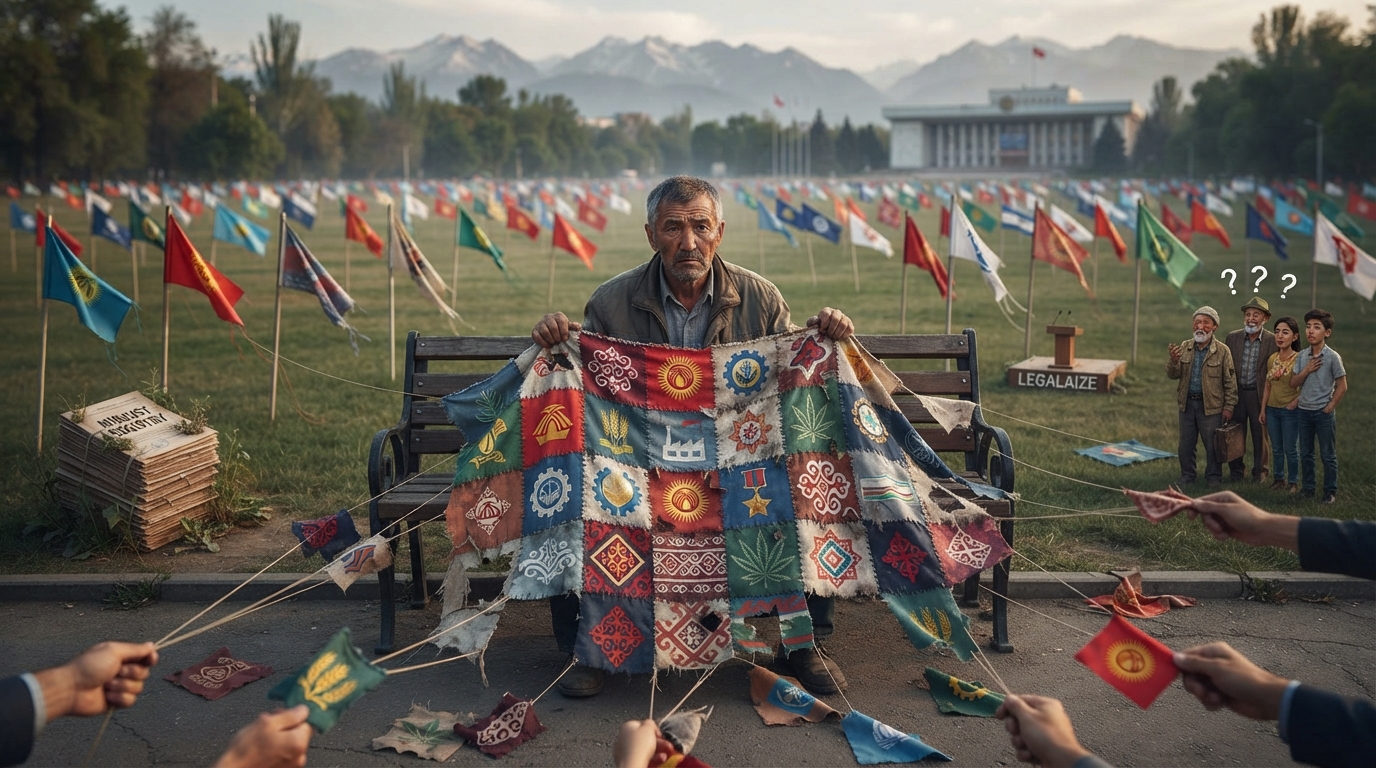
Two Kyrgyz — Three Parties
The Ministry of Justice of Kyrgyzstan has updated the list of registered political parties. There are now 306 parties in it. At the same time, the population of the republic as of January 1 of this year was 7.404 million people. It turns out that there is approximately one political party for every 24.2 thousand Kyrgyz citizens, including newborns.
Farmers, combat veterans, industrialists, merchants, and energy sector workers have their own parties. The national composition is also reflected in the names: Kyrgyz, Russians, Kazakhs, Uzbeks, Uyghurs, Koreans, Dungans, Germans. There are also parties with unusual names: "Komsomol", "Golden Throne", "Glory to the Centenary of October", and "S.S.S.R." ("Union. Freedom. Justice. Motherland").
There is even a "Legalize" party, which advocates for the legalization of cannabinoids for medical purposes and the revival of industrial hemp farming. Among the founders of the parties, one can find fathers and children, sisters and brothers, husbands and wives... In general, in theory, party life in Kyrgyzstan should be in full swing. But, alas, this is not the case. Registering a party with the Ministry of Justice does not mean at all that it is active. Otherwise, political life in the republic would be much more vibrant.
Some of the founders are currently abroad — like Kurmanbek Bakiyev, the second president of Kyrgyzstan, associated with the "Ak Zhol" party, which is still listed in the registry of the Ministry of Justice. Some are in prison for cases unrelated to their parties, and sometimes even to politics. Some have already served their sentences and have been released. Some founders and co-founders are no longer alive, but the parties they created formally remain in the registry.
And yet, 306 parties is not the limit for Kyrgyzstan. In May 2024, the Deputy Minister of Justice of the Kyrgyz Republic, Bakhtiyar Orozov, reported that there were 329 parties in the department's database. The difference with the current figure is 23 parties. But who, besides the state, which is obliged to keep these records, noticed their disappearance? Figuratively speaking, nobody came to the funeral except for the relatives of the deceased and the gravediggers.
By the way, earlier, when analyzing the 2021 elections, it was pointed out that for several years now, a rather interesting saying has periodically appeared in the Kyrgyz segment of social networks: "Poor is the politician in Kyrgyzstan who does not have his own party." Of course, this is a joke. But at the same time, it quite accurately describes the situation inside the Kyrgyz Republic, where there is virtually no consensus among various public figures, and everyone, for the sake of searching for some kind of "justice," pulls the already torn-to-shreds political "blanket" over their own beloved self.
It is worth recalling some episodes of the past. In 2007, Kyrgyzstan held its first elections to the Jogorku Kenesh entirely under party lists. Initially, 45 parties out of the then hundred intended to participate, but only 22 were able to meet the primary requirements: to form lists of candidates and pay the electoral deposit. Then another ten dropped out.
In the end, 12 parties ran, and only three received seats in parliament. The rest also gathered votes but did not meet the conditions for obtaining mandates. The turnout was 73.86%, and the pro-presidential "Ak Zhol" party received, according to the final data presented, 61.73% of the vote.
The opposition at the time accused the authorities of using administrative resources in favor of "Ak Zhol." Therefore, when Kurmanbek Bakiyev was overthrown in 2010 and the "Ak Zhol" party lost its parliamentary representation, the new authorities promised: the republic is now not presidential, but parliamentary (more precisely, parliamentary-presidential), and there will be no more administrative resources. This meant, the new "fathers of the Fatherland" said, that the elections would be fair.
But the questions for the parties did not diminish. For the 2010 parliamentary elections, 29 parties were admitted. About 1.68 million people came to the polling stations. The five parties that won seats in the Jogorku Kenesh together gathered about 1.1 million votes. The rest did not receive mandates. CEC KR
Even a superficial analysis shows: references to administrative resources allow parties in Kyrgyzstan to avoid answering many uncomfortable questions. For example, this one: why do you start campaigning shortly before the elections, rather than working with voters constantly — right up to the next electoral cycle?
Meanwhile, the answer is simple: first and foremost, parties fight for power. Although the main struggle for any party is for the voter. To do this, one must work constantly, regardless of the election results. But such work is not visible among most parties. Even among those whose names are well-known.
On the eve of the publication of this material, a survey of random passers-by was conducted — three people in each regional center of Kyrgyzstan and in Bishkek. To the question "Do you know that there are 306 parties in Kyrgyzstan?" the interlocutors reacted differently, sometimes using profanity. But the general thesis was the same: "Why do we need so many?"
Presumably, the same question is being asked at the Ministry of Justice. However, according to the law on political parties of the Kyrgyz Republic, terminating a party's activity requires a prescribed procedure — reorganization or liquidation. The mere absence of noticeable activity is not enough to cross it off the registry.
At the dawn of independence, great hopes were pinned on the multi-party system. It was believed that it would become a symbol of true democracy. But time has shown: the parties of Kyrgyzstan have squandered this credit of trust. And their large number in the registry of the Ministry of Justice also suggests that many have still understood nothing.
The country needs parties: leaving the authorities face-to-face with the people is generally dangerous. But these must be structures that actually work in the interests of society. At the very least, so that the multi-party system in Kyrgyzstan ceases to be a laughing stock.