

Turning the tides: Could hidden sea power energise our coastal towns?
Engineer David Mummery has developed a tidal energy generator that he says can change lives for people living in coastal communities.
**Turning the tides: Could hidden sea power energise our coastal towns?**
Engineer David Mummery says tidal power could change lives in coastal communities
In a secret spot in the Highlands of Scotland, a fast-moving river holds the key to understanding the immense force of water.
That was where engineer David Mummery found himself more than a decade ago.
With a length of cord tied tightly across the river, he swam out, held on firmly, and let the relentless current surge over him as he lowered his head beneath the surface.
“As an engineer we do the maths and stuff,” he says, “but sometimes you can get a lot more from actually touching the water and feeling it”.
Lying in the powerful rapids, he imagined a new kind of small-scale tidal energy generator.
He says it is an innovation that could transform life for people in coastal communities.
“I'd be under the river, feeling the turbulence of the water rushing over me.
“Trying to envisage how this turbine needed to interact with that environment - to understand the way the water was working.”
Mummery’s concept became the Swimmer Turbine - a 50kw tidal generator named for his experience in the river.
Fixed to the seabed, the fiberglass and steel machine sits unseen beneath the water’s surface. It can produce enough electricity to supply about 30 homes.
He started testing it in the river in the early 2010s. Acting on advice from a patent lawyer, he chose a hidden location, well away from inquisitive Highland tourists and their cameras.
“You're trying to be quite discreet because you're working with new technology,” he says.
That was during the early years of his company, Flex Marine Power, long before Britain was hit by the rising costs of an energy crisis.
What distinguishes the Swimmer Turbine from the large tidal schemes scattered across Scottish waters is its size.
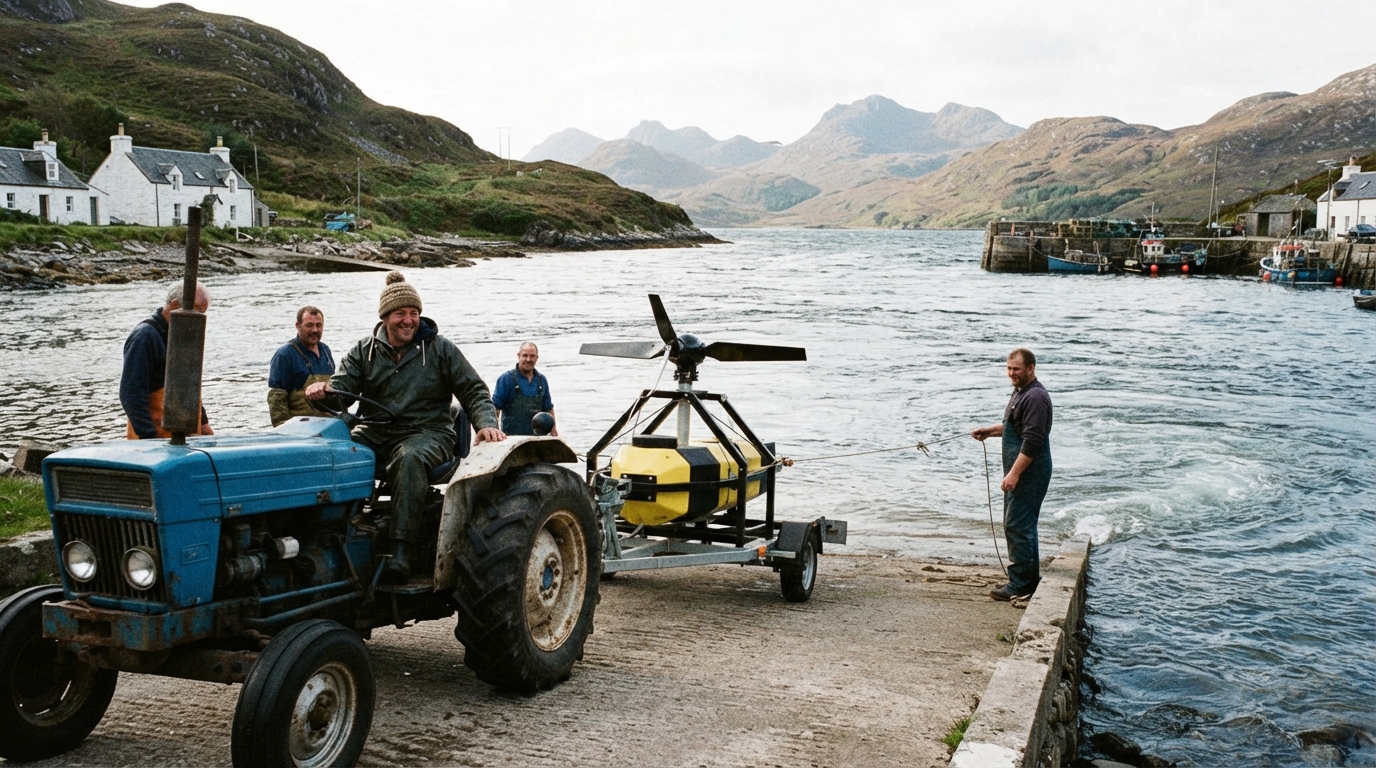
Mummery’s turbine is extremely compact and far cheaper than those giant machines. Fishermen and local workers can assemble and install it themselves from their own village harbour.
“Can you imagine like an Ikea furniture kit? You get a shipping container and you'll open it up and it will be about 20 components.
“You'll bolt them all together and then you've got your turbine ready.
“There'll be a launch plan, you follow these instructions, then you'll be in the water.”
Mummery did not always work on small-scale power. Originally from Guildford, he studied mechanical engineering at Surrey University.
Before setting up Flex Marine Power, he was a highly sought-after consultant in the UK energy sector. For a period, he focused on nuclear work and decommissioning, designing robots to remove material from contaminated tanks.
He moved north after falling for a girl studying at Glasgow University. Jo became his wife, and they now live in the city suburbs with three young children.
By chance, his move came as Scotland was building its reputation as a hub for marine power expertise.
In 2010, he took a secondment at Scottish Power Renewables on the pioneering Pelamis project in Orkney.
The 180m-long (591ft) Pelamis P2 - nicknamed the sea snake - was the first deep-water, floating wave energy machine to feed power into the national grid.
In the end, Pelamis went into administration in 2014, but the unsuccessful device is still remembered as a landmark in marine power innovation.
“The industry is littered with these examples of fantastic technologies and teams that do brave things that take decades,” Mummery says.
“But at some point the market doesn't step up and they falter. Some really good ones have lasted the course, but others have not and it's sad.”
Mummery says the UK has “phenomenal waters for tidal power” and he enjoyed being involved in major projects - but he could not ignore a sense of unease.
His work felt out of place in the many small coastal communities he visited.
“I'd be going out on boats around Scotland doing sonar surveys with all these really expensive pieces of kit.
“But the equipment was all really big, utility-scale stuff that would weigh hundreds of tonnes, shipped by people from the mainland.
“All the people I was meeting in harbours or in the pub were fishermen. And they were knowledgeable and they were interested.
“I thought 'we've got to do this in a way that they can take the lead'.”
He says that was what inspired the Swimmer Turbine idea.
In 2011, he walked away from large projects to found Flex Marine Power and concentrate on his turbine concept.
He spent hours at his desk sketching and figuring out how to make the technology smaller and lighter.
He hired a student employee and found a smart glass office outside Glasgow - which he soon realised was not really suitable for an engineer and his tools.
“It was a lovely place, but I wasn't allowed to take a hammer drill into the office.
“We were trying to make prototype turbines under the desk so the landlord wouldn't see them when he came in.”
Mummery looked to Clydeside’s shipbuilding heritage for a more practical workspace.
He put forward a plan to turn former shipyards into marine technology research sites, and Inverclyde’s redevelopment authority invited him to Greenock.
“There were lots of empty sheds that hadn't been used for years,” he says.
“They basically said 'we'll walk you around, you can pick a shed'. So I got the pick of the bunch right on the quayside.”
Mummery then had direct access to the River Clyde for sea trials to test his models.
He developed a prototype, which he successfully trialled in 2015 on the island of Luing, in the Firth of Lorn, near Oban.
That led to Flex Marine’s first major investment and expansion the following year.
The next major step came in Northern Ireland in 2020, at Strangford Narrows in County Down.
Mummery worked with Queen's University Belfast, which had an academic licence to test tidal equipment at sea.
“Me and Mark, my accountant, lifted all of the components into a shipping container and sent it out on a lorry.
“We were introduced to a bunch of local mariners. We pulled off a full-scale tidal turbine installation out of a container deposited in a farmyard.”
Producing electricity while attached to the back of a boat, Mummery says it was the full-scale proof-of-concept that “finally put us on the map”.
It helped Flex Marine Power win £968,000 from the UK government's Energy Entrepreneurs Fund for a team of nine people to develop a commercial turbine model.
This version would not be tied to a boat.
The Swimmer Turbine would be launched directly from shore and stay completely hidden, generating electricity beneath the water’s surface.
Mummery spent months last year testing it on the island of Islay - known for its many whisky distilleries and coastal waters that are ideal for tidal power.
He hired space at a boatyard where “talented local people” were trained to assemble and launch the device.
At last, after years of work, the defining moment arrived.
“I was standing at the end of the slipway, seeing our machine, without any of my guys touching it.
“It was all local people. Fishermen, using their own tractor, launching it down their own slipway. This was my vision in a nutshell.”
The next step is putting that power to practical use. Mummery will return to Islay next year with a plan to generate electricity for the island.
“The sea is a very big space and these things are invisible. There could be different tidal arrays in different parts of the island, all owned by different people.
“In those real coastal communities, they don't have flashy cranes and heavy lifting capabilities and big corporate companies with big pockets.
“But what they do have is knowledge and work ethic and a deep understanding of their environment and the sea.
“We're trying to equip real people to thrive by giving them access to the power that's in the tides.”