

How the oil capital of the US welcomed a solar power boom
Texas is now the country's biggest producer of solar-farmed electricity.
How the oil capital of the US welcomed a solar power boom
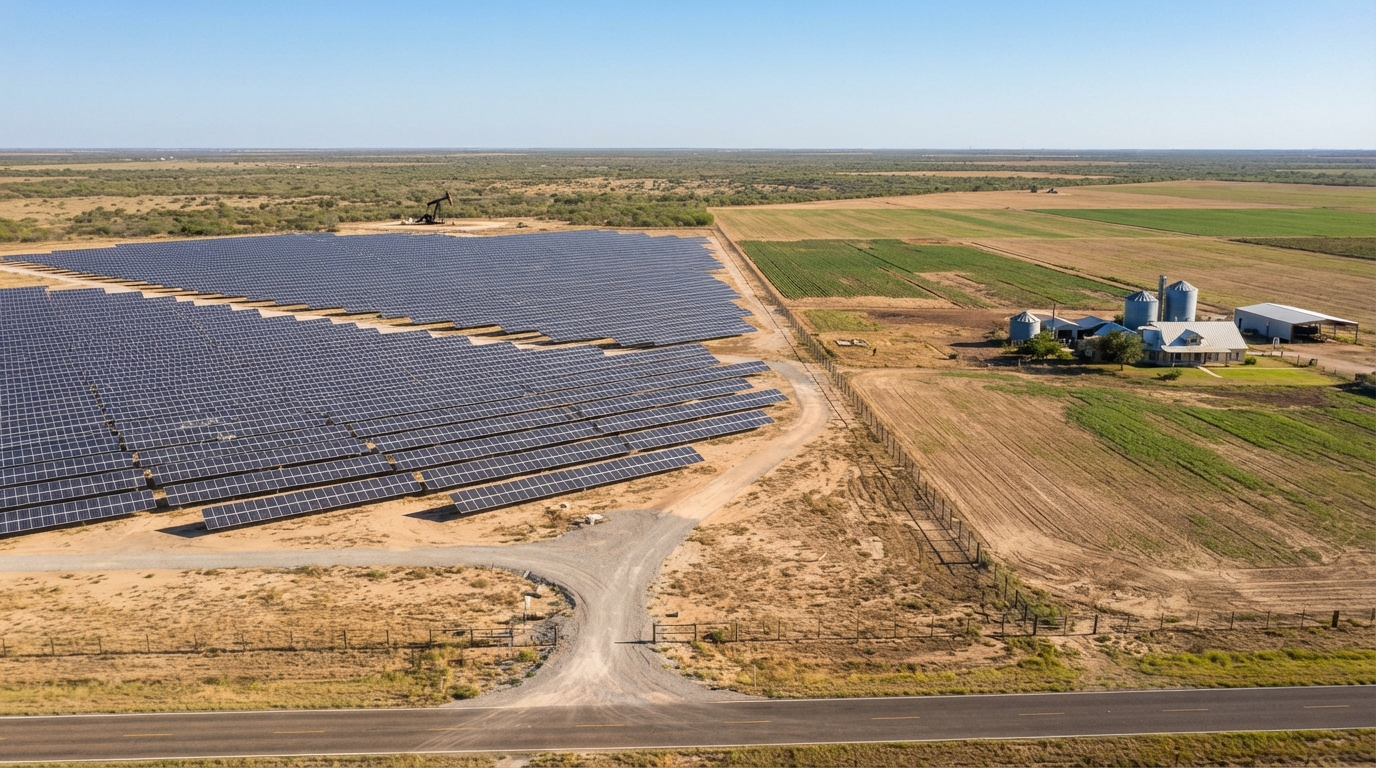
Farmer Steve Cargil now receives $200,000 a year for allowing a solar farm to operate on his land.
Steve Cargil’s family has worked the flat, dry land near Uvalde, a small city in southwest Texas, since 1953.
Cargil, 67, had long believed that one of his three children would one day take over the farm, just as he had inherited it from his father.
That belief was shaken one night in 2018 after a severe hailstorm.
Cargil and his son, Ryan, had spent months tending cabbage and onion crops until harvest. Then a storm swept through and wiped them out overnight.
"I remember my son saying, 'Dad, I just don't know if I can do this. You do everything right, and we work so hard, and you come out one morning and it's all gone'," Cargil says.
Cargil says his farm risked ending with him, because none of his three children wanted to farm full time. For years, he wondered what would become of the land and of his own retirement, since farmers rarely have a pension to rely on.
Then in 2001 Cargil signed an agreement to lease 600 acres of his land, roughly a quarter of the total, to a company called OCI Energy, which built a large solar farm.
"Never in my wildest dreams did I think that a solar project would be on my farm," Cargil says. Looking back, he now calls it a blessing.
The lease, which pays Cargil $200,000 (£150,000) a year, has allowed him to keep the farm going through a severe drought. He has been able to focus his water irrigation allowance on the land he still farms, and he no longer loses sleep over increases in costs such as diesel and fertiliser. "It's changed my life."
Texas, still the biggest oil producer in the US, earlier this year overtook California to become the nation’s largest producer of electricity from solar farms.
And in March of last year, solar generated more electricity in Texas than coal for the first time, according to the US Energy Information Administration.
On hot afternoons, when electricity demand peaks, solar now regularly provides about a third of the power used across Texas, says Mark Stover, executive director of the Texas Solar and Storage Association.
He says the solar boom is being driven by two main factors. First, it is cheap and fast to connect solar farms to Texas’ power grid, which is separate from the rest of the US. Second, Texas has a huge and growing demand for electricity, driven by a rapidly expanding population.
Between 2015 and 2025, Texas’s population grew by 15.8%.
"We need a whole lot of power in Texas, and we need it quickly," Stover says.
Solar has also become cheap. James Scott, vice president of project development at OCI, says years of small manufacturing improvements have pushed prices down to the point where it is now the least expensive way to generate power in the state.
"No one would have believed that 20 years ago," Scott says.
Once a project is built, he says, the price of the electricity it produces can be locked in for decades because the fuel, sunlight, costs nothing.
"We'll charge you $40 a megawatt hour for the next 25 years," Scott says, adding that major buyers such as Amazon and Apple value being able to secure a price for that long.
By comparison, new coal plants in the US generate power at nearly $90 megawatts per hour, says the Energy Information Administration.
Farmers have become central to that expansion because solar developers need large expanses of flat land.
Stover says the industry is now providing multigenerational income to families through leases that usually last 25 to 30 years and increase in value each year, allowing some people to retire, establish family trusts, or simply keep a farm afloat.
Stover argues that solar’s footprint is smaller than critics believe. "The industry is utilizing less than 0.15% of Texas land," he says.
Still, solar has opponents. In Franklin County, in northeast Texas, a small group of residents has spent the past few years resisting its growth.
BF Hicks, a local lawyer whose family has owned land in the county since the 1800s, says he watched neighbours sign 30-year leases with solar companies and saw bulldozers clear centuries-old oak trees near his property.
He recalls a summer when smoke from burning cleared land hung over his town for weeks. "It got real personal," he says, when a solar farm was built beside his family’s cemetery. His relatives have been buried there for two centuries.
David Truesdale, a retired federal law enforcement agent who moved to the county to escape city life, says he became involved after learning that a nearby solar project would be built close to his home. He also says that under Texan law no environmental review was required.
"We're destroying the world as we're trying to save it," Truesdale says of the land clearing he has witnessed. He also points to the large lithium-ion battery units installed alongside many solar farms, comparing them with fires that have occasionally engulfed similar batteries in electric bikes.
"If one of those things catches fire, they go off in series, so each one will progressively cause another one to go off," he says.
Both men say their objections are not political. Franklin County is strongly conservative, but residents helped push through one of the state’s first county-level moratoriums on new solar construction, before it was later withdrawn under legal pressure from developers.
Their complaints reflect a wider unease that has accompanied solar’s spread into rural Texas — concerns about visual impact, water runoff after land is cleared, and battery storage units that scorch their land.
President Trump has called solar and wind power "farmer destroying" and has moved to roll back tax credits for renewable projects.
Yet Fabrizio Lee and Associates, the polling firm used by President Trump, found in February that 68% of Republican voters believe the country needs "all forms of electricity generation, including utility solar" to keep costs down.
Stover says he has found broad support in the Republican-controlled Texas state legislature. "There is an acceptance that these technologies bring reliability benefits to the grid," he says.
Back in Uvalde, Steve Cargil says that although he has no plans to retire anytime soon, he is more hopeful that the farm may still reach a fifth generation now that the solar farm has put a floor under its finances.
"You're better off being lucky than being smart," Cargil says, echoing something his father used to tell him. "And this was one of those cases where I was just lucky."