

Trump's green card curbs test Indian tech workers' American dream
With immigration curbs and tech firms cutting foreign hiring, US residency is becoming a distant dream for many Indians.
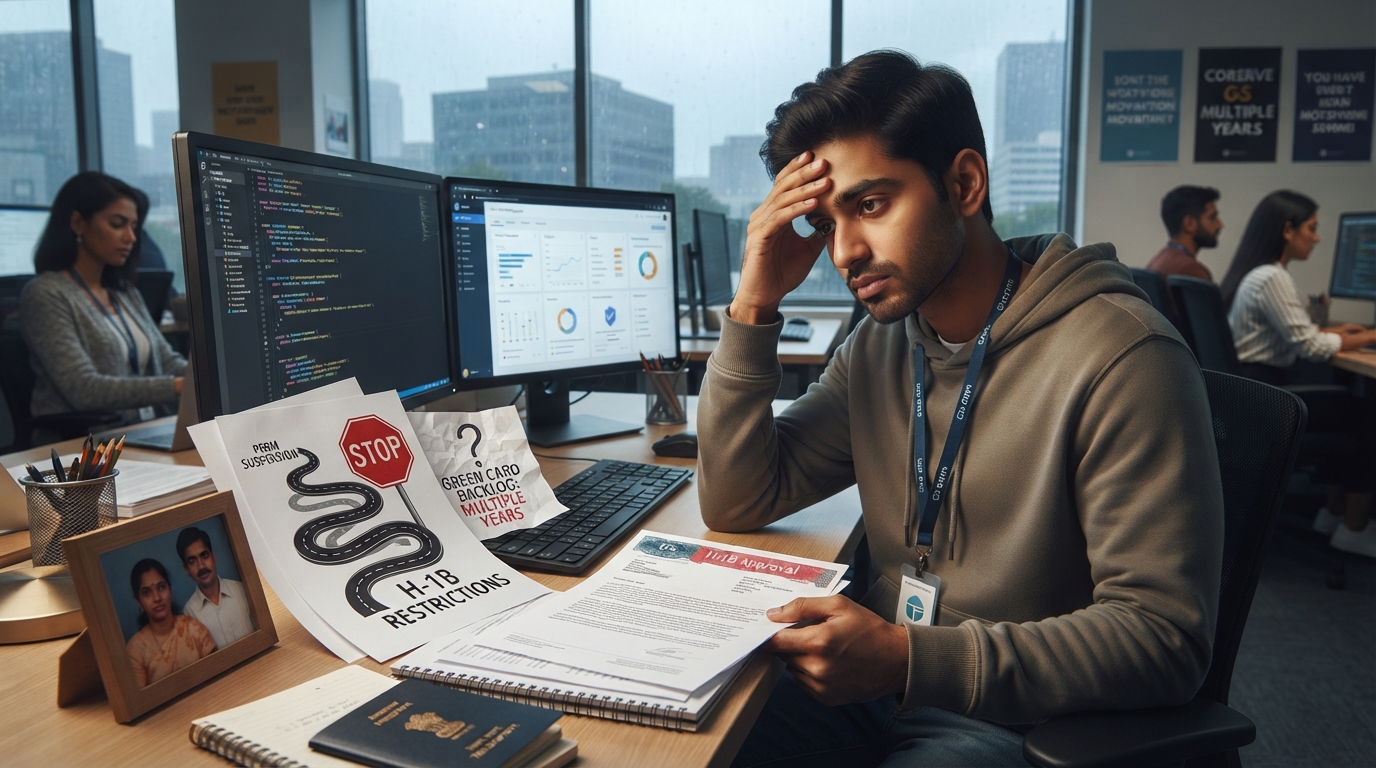
Trump’s green card restrictions put Indian tech workers’ American dream to the test
Indian tech workers are confronting rising uncertainty as US immigration rules tighten.
For millions of Indians, the path to the ultimate career goal followed a familiar pattern: an engineering degree, a tech services job, a posting in the US, repeated visa renewals, and then a green card granting permanent residency.
But that may be coming to an end.
Earlier this month, the US said it would suspend eight technology firms, including Microsoft, India’s Infosys, Tata Consultancy Services, Wipro and HCL Technologies, from hiring skilled foreign workers on a permanent basis through a widely used visa route.
New and pending applications under the Permanent Labor Certification Program, or PERM, have been put on hold. That is a major setback for Indians, who hold most H-1B visas - temporary visas for specialists - and have used them to work in the US while depending on PERM to obtain a green card and, eventually, citizenship.
The latest move fits with Trump’s drive for tougher skilled-worker immigration rules, and tech companies have been adjusting to that, so the business impact may be limited, experts say.
Nasscom, the trade body for India’s $300bn (£226bn) technology sector, says Indian firms have cut their reliance on H-1B visas and are hiring more people locally.
“Consequently, the number of employees transitioning from H-1B visas to permanent residency through the PERM process is also relatively limited,” the association adds.
Wipro said in a statement that more than 80% of its US workforce is locally hired. Tata Consultancy Services (TCS) said its PERM applications were in single digits over the past two years. Microsoft said in a statement that it has filed H-1B visas mainly to keep existing employees, not to bring in new workers.
A Business Standard report, citing PERM Tracker, said TCS filings dropped to two in 2025-26 from 513 in the previous year and 1,804 the year before that. The report said no records were found for Infosys and Wipro for 2025-26.
Brokerage HDFC Securities said the effect on tech firms would be minimal, since PERM-linked jobs account for only a small portion of revenue, even if they are replaced by higher-paid American workers.
But the US government’s decision has consequences beyond business.
Vice President JD Vance’s comments on H-1B workers have added to worries about US immigration policy.
A US-based senior executive at one of the eight firms told the BBC, on condition of anonymity, that the new PERM restriction will “not break the business”, but the human impact is more “intense”.
“A good number of people we know are stuck in a space where they have spent some years in the US but their green card application hasn’t moved. Even if they are ready to move back to India, their children don’t want to because they grew up here,” he said.
Recent policy changes have deepened uncertainty and increased online hostility toward Indian immigrants and H-1B visa holders.
Researchers at Stop AAPI Hate, a US non-profit that fights anti-Asian and Pacific Islander discrimination, have reported a sharp rise in anti-South Asian online sentiment since the 2024 US election, with Indian immigrants and H-1B visa holders often targeted.
While barring the eight tech companies from PERM, US Vice President JD Vance also described foreign professionals on H-1B visas as “foreign indentured servants”.
He later said that was “imperfect” rhetoric, but the remark drew strong criticism from India’s foreign ministry, which called it “unwarranted” and “deeply offensive” because of its colonial connotation.
Poorvi Chothani, founder and managing partner of global immigration law firm LawQuest, said many people came to the US for better opportunities, borrowing heavily to study and build careers. But with rules tightening, they now have fewer options and less ability to absorb the costs.
Immigration experts say that as routes to residency narrow, some may rethink their future in the US, while others may decide not to move at all.
Ahmet Gulek, a postdoctoral fellow at Stanford’s Immigration Policy Lab, told the BBC that although there are alternative ways to gain residency, not many may be practical.
Moving to another firm not affected by the suspension is one option, but he notes it is unclear whether those companies would be willing to hire immigrants given “the fear of retaliation”.
It is also a difficult time to switch jobs.
Indians dominate the US employment green card backlog
The tech industry has already been reshaped by layoffs, cost-cutting and the rapid rise of artificial intelligence (AI), making career changes harder.
Still, there are other ways to get a US green card. People with exceptional achievements or whose work serves national interests may qualify for categories that bypass the PERM labour certification process.
Applicants can also gain permanent residency by investing at least $800,000 in eligible US businesses.
Gulek warns that some of these categories “may be targeted next.”
Chothani says some people are so determined to remain in the US that they are considering the EB-5 investor route, though they may not have enough money to invest.
As of December 2025, nearly one million Indian nationals were waiting for employment-based green cards, making up 79% of all pending applications, according to the National Foundation for American Policy (NFAP).
Its report forecasts wait times of five to 179 years for highly skilled Indians filing labour certification or employment-based immigration petitions from January 2026, depending on the visa category.
Like other recent immigration measures, the PERM suspension could face legal challenges in federal court. But together, these steps point to a more restrictive environment for people hoping to study, work or settle in the US.
Earlier, the Trump administration imposed a $100,000 fee on certain new H-1B visa petitions, a measure later struck down by federal courts. More recently, it has also proposed a $70,000 fee for universities recommending international students for a programme that lets graduates work in the country after finishing their studies.
“This trend is not changing anytime soon,” said an Indian professional who spoke to the BBC on condition of anonymity and recently moved to an H-1B visa after a “long wait”. He said both the Republican Party and the Democratic Party agree that immigration laws need reform, even if they disagree on how to do it.
Some research suggests the restrictions could shift jobs to India rather than to American workers. Industry players say they are already seeing more companies offshore work.
“Companies benefit from cost arbitrage when they move work offshore. Post Covid, there is also greater acceptance and appreciation for remote work from clients,” the executive from the tech firm quoted earlier says.
Experts believe America’s demand for Indian tech talent is unlikely to disappear. What may change is the way that talent is used. For Indian professionals, that could mean rewriting the script for building a future in the US.