

Today is World Vegan Day. Are meatless dishes foreign to us?
Imagine you went to visit someone. A dish of pilaf was placed in front of you. Its rice is well-cooked, the carrots are sufficient, and its aroma whets your appetite
Today is World Vegan Day. Are meatless dishes foreign to us?
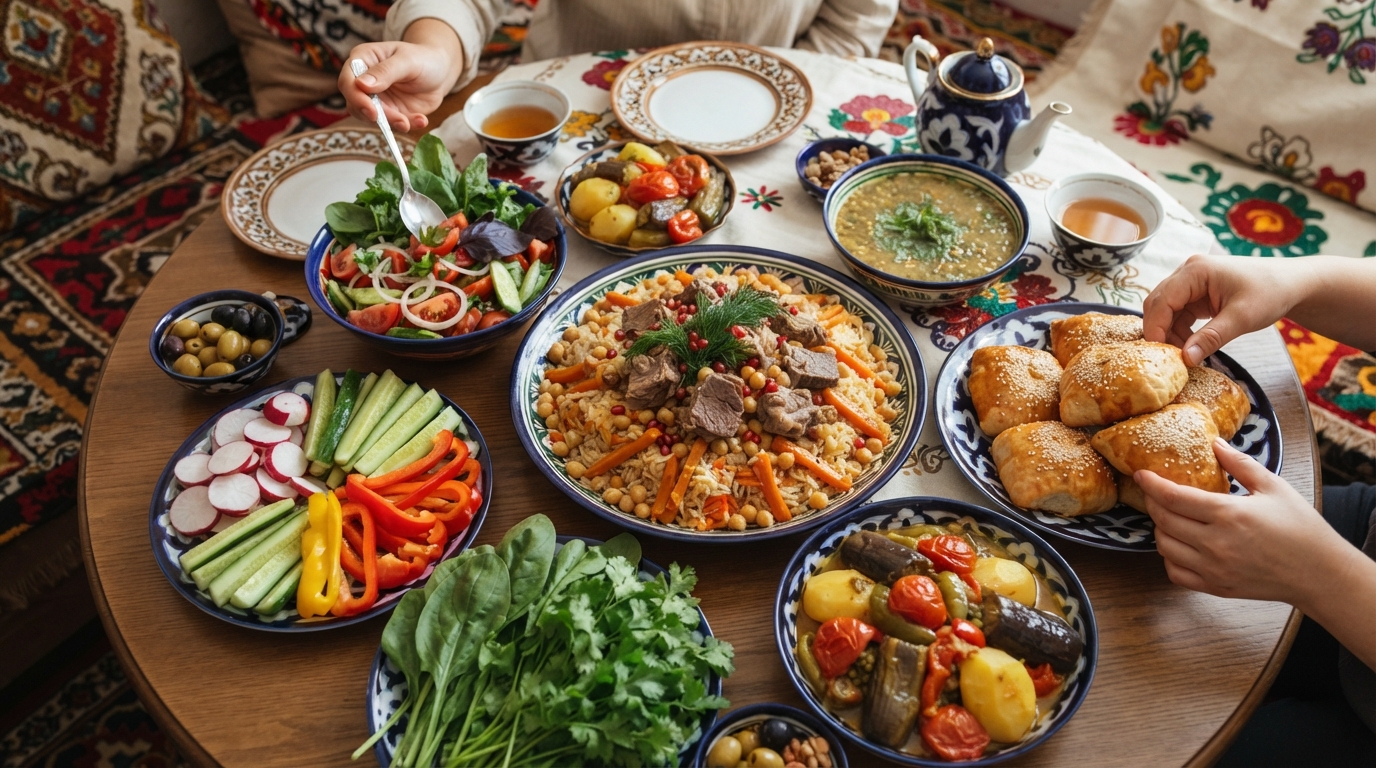
Imagine you are visiting someone's home. A plate of plov is served in front of you. The rice is cooked well, there is enough carrot, and the aroma whets your appetite. But it felt like there was a little less meat. Then pumpkin somsa, herb salads, and various vegetables were placed on the table. The spread is colorful, and the dishes are diverse.
What comes to our mind first at such a moment? Do we measure the abundance of the table by the variety of dishes on it, or by the amount of meat in the plov?
Meat has a special, even symbolic place on the Uzbek table. Whether we cook plov, host guests, or hold weddings and ceremonies, we pay special attention to serving meat. Even the second dish itself may consist solely of meat. Sometimes, how much meat is in the dish seems more important than how delicious and lovingly it was prepared. If there is little meat, we might doubt the host's financial capacity, and we may not consider a meatless dish a "full meal."
The roots of this view run very deep. In our society, meat has historically developed not just as food, but as a symbol of abundance, prosperity, and respect from the host. Past periods of scarcity and hardship seem to have ingrained a stubborn idea into our minds: "if there is meat, there is fullness; eating without meat is poverty."
Of course, meat is an integral part of our national cuisine. Plov, manti, and kebabs have their place. It is not a matter of giving them up, but is the richness of the table measured only by the abundance of meat? Why do we sometimes not value the variety that pumpkin somsa, herb salad, mung bean dishes, and meals prepared from beans and chickpeas add to the table as much as meat dishes?
"What do you eat then?"
Imagine another scene: a person sitting next to you at the table sets aside the meat from the plov. "I don't eat meat," they say, surprising others. Maybe they are vegetarian, maybe they gave it up for health reasons. In any case, this situation can immediately draw the attention of those around the table. Questions like "What do you eat then?", "Does your stomach get full without meat?", and "If a person doesn’t eat meat, where do they get their strength?" are bound to arise.
Because eating meatless or lower-meat food is still not a common occurrence for most of us. When we think of a meatless dish, we often only think of a diet or a temporary restriction. However, the culture of healthy eating around the world relies on dietary diversity.
November 1 is World Vegan Day. Veganism is not just about giving up meat and other products derived from animals. Behind this choice lie issues such as attitudes toward animals, environmental impact, and consumption culture. Today, however, we are talking about another aspect of the topic — the place of meat in our diet and our perception of it as the main criterion for the abundance of the table. This date is not meant to call everyone to suddenly become vegan or give up our traditional cuisine, but rather serves as a good reason to reflect on our daily eating habits and choices.
Are meatless dishes foreign to us?
In fact, meatless or vegetable-rich eating is not at all foreign to our culture. If we take a look at the history of our national cuisine, we find many satisfying and delicious meatless dishes. Moshkhorda (mung bean soup), bean plov, pumpkin somsa, herb chuchvara, vegetable dimlama, egg barak... These foods have historically been the pride of our table.
Often, even when we put less meat into plov or dimlama and replace it with chickpeas, say quince, carrots, or eggs, the dish does not lose its taste and heartiness. It's just that we have grown accustomed to perceiving them not as main dishes, but sometimes as light snacks or economical options.
The World Health Organization also emphasizes adequacy of nutrients, balance, moderation, and most importantly, diversity as the main principles of a healthy diet. Legumes such as mung beans, common beans, and chickpeas are also sources of protein. By combining our diet with vegetables and grain products, it is possible to obtain all the substances necessary for the body.
Meat and biological age
When it comes to meat consumption, views such as "meat makes a person age" or "those who don't eat meat live longer" are also frequently encountered. So, how much truth is there in these statements?
Biological aging is a complex process that depends not only on nutrition, but also on dozens of factors such as genetics, physical activity, sleep, stress, and smoking. The conclusions of the Global Burden of Disease (GBD) study, one of the largest research projects in the medical world, force a completely different perspective on this issue. According to scientists, eating meat in moderation does not impoverish the table; on the contrary, it extends our lives.
Meanwhile, a study published in the scientific journal Nutrients examined the potential link between meat consumption and biological aging. The authors noted certain correlations between the consumption of processed meat (such as sausages and hot dogs) and DNA indicators. However, no uniform, definitive conclusion was reached regarding fresh, properly cooked meat and its various quantities.
As emphasized in the study, the first and greatest risk is processed meat, namely sausages, hot dogs, and smoked products. Although they are the pride of the table, they are actually enemies of health. The excessive amounts of salt and chemical preservatives (nitrates) added to them for long shelf life sharply increase the risk of colorectal cancer, cardiovascular diseases, and diabetes. According to research, the daily safe limit for humans is only 2 grams (14 grams per week), but the global population consumes at least 2–3 times more than this norm.
The second category is red meat, namely beef and mutton, which forms the basis of our daily diet. It is not necessary to give up freshly slaughtered meat completely, but it also has its limit. Saturated fats in its composition, and especially carcinogenic substances released during frying meat over high heat or cooking kebabs, pave the way for heart disease. Scientists recommend eating 18–27 grams (about 150–200 grams per week) of meat as the optimal daily amount. People around the world usually exceed this limit by at least two times.
So, if fewer meat products are placed, does the table really become impoverished? Not at all. When meat is reduced, much healthier and more diverse blessings should take its place. To restore health, one should first completely avoid artificially processed sausage products. Most importantly, it is essential to add salads with plenty of greens and fresh vegetables alongside meat dishes, because the beneficial fiber in vegetables significantly reduces the negative and heavy effects of meat on the body.
If meat decreases, do expenses also decrease?
There is another side to the matter: the family budget. When meat prices rise, many people forcibly reduce it. But this can be seen not merely as "frugality" or "poverty," but as an opportunity to enrich the table. Mung beans, common beans, and vegetables can be a more economical alternative for the family budget.
Let us return to the previous scene: in front of you stands plov cooked with fluffy grains of rice, pumpkin somsa, herb salads, and various foods. The pieces of meat in the plov are a little less than you expected, but the table is full and there is plenty of choice. At such a time, do not rush to call this table "poor." A decrease in the amount of meat in the plov or on the table is neither poverty nor disrespect from the host. It is simply a dietary balance, a conscious attitude toward health, and a new stage of consumption culture.
World Vegan Day calls for rethinking precisely these daily habits of ours. After all, the true richness of the table is determined by the variety of the menu and the physiological benefit of the food.