

"Excess weight is not a lack of discipline, but a disease"
64% of adult residents of Uzbekistan are overweight or obese. For some people, excess weight becomes an obstacle in daily life: it prevents them from moving freely, doing their usual activities, and wearing their favorite clothes. "Gazeta" shares what people go through on their journey to weight loss and what solutions modern bariatric surgery offers them.
"Excess weight is not a lack of discipline, but a disease"
In 2016, a man weighing 236 kilograms came to see Dr. Shukhrat Khashimov, Doctor of Medical Sciences. An urgent bariatric surgery — a surgical method of weight loss — was out of the question at the time: the operating table in the clinic could withstand a maximum load of up to 200 kg.
The patient turned out to be an incredibly warm and open person. He brought flowers to the nurses and joked endlessly: "Girls, I'm actually very handsome, it's just all hidden behind the fat." At the same time, in the mornings, he could barely manage to get out of bed.
To bring his weight down to the acceptable 200 kilograms, a silicone balloon was temporarily placed in the man's stomach, occupying most of its volume. He began to feel full on very small portions. In a few months, 36 kilograms were gone. Then the balloon was removed, and the patient began preparing for surgery.
According to the World Health Organization, Uzbekistan ranks first in Central Asia in the prevalence of overweight among adults — 63.7%. In Turkmenistan and Tajikistan, this figure reaches 58%, in Kazakhstan — 56.5%, and in Kyrgyzstan — 56.2%. There are many reasons, and one of them is the national cuisine.
"Pilaf, manti, hot samsa are part of our cultural code. But the calorie content of this food was 'calculated' by our ancestors for heavy physical labor. To burn off a plate of pilaf, you need to work in the field all day. In the 21st century, a person eats a generous portion of fatty food, gets into a car, and drives to the office — to sit at a computer until evening," says doctor Shukhrat Khashimov.
In addition to high-calorie food and a sedentary lifestyle, the situation is exacerbated by addiction to gadgets. Young people stay on their smartphones until late at night, which reduces sleep. Lack of sleep can affect hormones that regulate appetite and increase the risk of weight gain.
Awareness of the problem comes to everyone in their own way, but always at the moment when the body stops obeying.
Before marriage, Makhmuda weighed 42 kilograms. With a height of 156 cm, her figure was slender, almost fragile. Now she is 41 years old. She works as a nurse's aide and is raising three children. Her whole life is a familiar cycle between hospital wards, home, and the bazaar.
Between that Makhmuda and today's is a whole lifetime, during which the woman's body gradually stopped belonging to her.
It all started at age 38 with a heavy emotional blow — she lost a child. Then came the pandemic, and Makhmuda ended up in the infectious diseases complex in Zangiata. The Covid infection was severe. The woman received high doses of a hormonal drug recommended by the WHO for critical conditions. The disease was defeated, but the body presented another bill: her weight, which had previously remained at 74 kilograms, sharply rose to 94.
For another Tashkent resident, Shukhrat Yu., the path to the critical point was different. Before his body reached 165 kilograms, he loved to travel and could walk for hours through unfamiliar cities. After age 40, the kilograms began to pile on one after another, and gradually his life route narrowed to a short stretch between his house door and his car door.
The turning point for the man was also the pandemic year of 2020. Cars were banned from driving, the streets were empty, and on one of those quiet days, Shukhrat's elderly father called him: "Shukhrat, come over, make some pilaf for me."
Shukhrat is 57 years old, and he is an excellent cook. But the road to his father's house is ten bus stops and a small, about five-meter, incline near a traffic light. For a person weighing 165 kilograms, this is not just an inconvenience, but an ordeal: for every 10–15 meters of walking, the body responds with heavy, suffocating shortness of breath.
"My relatives told my father: 'How can he come? He's fat. He won't even make it halfway.' But I went. My father is asking, how could I not go? There are no cars, just silence. I'm walking, slowly, gradually, step by step... I'm walking and thinking: on one hand, I need to fulfill my father's wish, on the other — it's so hard, I'm gasping, there's not enough air," Shukhrat recalls.
The man did reach his father that day. But it was precisely on the way to him that he was pierced by the bitter thought of how narrow and limited his world had become.
The main misconception of society, which doctors fight against, is the blind belief in "willpower."
"Advice to 'eat less and exercise' is irrational in most cases," explains surgeon Shukhrat Khashimov. "Excess weight at this stage is not a lack of discipline, but a full-fledged disease."
Along with the physical pressure of one's own body, social pressure also enters a person's life.
The changes in Makhmuda's appearance did not go without comment — neither at home nor at work. Her husband was the first to distance himself: "You are gaining weight, do something." Then her sisters joined in: "Look at yourself, you're getting fat." Her colleagues at the hospital were also not shy in their expressions: "Why are you gaining so much weight? You are short, you're starting to look like Kolobok (the Round Bun)."
Illustrative photo: Joachim Schnurle / Unsplash
In those moments, everything inside Makhmuda turned upside down, and she felt bitter.
"I was very anxious because I couldn't find suitable clothes. Because of my short height, I couldn't find anything at the bazaar. It was hurtful to have to buy ugly styles meant for elderly women. My husband made remarks: 'What did you pull on yourself? It doesn't suit you, look for things for large people,'" Makhmuda says.
Before recognizing the disease, Makhmuda and Shukhrat went through a vicious circle of trying to cope on their own.
With various diets, weight-loss teas and coffees, and fat-burning supplements, she managed to lose 10 kilograms — from 94 to 84, after which the scale needle froze completely.
He also tried to "pull himself together": he cut his portions, bought two treadmills — one for home and one for work, to walk at any free minute. During Uraza (Ramadan), he managed to lose 10–12 kilograms, but then the weight returned with "interest": 120, 150, 165 kg...
Neither Makhmuda nor Shukhrat lost weight using popular drugs like Ozempic or Mounjaro, but in doctors' practice, such stories are encountered constantly.
Surgeon Shukhrat Khashimov does not criticize these medications, but calls them a temporary crutch.
"I have had patients after such drugs. While you inject, you don't want to eat, you lose weight.
You stop injecting — the weight returns, and even with extra, which breaks a person psychologically.
Such medicines are needed for something else. For example, a patient comes with high sugar, and we cannot operate on them immediately due to the risk of complications. Then, together with endocrinologists, we lower the sugar, including with such injections, to an acceptable level to perform the surgery safely," the doctor explains.
Obesity in medical protocols is considered a multifactorial disease. It leads to a whole range of dangerous diagnoses — diabetes mellitus, cardiovascular pathologies, damage to joints and the spine, hypertension, and oncology. In women, excess weight can trigger infertility; in men, impotence.
In Makhmuda's case, her gallbladder was the first to give out, and during the examination before its removal, doctors detected diabetes mellitus. The woman argued with the doctors to the point of tears: "I don't have any diabetes!" Her grandmother had once died of this disease, and she did not want to believe the diagnosis. But the diabetes was already manifesting: an unbearable itch and irritation began, her heart raced with tachycardia, and a heavy lethargy rolled over her. Her nervous system also suffered — Makhmuda snapped at her loved ones, argued at work, and could burst into tears over any little thing.
Photo: Evgeniy Sorochin / Gazeta
Pills and injections did not help, her sugar jumped from 10 to 25 mmol/L, and when the indicator reached 30 mmol/L, Makhmuda ended up in a hospital bed in a pre-comatose state.
There, under IV drips, she finally "heard" the doctors: "You cannot live with such sugar — you will simply fall into a coma."
To reduce her weight and achieve diabetes remission, Makhmuda decided on bariatric surgery. There were many fears: "What if you pay the money, go under the knife, and the sugar remains? And the weight doesn't go away?"
Her family met the idea with hostility, but by that time Makhmuda no longer cared about other people's opinions. Years of reproaches and the constant fear of a diabetic coma helped her make her choice: "I am doing this for myself and my health."
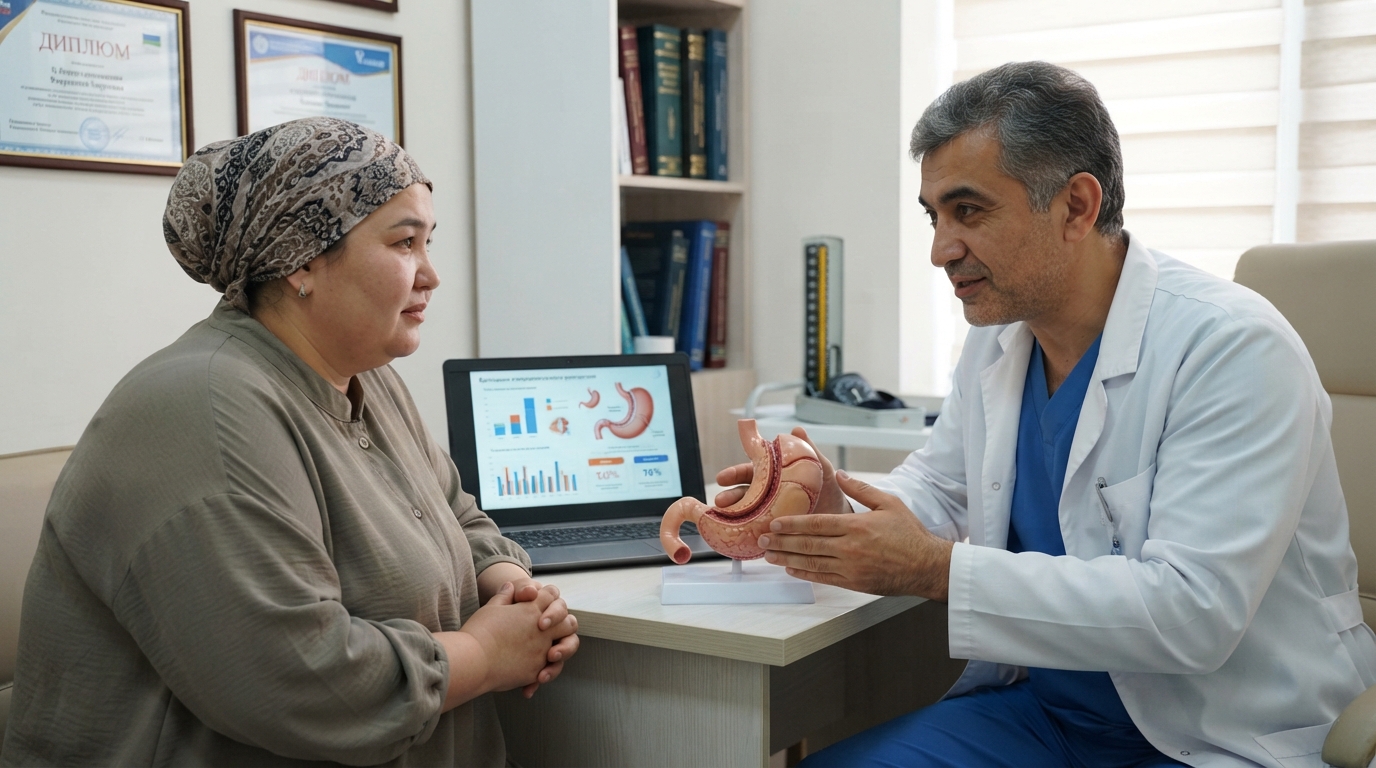
Surgeon Shukhrat Khashimov admits that he regularly has to give lectures to husbands who resist and say: "Let her just close her mouth and eat less." For such cases, the doctor has a special presentation prepared on his computer.
"I am always on the patient's side. I sit such a husband in front of the monitor, show him graphs, statistics, research data. I say: 'Understand, obesity is a disease. Tomorrow, severe concomitant diseases will develop against this background. Think about it, without surgery, your wife will live 10–12 years less. And your children need a mother, you need a healthy, active, and happy wife,'" he says.
Convincing husbands is important, because in 70% of cases, they are the ones who pay for the surgery. However, Shukhrat Khurshidovich often sees the opposite picture as well: when a spouse at the consultation tells his wife, "I am with you, I am by your side, I will support you." He is ready for any expenses, as long as his beloved woman tolerates the surgery easier and recovers faster.
The doctor says that everything depends on the relationship in the couple.
Photo: Evgeniy Sorochin / Gazeta
Shukhrat Yu. was brought to the operating table by the fear of death — in his circle, people with excess weight began to pass away one after another.
"In Kyrgyzstan, a close friend died, he was only 42 years old. Cardiac arrest against the background of obesity. In Kazakhstan, a driver died who had worked for me for many years — transporting goods. He passed away right on the trip. He delivered the cargo to Ust-Kamenogorsk, and they called from there — he got into the hospital, and that was it, the man was gone. The doctor said it was due to excess weight. In Shymkent, I had an acquaintance who was a doctor, young, only 35 years old. He himself used to say: 'Shukhrat, we both need to solve the weight issue! I just don't have time, I operate every day.' And so he didn't make it," the man says.
The way out was suggested by an acquaintance who used to weigh almost 180 kilograms and then sharply lost weight — with the help of surgical intervention. "He was a round bun, and became a handsome man," Shukhrat Yu. describes him.
The first bariatric surgeries in Uzbekistan were performed about 40 years ago, but since then practically everything has changed. In 2015, returning from a series of foreign internships — in Russia, China, South Korea, Turkey, and the UAE — Shukhrat Khashimov, together with his colleagues, performed laparoscopic surgical stomach reduction for the first time in the country.
"Previously, bariatric surgeries were done in an open way, through an abdominal incision. In large people, the incision is also large, there is no other way due to the thickness of the subcutaneous fat," throughout the conversation, Shukhrat Khurshidovich rarely uses the medical term "obesity," preferring to call patients "large people." — "Accordingly, everything healed with difficulty, with complications and purulent processes.
Today we work without incisions, through small punctures.
This provides minimal trauma and rapid rehabilitation. Patients get on their feet in 2–3 days instead of the former 7–10."
Photo: Evgeniy Sorochin / Gazeta
Modern technology looks like this: a laparoscopic telescope is inserted into the abdominal cavity through small punctures, which transmits the image of internal organs to a monitor. Then an endoscopic stapler comes into play — a special medical instrument that cuts off a part of the stomach, simultaneously clamping and "suturing" the tissue. Deflated like an empty balloon, the cut-off fragment is carefully pulled out through one of the punctures, slightly widened to one and a half to two centimeters.
Bariatrics is not plastic or cosmetic surgery, so patients end up on the operating table strictly according to medical protocols.
According to world standards, an indication for surgery is a body mass index (BMI) above 40, or above 35 — but on the condition that the person already has concomitant diseases: diabetes, hypertension, destroyed joints, etc.
Often, patients are referred to bariatric surgeons by doctors of other specialties: endocrinologists, traumatologists, gynecologists. Excess weight sometimes becomes an obstacle to motherhood, and Shukhrat Khurshidovich rejoices when former patients send him photos with babies in their arms. It also happens that a person's joints are so worn out that they require replacement with artificial ones, but the prosthesis simply will not withstand the body weight. Then the traumatologist advises first removing the kilograms with the help of bariatric surgery.
The motivation of men and women coming for a consultation differs.
"70% of my patients are women. They almost never admit that they are going for surgery for the sake of appearance, although there is nothing shameful in this. They are afraid of seeming selfish. They say that it is 'for the husband, for the children.' In such cases, I reply: 'Do it for yourself. If you are happy and healthy, your family will be happy,'" says the doctor.
In men, according to him, the main requests are health or career.
"A person with excess weight is embarrassed of himself, and in men, this insecurity is exacerbated by problems with potency. After weight loss, they become more active, regain confidence, and often get a promotion. In addition, there are areas where a career directly depends on physical fitness — the military, law enforcement agencies. I have had such patients too," Khashimov specifies.
Photo: Evgeniy Sorochin / Gazeta
In Uzbekistan, there is another category of patients, whom the doctor calls "kelin-kuyov" (bride and groom). They are brought to the doctor by their parents, since in many families with a traditional way of life, it is they who decide marriage issues.
Excess weight is perceived by them not as a health problem, but as an obstacle to starting a family.
"A father and mother bring a 20-year-old guy for a consultation. He weighs 150 kilograms, sits at the computer at night, eats pizza, and drinks sweet soda. The parents are upset: 'No one will marry him, save us.' Or they bring a daughter whom they want to find a husband for, to wait for grandchildren. That is, excess weight and deterioration of the quality of life do not always create sufficient motivation to seek medical help and pay for surgery, but the marriage factor does. Perhaps, without the question of starting a family, some of these patients would not have reached a specialist," the surgeon reasons.
Over 11 years of Dr. Khashimov's bariatric practice, only about 15 people have returned to the operating table for a second time. The stomach is a muscular organ, and if you constantly "stretch" it with food, it will inevitably expand again.
The first month after the surgery, patient Shukhrat Yu. ate almost nothing. He could not manage even one chicken egg — he switched to quail eggs. Two or three spoons of broth and a bowl of thin porridge — that was the whole meal. With a sinking heart, he watched the scale, which showed minus 0.5 kg every day. After some time, his weight stabilized at 105 — 60 kilograms were gone from the peak value. His blood pressure leveled out, and the exhausting heartburn and swelling disappeared. A peculiarity also manifested itself — the body stopped sending hunger impulses.
"Previously, the stomach and head screamed: 'Let's eat!' Now this is gone. I have to remember to eat myself, I try to eat by the hour. If I feel that my strength is leaving and my head is getting heavy, it means the calories have dropped, I need to have a snack. I keep some nuts, raisins, or good chocolate in my bag. But now I eat like a European. I have been to Europe and seen: they bring a large plate, with two spoons of food on it — and they still don't finish it! That's how I am now, although previously I could eat a whole laygan (large platter) of pilaf alone," the man shares.
Photo: Evgeniy Sorochin / Gazeta
Shukhrat Yu. does not tell the details of the surgery to a wide circle of acquaintances.
"People are different," he sighs. "Some will understand correctly, and some will start saying that I should have just eaten less. I was once visiting, ate my norm as usual, and stopped. One person started to mock: 'What, did you cut your stomach and now you're afraid to eat?' It was very unpleasant.
I replied to him: 'Listen, my dear, I am ready for anything to live normally, and you are ready for anything to eat a lot. Do you understand the difference?'
He got embarrassed and silently left the table."
However, if the man sees a person who finds it hard to breathe and move, he does not pass by. For him, this is a chain of help that must not be broken. Shukhrat shares his experience and does not spare time for explanations.
"When it was very hard for me because of my weight, I prayed, and the Almighty sent me a person who told me about the surgery, and then — good doctors," he explains.
After bariatric surgery, the lives of Makhmuda and Shukhrat Yu. changed dramatically. The man says that he is traveling again and walking for hours through his favorite cities — without a hint of shortness of breath.
"In the summer, I went on a business trip to Astana — to a major international exhibition. Four days in a row, from morning till evening, I clocked up kilometers through the pavilions. A person with excess weight would not have been able to do that!" the returned lightness fills him with sincere, almost childish joy.
Makhmuda is also pleased. In the first month after the surgery, 20 kilograms were gone. Along with the excess weight, the agonizing itching and skin inflammation disappeared, and her blood sugar level returned to normal. Today she weighs 57 kilograms. She says she copes with her hard work as a nurse's aide as before — without much effort, easily climbs stairs, and can wear what she likes. In one of her recent photos, she is wearing a fuchsia-colored dress with luxurious rose-shaped sleeves.
"Excess weight makes you a 'half' person," Makhmuda says in parting. "You cannot live fully, you cannot dress as you want. You need to return your weight to normal in order to become whole again."
International protocols for the treatment of obesity were created on the basis of long-term studies conducted in the USA, Canada, and Europe. That is, the standards were derived on the basis of the "average European."
"But if the standards are universal, we are different," explains Shukhrat Khashimov. "The global medical community is now actively discussing the concept of the racial factor. Representatives of the Negroid race can live with a high BMI and remain metabolically healthy. In Asians, on the contrary, complications — diabetes, heart and vascular damage — begin to develop at significantly lower indicators. If today a BMI of 35 is recognized as the threshold for class II obesity, then as the evidence base accumulates, racial differentiation may occur. For example, 37 — for the Negroid race and 33 — for the Asian race."
That is why Dr. Khashimov's team, together with the Republican Center for Sports Medicine under the National Olympic Committee, launched a scientific project on the genetic study of metabolism in Uzbekistan.
The grant for the work was allocated by the Ministry of Higher Education, Science and Innovation.
"Now all over the world, wealthy people have rushed to study their genome. A personal test can tell a lot: what diseases there is a predisposition to, what tests to take, what diet to follow, what sport will give the body the best result. And what if we extrapolate this approach to the whole country?
A genetic cross-section can become the basis for government decisions.
Understanding the characteristics of the population's metabolism, it is possible to change the diet in kindergartens and schools at the national level, or determine which sports need to be developed and subsidized so that people do not reach the surgical table," says the doctor.
Any person with diagnosed obesity can try to become a participant in the study.
For people, this is also an opportunity to reduce the cost of bariatric surgery, since part of the consumables is purchased under the grant. The discounted cost of the surgery is 15–16 million soums instead of the usual 19–20 million. It is difficult to name the exact amount in advance: it depends on the length of stay in the hospital, the presence or absence of concomitant diseases, and other factors.
At the same time, Shukhrat Khurshidovich does not take everyone who wishes. In addition to BMI, he assesses the patient's motivation and their readiness to follow recommendations after the surgery.
"There must be a personal, conscious desire of the person. The option 'study me, and I will continue to sit on the couch and eat chips' will not work.
It is important for us not just to collect statistics, but to understand how to change the situation.
Participants are observed in dynamics: they undergo genetic analysis, are operated on, and then their metabolism is tracked after two months, three, and six months. This allows, step by step, to guide a person from the phase of active weight loss to stabilization and, ultimately, to a healthy diet," the surgeon emphasizes.
Based on the results of the large-scale two-year study, Shukhrat Khashimov plans to develop new algorithms for the treatment of obesity and test them in medical institutions of Uzbekistan.