

Three hydropower units have started operating at the world's tallest dam
At the Shuangjiangkou Hydropower Station built on the Dadu River in China's Sichuan Province, three hydropower units designed for the first phase have been fully commissioned. Standing at a height of 315 meters, this structure is considered the tallest dam in the world.
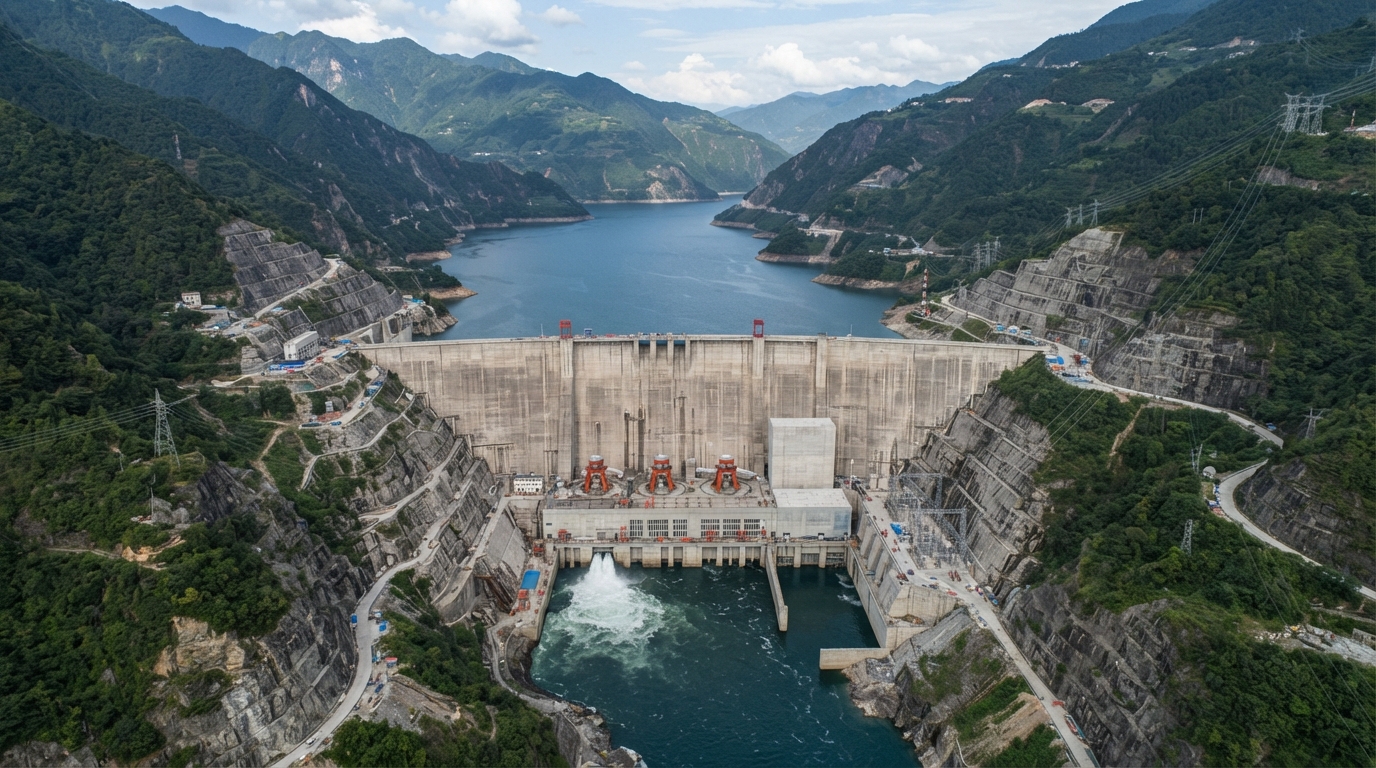
Three hydraulic units commissioned at the world's tallest dam
At the Shuangjiangkou hydropower station, located in Sichuan Province in southwestern China, all three hydraulic units belonging to the first phase have been commissioned.
Built on the Dadu River, this HPP is considered one of China's major national energy projects. The height of the dam at the station reaches 315 meters, and the source notes it as the tallest dam in the world.
The total installed capacity of the Shuangjiangkou HPP is 2 million kilowatts, which is 2 GW. According to the project, the station is planned to operate four hydraulic units, each equipped with radial-axial turbines with a capacity of 500 thousand kilowatts.
The volume of the HPP reservoir is equal to 2.9 billion cubic meters.
The first hydraulic unit at the Shuangjiangkou HPP was commissioned in June. Following this, specialists gradually commissioned two more units.
Thus, the three hydraulic units envisaged in the first phase have started operating.
The commissioning of additional capacities made it possible to increase electricity generation in the Chengdu-Chongqing economic region during the summer period of high electricity demand.
According to the source, the Shuangjiangkou HPP has so far generated a total of nearly 500 million kilowatt-hours of electricity.
This serves to strengthen the electricity supply capabilities of Sichuan Province and the Chengdu-Chongqing region during the summer peak demand period.
Shuangjiangkou is not only a power-generating facility but also an important regulating hydraulic structure in the upper reaches of the Dadu River.
The station performs several tasks simultaneously: it generates electricity, participates in the distribution of water resources, and serves to protect areas from floods.
For the project to reach full capacity, the fourth hydraulic unit at the station must also be commissioned.
Once all four units are commissioned, the Shuangjiangkou HPP is expected to generate nearly 7.7 billion kilowatt-hours of electricity annually.
In addition, by regulating the water flow, this HPP will also allow for an increase in electricity generation at cascade hydropower stations located downstream of the river.