

Three horror books for children in which even monsters get scared
It is getting dark earlier outside—high time to pull scarier books off the shelves. Designer and reading father Azamat Shamuzafarov offers adults and children a chance to venture into other people's nightmares, a famous monsters' party, and an English graveyard, home to a boy raised by ghosts. It will be a bit creepy, funny in places, and perhaps after these stories, you will begin to sympathize with the monsters.
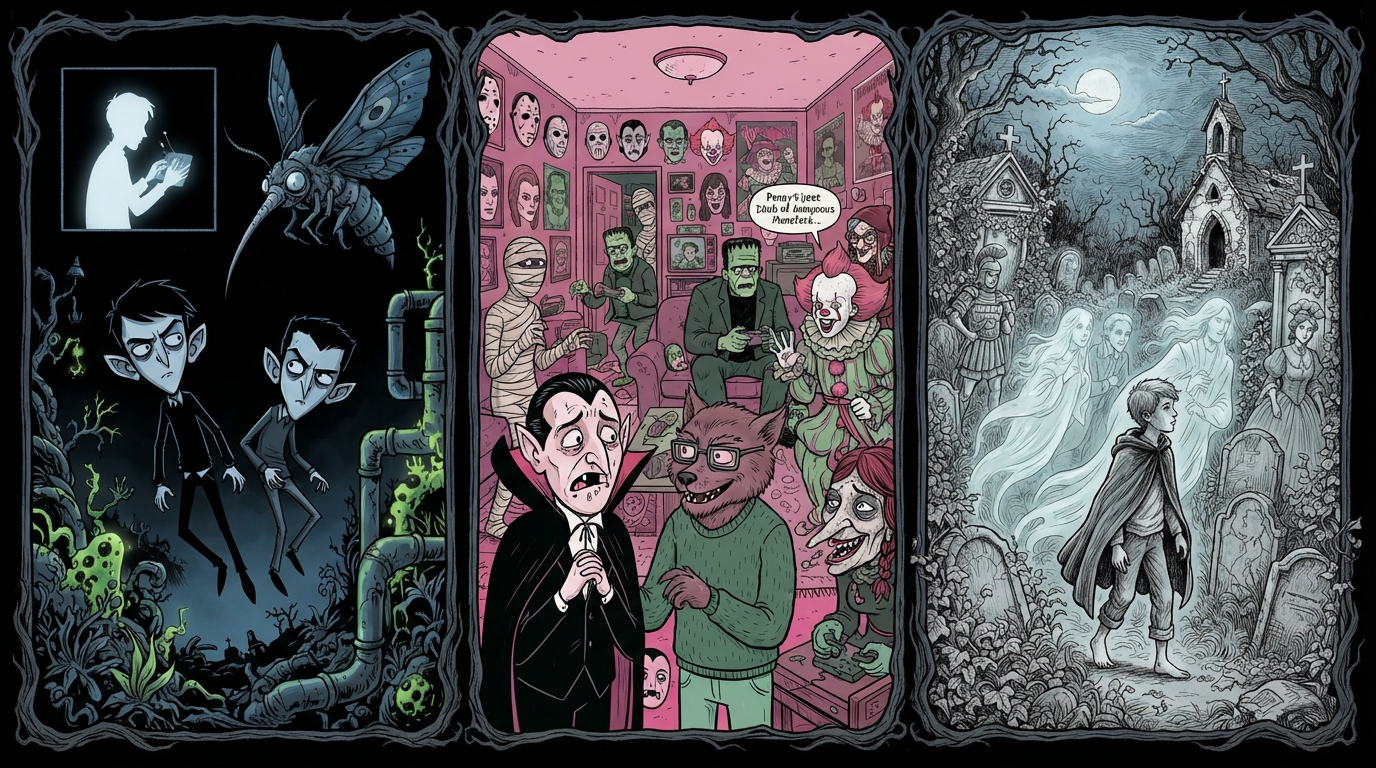
Three Children's Horror Books That Will Give Even Monsters the Creeps
The spine-tingling review begins with the first volume of "The Nightmare Hunters" (Les Chasseurs de Cauchemars), brought to life by a team of three French creators.
The storylines were devised by Franck Thilliez, a professional writer and author of modern psychological thrillers. He infused the story with hallmarks of his adult books: psychological puzzles and scientific experiments.
The artwork was created by comic artist Yomgui Dumont, who previously worked in animation and video games. The coloring was handled by artist Drac. It was she who developed the color palette that heavily influences the comic's atmosphere and mood. And believe us, the colorist's work here is truly noticeable and essential, but we will return to that later.
The book features a fascinating overarching plot. The main characters—ordinary schoolchildren Tristan and Esteban—enter other people's nightmares to uncover their root cause and help patients at a sleep clinic overcome their sleep disorders. Meanwhile, Tristan's father, Professor Angus, is trying to rescue his wife, who is trapped inside the nightmare of one of the clinic's patients. The teenagers assist him, risking their lives every time (which we do not encourage!).
The Russian edition of the first volume includes two stories at once—two dossiers: one on Sarah and one on Nicolas. The subsequent volumes feature other dossiers.
The first story focuses on a girl named Sarah who is haunted by nightmares. The friends enter her dream while she sleeps at the clinic, connected to a monitoring system. But it seems Esteban has met Sarah somewhere before, and the professor is clearly keeping secrets.
The second case involves a patient named Nicolas. Suddenly, the action shifts to 1986, right into Pripyat following the nuclear disaster at the Chernobyl Power Plant. Matters are complicated by a dangerous patient, Léonard, who inflicts insomnia upon himself and pursues his own motives, entering this dream. It is inside his nightmares that Professor Angus's wife is trapped. It turns into a real-world version of Christopher Nolan's "Inception." The comic even contains a segment that uses Russian nesting dolls (matryoshkas) to explain a dream within a dream within a dream within a dream.
The concept of dream-travel is extremely effective: it allows the creators to send the characters to completely different settings every time without worrying about how the main world is constructed.
Moreover, the teenagers have plenty of their own affairs and troubles to deal with—school life, for instance. The authors can invent the most unbelievable dreams, and they will still fit seamlessly into the overall story, offering readers a new plot and a fictional world every time that does not have to obey conventional logic.
Thus, in one dream, enclosed flower-cities appear where giant butterflies suck children in through proboscises as long as gas pipes. In another, the characters must escape a maddened fairy wearing traditional Russian attire with a kokoshnik and teeth down to her knees. She emits radiation and turns people to stone with her gaze—just like that woman with the snake-like hairstyle.
This is arguably the scariest of the three books, largely thanks to the artists.
All the characters—both in the real world and in the imaginary one—look like little freaks, as if specifically prepared for life in a world of nightmares. This is emphasized by literally unnatural appearances: large ears, bulging eyes or, conversely, tiny bead-like ones, and all sorts of nose shapes.
The dramatic plot twists featuring creepy monsters and other narrative reveals are supported by panel layouts that leave readers thoroughly engaged. Colorist Drac separates the world of dreams from reality through color: panels depicting scenes from our world always feature a white background, while nightmares are set against black. This makes it easy to understand exactly where the action is taking place.
The interaction between Professor Angus and the children is also creatively designed. When he speaks to them inside a dream via the sleep-navigator, he is depicted as a white outline against a black background—like a ghost caught between our world and the afterlife.
The sequence of comic panels is interspersed with dossier spreads, which present information about the patients, the mechanics of the world, or how the brain functions during sleep, formatted as classified documents.
Adults who might find the overarching plot too simple will at least enjoy examining the illustrations. Individual scenes are also well worth attention.
A total of four books have already been published in Russian, each containing two stories. The series is ongoing.
We are used to movie and book villains scaring us from laptop screens and thriller pages, but we rarely wonder: is everything alright with them? Maybe the creatures of the night are exhausted and sick of it all? Maybe while terrorizing humans, these fine representatives of the underworld simply cannot sort out their personal lives?
A similar concept was explored in the animated film "Hotel Transylvania," set in Count Dracula's hotel where monsters from around the world come to get away from humans. The comic series "Anonymous Monsters Club" belongs in the same category, offering far more laughs than scares.
The characters in these books are monsters with personal, yet entirely human problems.
They all live in different worlds and eras, visiting our reality for support group meetings where they share their grievances and help one another. Language barriers are no obstacle for them.
In the first volume, we learn how the Club operates. It is a standard apartment featuring a kitchen, a carpeted living room with houseplants, and a bathroom—just like human homes. Behind a curtain lies a rec room where participants of the secret meetings can play board games and video games or read books.
The shelves hold an antique collection of old skulls, preserved freaks, and human heads. Masks hang on the walls, including the one from the movie "Scream," and Geralt of Rivia's silver sword can be found in the weapon collection.
One of the comic's delights is its cultural references, which do not participate in the plot directly.
Readers can hunt for them independently by examining the surroundings.
The basement is used by the meeting organizer to draw a pentagram to summon the Devil himself, who favors dramatic entrances. Incidentally, he is dating a devilishly jealous ancient Egyptian mummy (possibly Cleopatra VII).
The familiar Count Dracula is the first to arrive at the Club and complains about the inconvenient meeting times—they take place during the day. Then it turns out he has lost a fang. For a vampire, this is a true tragedy: he maintains a sharp style and wants to look flawless at all times. And the tooth fell out because he has nowhere to get calcium, since "there's plant-based milk everywhere"—a classic first-world problem for demons.
The girl protagonist from the movie "The Ring" crawls out of a plasma screen, getting tangled in game console cords. Later, it becomes clear that she has trouble making acquaintances. Thanks to the Club, she starts live streaming on the internet using virtual cute waifu avatars to avoid scaring off donors.
One of the funniest characters is Valya the werewolf. He is the "weak link" in his family: both of his parents and brothers are genuine alpha wolves, whereas Valya is a shy, emotional guy with glasses who prefers chihuahuas over Alabais. His unexpected problem is revealed in the second volume, which focuses more on romantic relationships.
The second book begins with a monstrous party where, alongside the characters from the first part, one can spot Pennywise the Clown, the Alien, Pyramid Head, members of the band Slipknot, Pinhead from Hellraiser, Freddy Krueger, and many others—even if only in cameo roles.
Throughout the evening, the characters socialize, meet new figures, and wrap up their story arcs. The Devil introduces the Mummy to his stunning sister, a succubus. Readers find out who has been stalking Valya the werewolf. Baba Yaga drinks a magic potion and steals guys away from modern Instagram witches. In the dialogues, readers will recognize their own relationships and familiar personal struggles.
To be frank, the plot cannot be called extraordinary, but most of the characters' problems will certainly be relatable and understandable to teenagers.
The main thing is that the comic allows for a fresh look at familiar characters while fostering imagination and out-of-the-box thinking.
The monsters' stories were created by artist Glasha Lapteva, a graduate of the HSE Art and Design School. Her drawing style can be described as minimalist and linework-heavy. Angular shapes effectively emphasize our perception of monsters as something unnatural and dangerous.
Both volumes are executed primarily in pink and green tones. This sets a unified visual identity and avoids distractions from complex backgrounds, especially since a single person worked on both parts, whereas full-color comics with intricate plots are often created by entire teams.
Even more importantly, the art style does not hinder the reading experience, as it completely fulfills the main purpose of the comic: using light humor grounded in everyday problems to show monsters as slightly more human than we are used to thinking of them.
The comics are suitable for teenagers aged 12 and up who enjoy horror but are ready to read something out of the ordinary.
Author:
Neil Gaiman
Illustrator:
Chris Riddell
ISBN:
978-5-17-085548-3
"The Graveyard Book" is the most literary and sophisticated title in this selection. It combines elements of a gothic novel and a coming-of-age story. It was written by Neil Gaiman, whom you may know from his novels "American Gods," "Good Omens," "Coraline," and the comic series "The Sandman." Among the top dark fantasy authors, his name stands alongside George R.R. Martin, Glen Cook, Andrzej Sapkowski, and Joe Abercrombie. Unlike his peers, Gaiman also writes books for teenagers.
"The Graveyard Book" was originally conceived as "The Jungle Book set in a graveyard" back in 1985, but was only completed and published in 2008. It earned several prestigious honors, including the Hugo and Locus Awards for Best Novel, as well as the Newbery Medal for distinguished contribution to American children's literature.
Only a tiny boy manages to escape a killer. He reaches an abandoned graveyard, where he is taken in by the Owens family of ghosts. The boy is named Nobody Owens, or Bod for short.
Bod grows up among tombstones, the ruins of an old church, family crypts, and even an Egyptian avenue featuring structures styled after pharaonic tombs. He is primarily raised by his guardian, Silas, a mysterious figure who is likely a vampire. Since ghosts cannot leave the graveyard grounds and are physically incapable of feeding or clothing a child, Silas assumes these duties. He brings Bod food, clothes, and books from the world of the living—the boy learned to read from the inscriptions on headstones.
Bod's neighbors are the spirits of long-deceased people from various eras. Each ghost retains memories of their life and the specifics of the time in which they lived and died. Liza, a witch whom the boy befriends, was buried 500 years ago without a headstone on unconsecrated ground. The Roman legionnaire Gaius Pompeius, one of the oldest spirits, found his rest here back during his military service. Thus, the graveyard becomes a sort of history museum staffed by curators who can share what they witnessed firsthand.
Thanks to his status among the graveyard's inhabitants, Bod masters useful ghostly abilities such as passing through walls, invisibility, and entering other people's dreams.
The boy spends most of his childhood inside the graveyard fence because all this time, a man named Jack is hunting him—or rather, simply waiting for him to appear somewhere. Even here, where living people rarely venture, he befriends a girl named Scarlett. Many years later, she returns to the town as an adult.
Bod grows up as well, and as he matures, various events unfold. At one point, he falls into the clutches of ghouls, from whom he is rescued by his disliked teacher, Miss Lupescu. Another time, he ventures onto forbidden ground and encounters the witch Liza. Finally, he tries attending a regular school—only to bring more trouble upon himself (no surprise there). Throughout the book, the threat of the return of the man named Jack persists, and he will not keep readers waiting long.
Despite the abundance of supernatural elements, the mysteries of the old cemetery, and the overall gothic mood, the book contains plenty of dark humor, and the horror is delivered in measured doses. That is to say, it is unlikely to terrify a child who is no longer frightened by dead bodies, ghosts, ghouls, or witches.
However, it is worth noting that death is brought up here more often than we, the living, might prefer.
At times, one feels a strong urge to quote the story line by line—primarily thanks to the deceased characters, who share their wisdom from the perspective of those who no longer need to fear death. They are allowed to say things that the living would not appreciate hearing from one another.
Gaiman strives to guide his protagonist out into real life, teaching him to treasure it, because the time of the graveyard's residents has passed, whereas the living boy still has a chance to live a full and interesting life.
"They are dead. And they have done with the world. You're not. You're alive, Bod. That means you have infinite potential. You can do anything, make anything, dream anything. If you change the world, the world will change. Potential. Once you're dead, it's done. Over."
— from "The Graveyard Book."
As you read, you become so accustomed to conversations about when someone died that while you might not stop fearing it altogether, you certainly come to view the somber atmosphere of cemeteries more calmly. They begin to feel almost like small parks for walking.
This trial encounter with ghosts—who, despite their incorporeal form, retain human struggles—seems to accustom the reader to the idea that they definitely do not exist and cannot exist.
One less fear to worry about.
The book was illustrated by Chris Riddell. He is a three-time recipient of the prestigious Kate Greenaway Medal for achievements in book illustration. His style complements the story of a ghost world perfectly.
All the characters are elongated like the pointed arches of gothic cathedrals and covered in clusters of small, sinister eyes. Hands, legs, and fingers are gnarled, bent, and sticking out like spider legs. The characters—even the positive ones—resemble wax figures from a cabinet of curiosities, as though constructed entirely of bones, as if the graveyard world spawns all its inhabitants with this distinct appearance.
The only thing I missed in Gaiman's book was a map of the cemetery to understand who was going where. AI could draw one—all it takes is asking politely.
If your children have already read something about cemeteries, murders, vampires, ghosts, and the afterlife and are generally doing fine, then this book can be recommended for independent reading from age 12.
If life circumstances have not yet led them to such topics, our reviews feature plenty of other great books.