

Three children's detective stories that grip you from the very first page
Preparing another review of modern children's literature required the designer and reading father Azamat Shamuzafarov to demonstrate the skills of a real detective. He found three books to introduce the genre. In one, the investigation leads to 18th-century Versailles, in another, a little sleuth faces a zombie, and in the third, readers themselves learn to inspect crime scenes and search for evidence so that no case remains unsolved.
Three children's detective stories that grip you from the first page
Annie Jay is a French writer who became famous for her historical novels for adults and children. Many of her books are set in the 18th century. This story is dedicated to Elisabeth, sister of the French King Louis XVI (his great-great-grandfather was the famous Sun King, Louis XIV), and her friendship with Angélique, daughter of the assistant governess, Madame de Mackau. All the main characters in the book really existed, but Annie Jay invented their childhood.
Elisabeth of Versailles, like many princesses, was prepared for a dynastic marriage and raised in strict traditions. At the age of two, she lost her parents, and Madame de Mackau took care of her. Elisabeth grew up deeply religious and stayed away from politics. During the French Revolution, at 30 years old, she was executed on the guillotine because of her relation to the king.
The series "Elisabeth, Princess of Versailles" focuses solely on the protagonist's childhood and her adventures in the Palace of Versailles. Our review focuses on the first book, "The Secret of the Music Box". The second part has also been published in Russian. In total, more than 30 volumes have already been published in France.
Elisabeth lives like a real princess. But, as often happens, royal conditions turn out to be a "gilded cage". Everything changes when the girl gets a friend—Angélique. The tandem is complemented by Theo, a loyal young page who helps the girls. It is with him that the detective story begins.
In her childhood, Elisabeth was quite a troublemaker: she didn't want to study, loved to ride horses, and hide around the palace. Over time, under the influence of Madame de Mackau and her older sister Clotilde, she changed a lot. Angélique, on the contrary, was used to behaving exemplarily and dreamed of a good education, so she often became the opposite of her friend's stubborn and willful character.
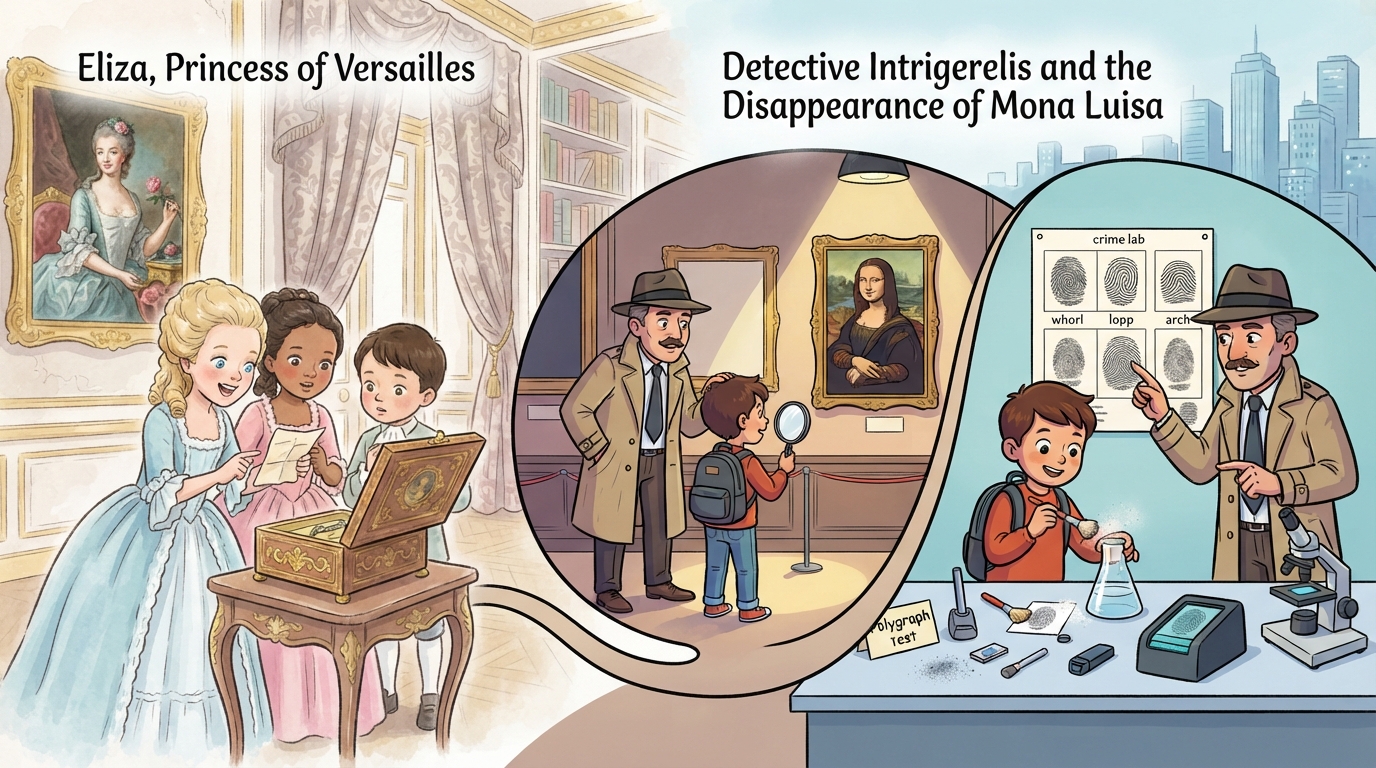
One day, the girls find a mysterious note with a secret inside a music box. Having started an investigation, they learn about the painting "The Lady with the Rose", which belonged to Theo's grandfather. He did not share the inheritance with his brother and hid the painting, leaving clues in the box on where to find it. The adventures begin!
I understood how to read the note by the second sentence, but the code of the message itself turned out to be much more interesting. The author successfully maintains a balance between the complexity and simplicity of the riddles.
Step by step, the characters move toward the solution, and the answer does not arise suddenly or by chance.
Therefore, the reader has time to think for themselves. And children will be able to use some of the clues even after reading, playing detectives—a great solution for a book of this genre.
The story is not limited to the investigation alone. From Elisabeth's adventures, readers will learn more about the court life of France at that time, and this is one of the book's advantages. Annie Jay knows the subject well and adheres to historicity as much as possible in describing the environment, relationships, and characters. However, it is important to remember: real historical figures and details in the book coexist with fictional events.
The Russian edition uses original illustrations by Ariane Delrieu. She lives in Normandy, graduated from art school in Caen, and received a master's degree in literature—who better than her to illustrate books? Delrieu has illustrated dozens of volumes in the Elisabeth series. To some, her drawings with soft, lively lines might recall Japanese kawaii.
There are many illustrations in the book. On the first pages, portraits of key characters with brief descriptions are collected to make it easier for the reader to navigate them. At the end, there are interesting facts about life at that time. This volume, for example, tells about the hairstyles of the Louis XVI era.
All the characters are charming in their own way. Even when they are angry, they look rather funny. Soft watercolor and pastel colors refer to Rococo painting—the style of the era in which the story takes place.
Until the last page, I was unable to solve the secret of the music box. Largely because the solution, apparently, will be in the continuation of the story—in the second book.
If you like the characters and the atmosphere of monarchical life, you can take both volumes right away.
They can be recommended for readers aged 10–11—roughly the age of the main character.
Therefore, for independent reading, I would advise the comic book to children from eight years old.
While the first book in the review told about a princess from the distant 18th century, and the second immersed us in a fantasy detective story in a comic format, the third—"Detective Intrigulis and the Disappearance of Mona Louisa"—is the most unusual. This is not only a story about a missing painting, but also a small children's non-fiction about the work of detectives. Readers will meet another investigator of intricate cases and learn many secrets of criminal detection.
The book has three authors at once, and this is a rare case where a popular science book was not written by journalists.
Amaicha Depino and Carla Baradés worked on the text. Both are scientists. Carla founded a children's publishing house in Argentina to publish such unusual non-fiction books. Argentine illustrator Fabián Mezquita, who promotes children's and YA comics, was responsible for the graphic part of the story.
The painting "Mona Louisa" disappears from a mansion. Private detective Intrigulis and his grandson begin an investigation. They act by the book: inspect the crime scene, look for evidence, question suspects, test theories, and draw conclusions.
The grandfather plays the role of an experienced professional who can be tough if needed. He wears a mustache and a cloak. The grandson, as it were, takes the side of the reader and guides us through the plot: he asks questions that a child might have while reading the comic. The story of the painting's theft is short, but it is divided into several parts, between which commentary appears.
The entire plot is built to tell children about the structure of forensics.
At each stage of the investigation, popular science explanations appear, introducing the reader in more detail to the work of detectives.
This is the strongest part of the book. You will learn what a crime scene is, what you need to pay attention to, what cannot be done, and how you should behave.
As the investigation progresses, Intrigulis discovers fingerprints on the wall next to where the painting hung. Here, the book explains what fingerprints are, what types exist, how they are formed, why every person's are different, and how they are lifted from different surfaces.
The next stage of the investigation is questioning witnesses and suspects. Here, the reader will learn about the lie detector, whether the testimony of suspects can be trusted, and whether the court accepts polygraph results. It even covers the so-called "truth serum" used by special services during interrogations. Interestingly, in reality, it turned out to be one of the anesthetics, under the influence of which a person relaxes so much that they lose the will to resist.
I won't tell you everything, but I will note that since the plot of the comic involves the theft of a painting whose title explicitly refers to Leonardo da Vinci's masterpiece, the authors added spreads about art theft to the general information about forensics. Children will learn how the "Mona Lisa" was stolen from the Louvre in 1911 and get acquainted with the methods used by art historians, restorers, and forensic experts to establish the authenticity of paintings and investigate their thefts. The book also tells about the search for criminals through Interpol.
Finally, the authors invite readers to play detective themselves: learn how to lift and distinguish fingerprints, question suspects, and so on.
If a child had little interest in stories about crimes and solving them before, after reading the book, they will certainly want more.
The book reminded me of a literature tutor who instilled a love of reading in me. She simply told us what awaited us in the work, and that was enough to spark interest. At school, however, we started reading because we had to, because it was a great work in front of us. And if we had heard its "trailer" first, perhaps we wouldn't have had to hammer the image of a "ray of light in the kingdom of darkness" into children.
"Intrigulis" is suitable for independent reading for children aged 10–12—both boys and girls.