

Three books for teens that talk honestly about school and growing up
School is a place where you feel most acutely what it's like to be different. Literature has often addressed this experience—just think of "The Catcher in the Rye" or "Scarecrow." Before the start of the school year, designer and reading father Azamat Shamuzafarov selected three lesser-known books that will make you laugh, touch a nerve, and provide an opportunity to talk to your teenager on an equal basis.
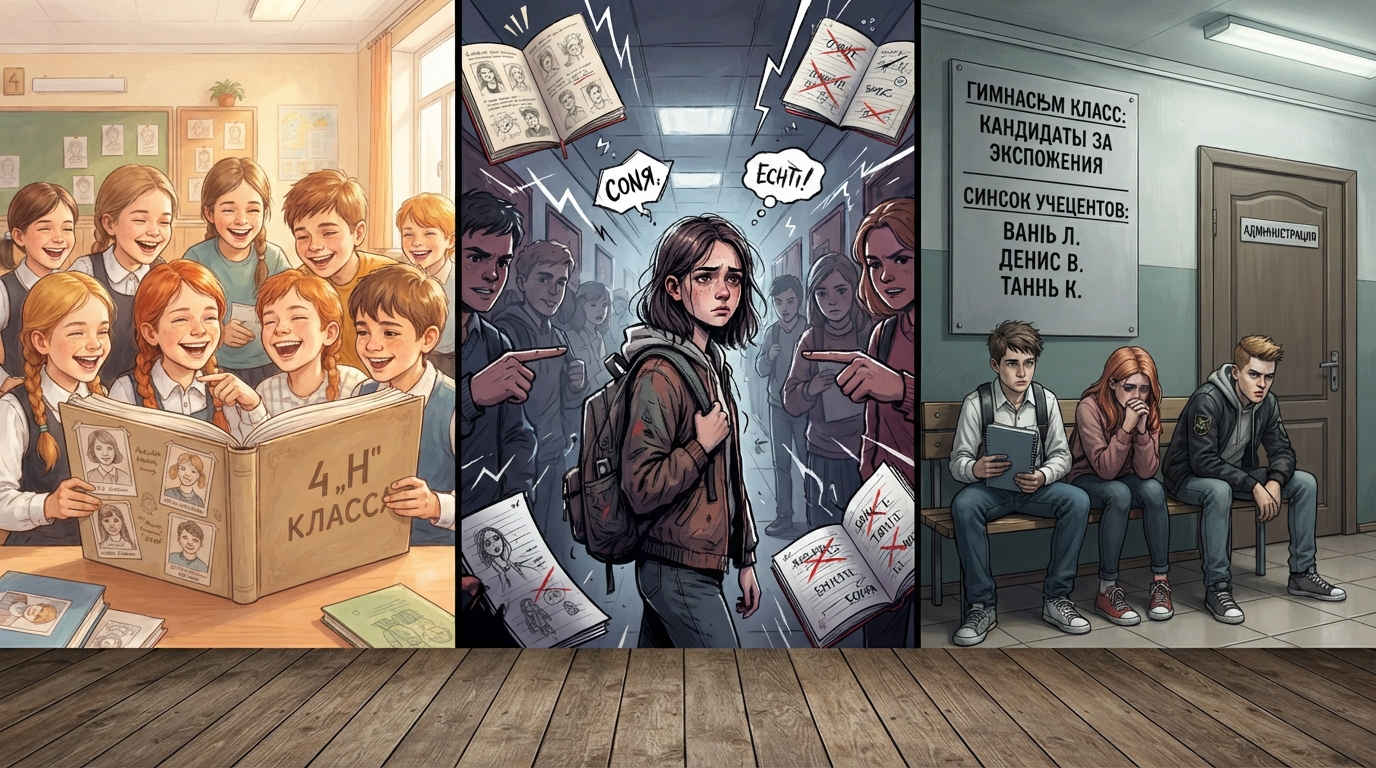
Three books for teenagers that frankly talk about school and growing up
**Victoria Lederman**
**Polina Erofeeva**
**ISBN: 978-5-907957-57-2**
Victoria Lederman's books for elementary school children are often compared to the works of Viktor Dragunsky or Nikolai Nosov due to their harmless and childish humor. This easy-to-read book, once again presented in 13 stories, tells the story of students in Grade 4H of a regular school. The neutrality of the events makes the book timeless, which is one of its advantages: it will not become outdated and will be relevant to children in any country.
When students perform well, their "scientific" class is called "resourceful," "reliable," or "cheerful." However, as soon as they relax, the class immediately becomes "restless," "disobedient," and "inattentive." Notice how all the character descriptions begin with the letter "N"? And that's not all – the title of each story also begins with "N." For example, "Prick Up Your Ears and Listen Up!", "Unsportsmanlike Conduct," or "Real Winners." This can be a bit tedious, but overall, it's not a deal-breaker.
In one story, two friends who disrupt a young teacher's lesson find themselves in her shoes and experience the difficulties of school firsthand. It gets to the point where they themselves begin to criticize their classmates.
In another story, a father challenges his son to a bet: tell the truth all day, as the child doesn't yet understand the complexities of social relations. Of course, the son loses, and the father (not being a fool) tells their mother early in the morning that her new hairstyle really suits her.
There are many such stories, and they are all easy to read. The stories are short, the font is large – for a child who doesn't particularly enjoy spending time with books, this format can be an excellent introduction to reading. You can devour this collection in one sitting and feel like a true genius.
At the very beginning of the book, a "school album" is presented with portraits of all the students and key teachers, making it easy for children to keep track of who is being discussed in each story.
Almost all the stories have a moral, but it's kind and not preachy, more of a suggestive one.
Polina Erofeeva's illustrations maintain a lighthearted mood, but nothing more. A second edition was recently published, and the illustrations seem more interesting, but overall, they're not surprising—they do exactly what they're supposed to.
For example, in my opinion, the children are too similar to each other—all moderately cute. We've encountered similar flaws in our other reviews, but don't let them put you off. This is still an easy read for children aged 8-10, with funny school stories.
So, what makes this book good for parents? Lederman writes about school without adult arrogance – her characters are real, with their own blunders and tricks, in which children easily recognize themselves and their classmates. This makes the stories easy to read together: almost every story is a ready-made opportunity to discuss something important with children, but without lecturing.
The book asks questions about school life and friendship between the lines, leaving the reader to draw their own conclusions.
If your child develops a love for the characters, Lederman has a sequel. The books "Stories from the Back of the Classroom," "Vasilkin... Is Coming to the Blackboard!" and "No Lessons!" are also about school life and friendship and are no less excellent.
**Alexey Oleynikov**
**Timofey Yarzhombek**
**ISBN: 978-5-00114-495-3**
"Sonya from 7 'Bue'" is a rare case where a teenager is given the opportunity to express themselves, without adult translation. Alexey Oleynikov is not only a poet but also a school teacher, so he's well-versed in the subject. His book speaks from the perspective of a child already beset by problems that seem almost adult.
It's a rap comic: the poetic form is picked up by images that convey what words can't.
Books usually have a plot, but this one is more of a monologue. It's a teenager's frank account of her problems at school. Sonya shares what she sees around her, what hurts her, what perplexes her, and what reassures her.
The book is divided into chapters, each tied to a school lesson: geography, literature, or physical education.
Only instead of lesson notes, it features the feelings and emotions swirling within a teenager.
Interestingly, these feelings are shared by both boys and girls and generally don't reflect the typical difficulties of one gender. These feelings will resonate with everyone, even some adults.
Oleynikov understands how teenagers really talk, not how they're portrayed in "proper" children's books. While the comics are largely free of the latest trends, jargon, or Americanisms, the overall tone—"everything's wrong and everything's not right"—will be familiar to children, and perhaps even to you if you experienced something similar in middle school.
The book's main theme is bullying.
It's about what it's like to be different and not understand why you're being punished for it. At the same time, the heroine isn't a cornered victim, but rather a misunderstood and unheard living being. She holds on and searches for a way out, speaking out about what's going on in her head. Sometimes, it feels like a cry for help. I would recommend this book not only to teenagers but also to their parents or guardians.
*Or you can intervene, disrupt the hunt,*
*Tear the prey from its clutches at the turn,*
*Catch someone in the pack with a word –*
*And you're next, be ready.*
The illustrations here don't simply decorate the book, as is often the case. They are no less significant than the text, because they don't simply depict what is said literally, but rather convey it as the author—illustrator Timofey Yarzhombek, curator of the Illustration and Animation program at the HSE School of Design—sees it.
Notice how the pictures support the rhythm of the poems.
The unusual, jagged form conveys a believable sense of a teenager's inner monologue.
This monologue should be read aloud in class against the backdrop of changing illustrations projected by a projector.
By the way, the book is suitable for teenagers who "don't want to read anything." It addresses real-life children's problems in a language they understand, and it's full of funny and dramatic illustrations. And if you're interested, there's a sequel, "Sonya-9," where the heroine is older.
**Larisa Romanovskaya**
**ISBN: 978-5-907180-44-4**
Michel Foucault described school as being on par with prison and barracks. In both, a person is molded into an obedient citizen. School constantly compares students to the norm—through grades and exams. It divides them into "good" and "bad," "capable" and "underachievers." The good are rewarded, the bad are punished. The system makes it clear how to behave so as not to get into trouble. This is how the standard of a "normal" student is created.
In "Candidates for Rejection," school is a "storage room," as one of the characters says.
Here, every day, you are weighed on the scales: fit or unfit, passed or failed. "We study equations at school. Here, we are equalized." "Everyone with everyone," adds another. It becomes clear that this won't be an easy ride.
In the gymnasium class, they announced who is at risk of being expelled next year:
Vanya L., Denis V., Tanya K.
Now the heroes must grapple with a much more difficult question: what is important in this life, and what is not.
Gymnasium classes were invented to avoid egalitarianism, to avoid molding all children into the same. It turns out that now it is the "gymnasium students" who are supposed to be the same.
The book is structured as first-person stories from the main characters. We seem to move between them, seeing events from their perspectives. Each character shares their perspective on the issue, so some may find the beginning of the book a bit challenging due to the rush of thoughts.
Tanya had a fight with her friend and her missing father. She spends the entire book immersed in this thought: she's worried about her relationship, and now there's school!
Denis lives with his devout mother, and now he shares a roof over his head with a new neighbor.
Vanya is the strangest of the bunch, an outcast, and no one accepts him. His favorite part is going to a literary club, where he writes plays.
A special class of gifted children avoids contact with the most talented of them. His problems stem from the depths of his upbringing, which his mother, who herself experienced, seems to have passed on this fear to her children.
The sentences are generally short, like gunshots. Thoughts jump from one to the next. After just a couple of pages, you'll get used to it and be floating from Tanya to Denis, from him to Vanya, to Kirill, to Anna, to Arina, and the other characters. The book features classmates, parents, teachers, and a typical head teacher with the characteristic last name of Serova.
While Lederman's book is funny and tells the story of a "normal" school, and the rap comic screams about one cog in the school system, Romanovskaya speaks to teenagers almost harshly, and this is the main difference in "Candidates."
Here, school is shown from its uncomfortable, oppressive side, where the organization lumps everyone together, and lively, "uneven" kids don't fit in.
This is partly why reviews of the book vary. Some believe it's interesting for both children and adults because it addresses important issues. Others are convinced the author is being depressing and that sixth-graders don't think that way. It's probably best to ask the teenagers themselves. Some will be touched by the book, while others will be left out.
There are almost no illustrations. The edition is modest: a softcover with yellowed pages—I like that kind of thing because you can feel the texture, but most consider the paper to be second-rate.
This is a story for reading; you won't be tempted by pictures—it's for "grown-ups."
But after reading, you'll have something to discuss—real conversation. It was written for this very reason.
The 12+ rating accurately reflects the content. Around this age, children strive to be different from others, to express their individuality, and it's precisely this "abnormal" behavior that creates problems at school. Therefore, the book's theme will be understandable to a child of around this age, but not earlier.