

World Literature: 20 Books You Should Read at Least Once in Your Life (Part III)
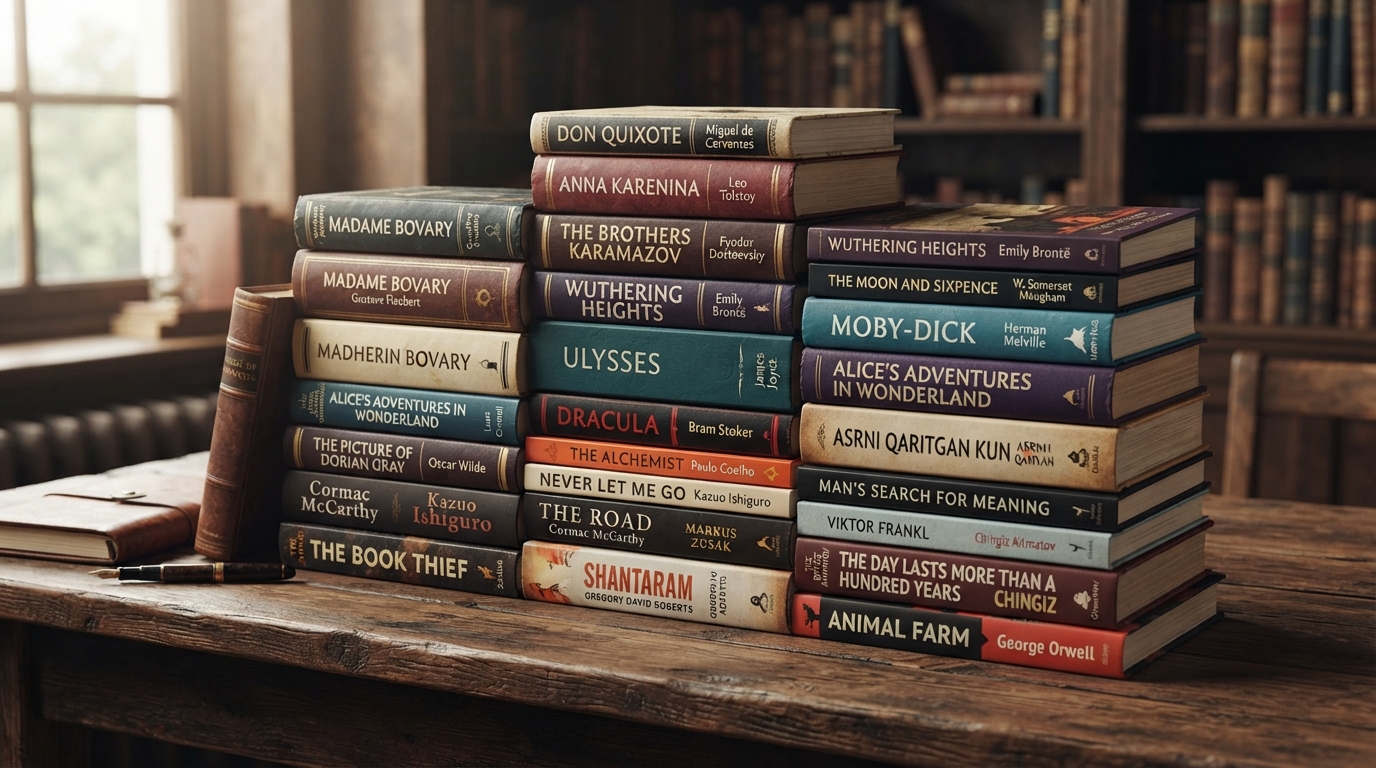
**World Literature: 20 Books You Should Read at Least Once in Your Lifetime (Part III)**
World literature is home to dozens of works that have had a profound impact on culture, shaped entire literary trends, and are still finding new readers. In the previous two parts of the collection, we collected 40 books that are a must-read. The third part contains 20 more works that are worth adding to your reading list.
**World Literature: 20 Books Everyone Should Read at Least Once in Their Lifetime (Part I)**
**“Don Quixote” by Miguel de Cervantes**
This novel about the adventures of a knight and his faithful companion Sancho Panza is at the same time a parody of chivalric tales, and a profound reflection on dreams, reality, and the human imagination.
**Anna Karenina by Leo Tolstoy**
This novel about love, family, and social prejudices remains one of the most famous works about human choice and the search for happiness through the tragedy of Anna Karenina.
**The Brothers Karamazov by Fyodor Dostoevsky**
A philosophical novel about faith, freedom, responsibility, and the complex relationships between family members.
**Madame Bovary by Gustave Flaubert**
A story about Emma Bovary, who dreams of great love and a beautiful life, but is disappointed in reality.
**Wuthering Heights by Emily Bronte**
A sad story about love, passion, revenge, and destructive human emotions that has become a classic of English literature.
**The Moon and the Child by William Somerset Maugham**
A novel about betrayal, crisis in relationships, and the inner rise of a person who learns to take responsibility for his own decisions.
**Moby Dick or the White Whale — Herman Melville**
A sweeping tale of Captain Ahab, obsessed with revenge on a great white whale. The adventure unfolds as a meditation on temptation, fate, and human nature.
**Ulysses — James Joyce**
One of the seminal novels of modernism, it tells the story of a single day in the life of a Dubliner. The book is known for its unusual structure and experiments with language.
**Little Ladies — Louisa May Alcott**
A story about four sisters who grow up and dream of a future, experiencing love, loss, and the trials of life.
**Alice in Wonderland — Lewis Carroll**
A popular tale about a girl who finds herself in a world where the usual laws of logic do not work. The book is still interesting for readers of all ages.
**The Picture of Dorian Gray — Oscar Wilde**
A story about a young man who retains his outward youth because his portrait is aging instead of him. The novel explores beauty, morality, desires, and the consequences of choice.
**Dracula — Bram Stoker**
A novel that shaped the modern image of the vampire in popular culture. The story of Count Dracula combines mysticism, Gothic atmosphere, and the struggle of man against the unknown.
**The Alchemist — Paulo Coelho**
A philosophical story about the shepherd Santiago, who sets out in search of treasure. The novel talks about dreams, destiny, and the courage to follow your own path.
**Never Let Me Go — Kazuo Ishiguro**
A dystopian novel about three friends who gradually learn the truth about their fates. The book makes you think about humanity, love, memory, and freedom.
**The Road by Cormac McCarthy**
A story of a father and son trying to survive in a broken world. A heartbreaking novel about love, hope, and maintaining humanity in the face of disaster.
**The Book Thief by Markus Zusak**
A story about Liesel, a girl who lives in Germany during World War II and is saved by books. The novel tells the story of the power of words, friendship, and humanity.
**Shantaram by Gregory David Roberts**
An adventure novel about a man who escapes from an Australian prison and ends up in India. The work combines travel, friendship, love, crime, and self-awareness.
**Man's Search for Meaning by Viktor Frankl**
A book that combines the author's memoirs and his reflections on the human psyche. The main theme is the ability of a person to find meaning and maintain inner freedom even in the most difficult circumstances.
**“The Day That Made a Century Old” — Chingiz Aitmatov**
Chingiz Aitmatov’s famous novel tells the story of human memory, loyalty, and the meaning of life. The work depicts a railway worker named Edigey’s long journey to bury his friend Kazangap and his recollection of past events in the process. The novel highlights the conflicts between humanity, national values, historical memory, and modern development.
**“The Barn” — George Orwell**
George Orwell’s famous allegorical work about society, power, and political systems. In it, animals rebel against their master and try to build a new life based on equality, but the pigs who seize power gradually become the very tyrants they oppose. The work shows the danger of power corrupting people and using false propaganda and slogans of equality to control the people.
**World Classics: Books You Should Read at Least Once in Your Lifetime (Part II)**