

“This is our second home.” How the only Pantomime and Sign Language Theater in Uzbekistan works
In Uzbekistan, few people, even in the capital, know about the unique Mime and Gesture Theatre. Here, deaf and hard-of-hearing actors perform roles in sign language, while an interpreter voices the plays for hearing audience members. Due to a lack of funding, the troupe produces a new play only once a year and rarely goes on tour, yet they continue to work. Gazeta tells the story of this unique theatre.
“This is our second home.” How the only Mime and Sign Language Theatre in Uzbekistan operates
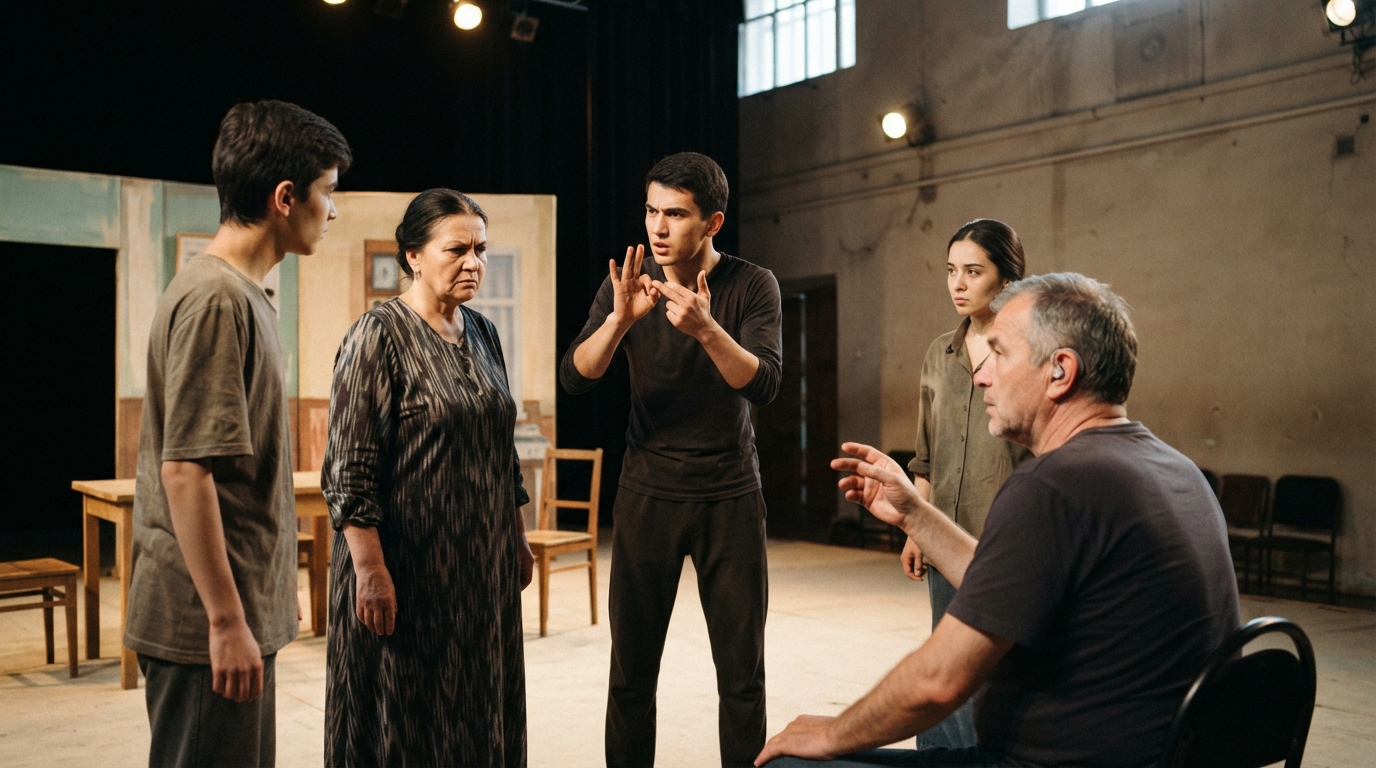
The Uzbekistan Mime and Sign Language Theatre is the only such venue in the country. Currently, rehearsals are underway here for the play “Ko‘z yoshlar” (Tears), based on a script written by the troupe. The team is preparing for the International Week of the Deaf, which will be held from September 21 to September 27.
The actors are practicing the most emotional part of the play — the final scene. The main character, Asad, reunites with his family after a long separation. Addressing his aunt in sign language, who had previously opposed his marriage to Oygul, the young man shows that the woman was mistaken — now he is together with his beloved and happy.
Director Oleg Oshepkov stops the rehearsal, demonstrates the required movement, and asks to run the scene again. The participants return to their previous positions, observing the signs and facial expressions of their partners, waiting for their turn.
Beside them is sign language interpreter Kamila Yakubjanova. She helps in preparing the plays, and during our meeting, she facilitates communication with the actors, translating questions and answers — the troupe consists of deaf and hard-of-hearing individuals.
In 1973, the Republican Palace of Culture was opened under the Society of the Deaf of Uzbekistan. Because a sports complex, a dormitory, and residential buildings for the society's members were located around it, this part of the Olmazor district was called the “town of the deaf.”
For many years, the palace served as a gathering hub for deaf and hard-of-hearing residents of Tashkent — they came here for plays, concerts, and film screenings. In 2001, it was transformed into the Cultural Center of the Deaf and Deaf-Blind. Today, the Mime and Sign Language Theatre, established by the Central Board of the Society of the Deaf of Uzbekistan, operates under it.
This is the only troupe in the country that performs in sign language.
The theatre is located in an inconspicuous two-story building on Qorasaroy Street. Inside, there is a large hall designed for 400 spectators, a dance studio, a library, a costume room, and a workshop for making decorations. Photos from plays and tours of various years hang on the walls of the foyer, reflecting the history of the team.
Deputy Director Oleg Oshepkov’s almost entire life is connected with the theatre. He is hard of hearing but has verbal speech. He first stepped onto this stage in 1991 — while still a school student — as part of the dance group of specialized boarding school No. 102 for deaf and hard-of-hearing children.
“I liked going on stage, taking on different personas, and conveying feelings through signs and facial expressions. I was especially inspired by the reaction of the hall: the audience smiled, laughed, applauded, and I saw that our performance evoked a vivid impression in them.
It was then that I realized I wanted to connect my life with the stage,”
Oshepkov recalls.
After finishing school, he entered the Tashkent Variety and Circus College, then continued his studies at the Uzbekistan State Institute of Arts and Culture. After receiving his diploma, Oleg Oshepkov returned to the theatre dear to him as an actor. After 25 years of performing on stage, he took the position of deputy director.
Oleg Oshepkov.
Now Oshepkov stages plays and dance performances, selects music, and supervises lighting and costume preparation. When necessary, he also participates in plays, although recently he prefers to hand over roles to others and stay behind the scenes. The director explains this wide range of duties by the theatre's modest staff and limited budget.
“Our actors work both on stage and behind the scenes. The theatre does not have a separate technical team, so we distribute duties among ourselves: while some play roles, others manage the curtain, change decorations, and control the lighting. Everyone must help each other,” Oshepkov explains.
The troupe gathers for rehearsals after six or seven in the evening. As the premiere approaches, the involved actors stay at the theatre until late — they run through the play completely several times, checking costumes, props, lighting, and sound design. They are united not only by work but also by the leisure time spent within these walls.
“Sometimes we sit until night, talking, exchanging ideas, playing games, and supporting each other in every way.
Spiritually close people are gathered here. This is our second home,”
says Oleg Oshepkov.
The theatre tries to release one new play a year. Preparation takes several months and begins with discussing an idea — this could be prompted by a movie, a book, or a real-life event. Oleg Oshepkov, together with the troupe, invents scenes, character traits, and distributes roles.
After that, the team analyzes the script together with sign language interpreter Kamila Yakubjanova.
Lines cannot be translated literally into sign language — the same sign can mean different things, and the choice depends on the context.
Therefore, Oshepkov and Yakubjanova first determine the meaning of each line, then select specific sign phrases and explain them to the actors. In rehearsals, not only signs are practiced, but also the facial expressions, body language, and interactions of the characters.
At the same time, voiceover is prepared for the hearing audience. Previously, lines were pre-recorded, but the phonogram could fail to match the pace of the play due to even a slight delay or pause. Therefore, now the interpreter voices the text aloud, adapting to the actors on stage.
The team works separately on music and dance numbers. The music is played with strong bass — so that deaf and hard-of-hearing actors and spectators can feel the rhythm through vibration. Video cues are used to enter the stage on time and keep to the beat: while previously the choreographer counted from the front rows, now their movements are transmitted to monitors in front of the stage.
Over the past five years, the repertoire has featured the comedies “Family Traditions of Uzbekistan,” “Searching for a Person,” “Three Uzbek Women Meet the Stars,” “21st Century: Cinderella and the Caucasian Captives,” as well as the first drama “Ko‘z yoshlar,” which required special emotional depth from the actors. They had to convey the complex experiences of the characters — pain, anxiety, and inner doubts — through signs and facial expressions.
The theatre presents an average of four to five major performances a year on the occasion of state holidays and the International Week of the Deaf. Sometimes the artists also prepare chamber programs for the elderly visitors of the center.
Each play is performed only a few times: due to changes in the cast, it is difficult to return to the old repertoire — roles have to be redistributed and learned again.
In 2021, the theatre participated for the first time in the “Gesture Territory” (“Территория жеста”) festival in Moscow, presenting the comedy “Family Traditions of Uzbekistan” and a program of national and modern dances. The team took first place. Later, the actors also successfully participated in festivals in Moscow, Lipetsk, and St. Petersburg. And in 2024, on the occasion of the 95th anniversary of the Society of the Deaf of Uzbekistan, the troupe went on a large-scale tour across all regions of the country.
The play “Family Traditions of Uzbekistan.” From the theatre archive.
There are 15 people in the permanent troupe. Not everyone has a professional acting education: some work part-time on the staff, some came as volunteers, and many combine the stage with their main job.
The path to the stage is different for everyone. Aleksandra Krivousova was 12 years old when she first came to the theatre in 2003 with an elderly deaf neighbor who attended pensioner meetings. She was amazed to see so many people gathering at the center to talk and spend time together.
Aleksandra Krivousova. Photo: Yevgeniy Sorochin / Gazeta
Later, Aleksandra enrolled in Oleg Oshepkov’s dance club at specialized boarding school No. 102 for deaf and hard-of-hearing children. When she learned that he was inviting students to the theatre, she decided to try her hand.
Her debut on the big stage took place at the age of 13 — the girl danced energetically to a song from Filipp Kirkorov’s repertoire, translating the lyrics into sign language. Before the performance, Aleksandra says, her heart was beating fast and anxiety took over, but once she stepped onto the stage, the nervousness disappeared. The hall welcomed the girl with applause, and since then she dreamed of performing in front of the audience again and again.
At the Mime and Sign Language Theatre, Aleksandra Krivousova’s career began with dance numbers. She started performing roles in plays later. The 35-year-old actress has no specialized education — Oleg Oshepkov and her colleagues in the troupe, whom she observed during rehearsals, helped her master and learn the roles.
Aleksandra often plays in comedies. One of her favorite works was the play “Three Uzbek Women Meet the Stars.” She played one of three friends who came from the countryside and saw celebrities up close for the first time. In the drama “Ko‘z yoshlar,” Krivousova got an unusual role — the image of an evil and dominant woman. Trying to feel her character's personality, the actress re-watched movies featuring similar characters and adopted their facial expressions, gaze, and gestures. After the premiere, Aleksandra asked the audience for their impressions. Hearing that her character had aroused their anger, she realized that the image was successful, even though it was completely opposite to her true self.
In everyday life, Aleksandra works as a cleaner in a dental clinic — the income she earns from the stage is not enough to support her son. At the clinic, they know about her interest in the theatre and allow her to go to rehearsals, and they come to her plays with flowers. Krivousova dreams of receiving a professional acting education, developing in her profession, and gaining wide recognition from the audience.
Another actor of the theatre, Abbos Yuldashev, joined the troupe recently. He spent several years behind the scenes: first he helped set up the lights, then he filmed concerts and plays. During this time, he became friends with the team, often came to performances, and stayed to talk with the artists, although he did not plan to go on stage himself.
During the preparation of the drama “Ko‘z yoshlar,” the team faced a shortage of actors and offered one of the roles to Abbos. At first he refused — he was afraid of what his acquaintances would say, but over time he decided to try anyway and came to the rehearsal.
Abbos Yuldashev.
Since Abbos grew up in an Uzbek-speaking family, reading the script in Russian was not easy for him. Interpreter Kamila Yakubjanova analyzed the scenes with him in sign language, and he recorded the explanations on his phone to remember the sequence of lines and actions, and re-watched the videos at home. At first, communicating with partners was also difficult, but the troupe supported him and helped him believe in himself. Over time, Abbos got into the role and began to behave completely freely on stage.
Yuldashev’s acting debut took place in May of this year. He played Asad — a kind, well-mannered, and confident young man from a wealthy family, who was ready to fight against his parents' opinion for his love for a girl named Oygul. After the play, spectators came up to Abbos to take pictures, and his acquaintances sent him videos featuring scenes from the performance. He admits that such attention was unusual for him.
Outside the theatre, Abbos works as a taxi driver and is able to adjust his work schedule to rehearsals. He says he does not plan to become a professional actor for now.
He admits that he came to the theatre primarily to communicate, finding a circle of people where he feels free, learns new words, and tries things he has never done before.
For now, few people even in Tashkent know about the Mime and Sign Language Theatre. Its main audience remains the community of the deaf and hard of hearing. In recent years, the team has been striving to attract hearing spectators as well, so that as many people as possible learn about the theatre and its actors.
A ticket to a play usually costs around 30,000 soums. The theatre tries to keep the price affordable, taking into account the capabilities of regular spectators. On September 27, the performance dedicated to the International Week of the Deaf was shown free of charge for everyone.
However, the income from tickets is not enough to maintain the theatre. Part of the money earned is spent back on the plays: materials are purchased, costumes are sewn, and decorations are created. The remaining money is directed towards distributing gifts to the audience and organizing charity events.
The limited funding also affects the repertoire: money is needed to expand it, but it is lacking.
For this reason, the theatre usually releases one play a year and performs it several times. Since the cast changes frequently, it is impossible to bring previous plays back to the stage.
The lack of funds also limits the geography of performances. The troupe receives invitations to international festivals, but cannot always use them. Recently, the team had to refuse to go to Kazakhstan because the artists had to cover travel and accommodation expenses at their own expense. Due to the lack of funds, tours across Uzbekistan are also not conducted regularly. Meanwhile, the residents of the regions are eagerly waiting for their performances.
“We want to perform more on our stage, stage new plays, and participate in foreign festivals. For this, the theatre needs stable salaries, additional staff, and funds for costumes, decorations, and trips. We hope that over time we will have the necessary opportunities. Then the theatre will be able to develop, and our plays will be seen not only by our own audience, but also by spectators abroad,” says Oleg Oshepkov.