

"They want to liquidate us under any pretext" - who dislikes the self-governance of apartment buildings in Tashkent?
On Navoi Street in the Shaykhantakhur district of Tashkent, some multi-story buildings have refused the services of traditional management companies and switched to a self-management system. Kun.uz spoke with the chairmen of the self-management councils of buildings No. 35 and No. 41 on Navoi Street, Abdurazzak Khujabekov and Bakhtiyor Kadyrov, about the reasons for this decision, the advantages of the system, and the problems they are currently facing.
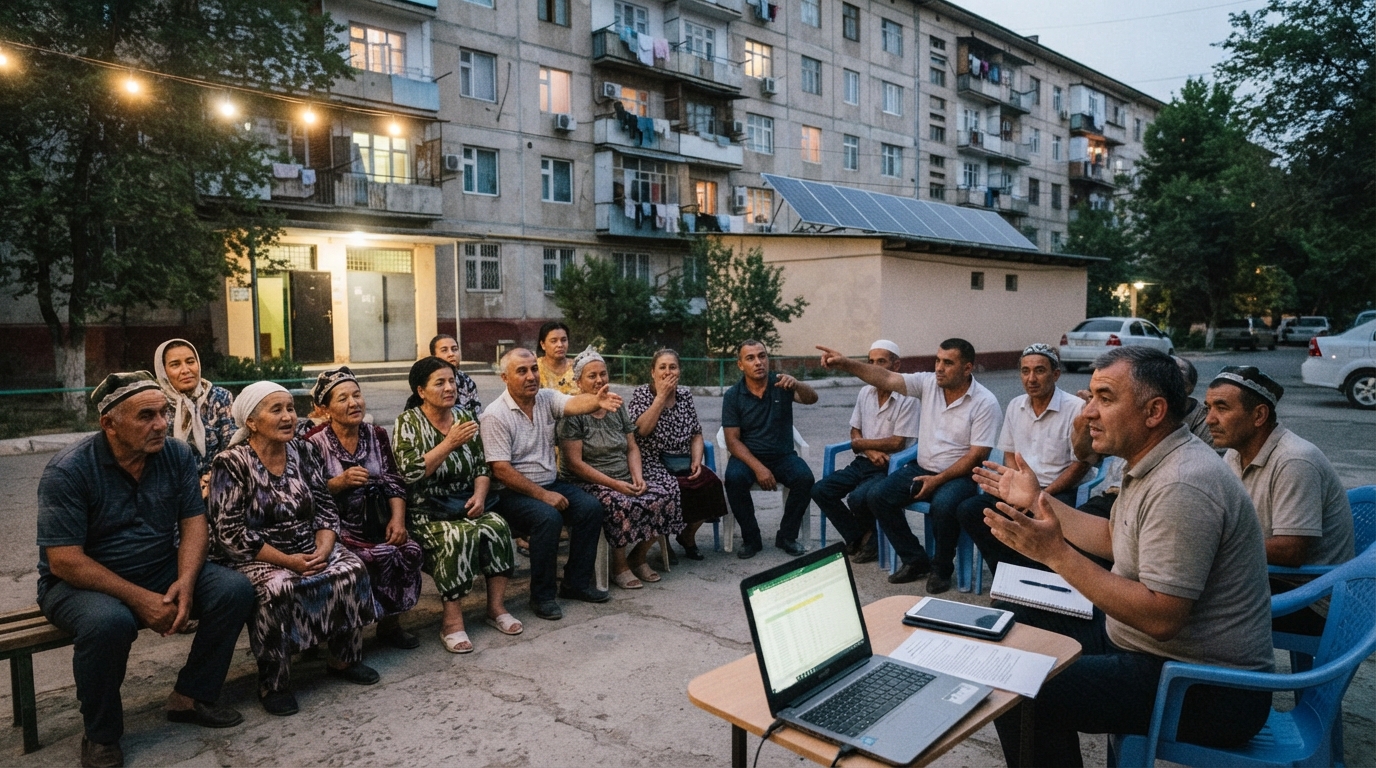
"They want to liquidate us under any pretext" - who does not like the self-governance of high-rises in Tashkent?
- This building is one of those that switched to self-governance. How did you come to this decision?
- Building No. 35 switched to self-governance in September 2024. This decision was driven by maintenance problems under the previous management system.
In particular, due to financial problems, there were difficulties with the hot water supply to the building for three months. There were also shortcomings in the quality of the services provided. Therefore, after consulting with the residents, we decided to manage the building on our own.
- Did the self-governance system suit you?
- At first, it was very difficult. Due to confusion in previous calculations, some debts had to be paid a second time.
Practically, we started our work from scratch. We concluded separate contracts with employees performing administrative work, plumbing, electrical services, and others. We started working directly with service organizations, making prepayments where necessary. We also entered the billing system.
The first year was quite difficult. But now the building has a council and internal control. Each of the 40 apartments has its own voice.
Among the residents, there are people who are well-versed in various fields. Some helped with their experience, others with their professional knowledge. I think our greatest achievement is constant dialogue and information exchange.
- What negative situations can such a system prevent?
- Firstly, decisions are not allowed to be made by one person or a small group. Internal control is strengthened, and the initiative of the residents grows. Most importantly, decisions are made collectively. Not everything depends on a decision handed down from the center.
- For example, if new equipment needs to be installed, does the ability to prevent the promotion of low-quality products or the misuse of funds increase?
- Of course. Any building needs modernization. This could be an elevator, a heating system, pipes, or other infrastructure.
But all of this depends on funds. It is necessary to prepare for the season, plan the budget correctly, and use money efficiently. For example, we are currently discussing the possibility of using solar panels to provide electricity to the entrances of our building.
Such issues are discussed by the residents of the building. A decision is made only after the consent of the majority. Therefore, it is quite difficult for someone to impose a specific product on us. For instance, we received a proposal to replace the elevators. We studied the proposal and compared the offered elevators with the ones currently in our building. The majority of residents concluded that there was no need to replace the current elevators. Therefore, we spoke out against this proposal.
- In April of this year, representatives of the inspection body supervising the construction and housing and communal services sector came and monitored our activities.
They asked us more than ten questions. We provided information on the billing system, payments, elevator maintenance, and other issues. Then they raised the issue of a dispatch service.
We explained: in our building, this task is assigned to responsible persons. Residents get in touch by phone. For example, if a plumbing problem arises, the responsible person contacts the servicing plumber, and the issue is resolved.
Despite this, a fine was later imposed on us on the grounds that "the dispatch center is not functioning." My opinion was not fully listened to. Then, for the same reason, we were fined a second time.
By August 4, a notification was received through the billing system stating that building No. 35 on Navoi Street could be removed from the billing system.
We were hit with three consecutive fines of 6 million soums each, totaling 18 million soums.
- What conclusion do you draw from all of this?
- In my opinion, the goal is to suffocate the self-governance system. Through fines, they can morally break the activists, force them to abandon this work, and ultimately attach the buildings again to management organizations that service many buildings at the same time.
As far as I understand, the more centralized the system is, the easier it is to control it and push decisions through. But here, there is a community decision. We act as representatives of the community.
There are modern technologies: you can constantly keep in touch with residents via phone, Telegram, WhatsApp, and email. Why is it absolutely necessary to build a separate room where someone will sit by the phone 24/7?
If there are other effective ways to solve the problem, they should also be recognized. Applying a single template of requirements to every building is wrong, in my opinion. I view this approach as an action aimed at suffocating and destroying the self-governance system.
- Since when has the self-governance system been operating in building No. 41?
- We have been managing our building ourselves for five years now. This decision was driven by dissatisfaction with the activities of the previous private homeowners' association (TCHSJ).
We paid for services, but there were cases when the established payments for gas, electricity, and water were not made on time. In winter, there were even cases when we went without gas for three or four days.
After that, we gathered with the residents and decided to manage the building on our own. Among the forms of management offered to us, we found the self-governance system to be the most acceptable.
It is now the fifth year. We pay for gas, electricity, water, and other mandatory payments on time.
- Are you also facing some obstacles now?
- Yes. We believe that attempts are being made by some responsible persons to return us to the previous form of management.
In one instance, information was provided as if the residents of the building had agreed to rejoin another management organization. After that, I gathered the apartment owners and held a meeting again. At the meeting, the residents stated that they had not made such a decision and did not want to return to the previous system.
Therefore, we want to preserve the form of management we have chosen. I think our experience can even be studied as an example for other buildings.
- What is the main advantage of self-governance for the residents?
- Firstly, people living in the same building become like a big family. We manage our building ourselves. Timely payment of utility bills is under our control.
Secondly, we have made the management system much more compact. We have a separate group; we are in touch day and night. If a problem arises, we try to resolve it promptly.
We have also organized the dispatch function based on our capabilities. We do not consider it necessary to create a large staff or a separate dispatch room for this, which would bring extra expenses for the building.
Thirdly, we have provided jobs for needy people from among our residents. Currently, five people from our building work within this system and receive a salary.
Therefore, for us, this is not just the organization of utility services. It is a system of responsibility for our home.
We do not want to return to the old system.