

"They're trying to find a reason to finish us off" - Who doesn't like the fact that apartment buildings in Tashkent are self-governing?
Some apartment buildings on Navoi Street in the Shaykhontohur district of Tashkent have abandoned the services of traditional management companies and switched to a self-management system. Kun.uz spoke with Abdurazzok Khojabekov and Bakhtiyor Kadirov, chairmen of the self-management councils of houses 35 and 41 on Navoi Street, and asked about the reasons for such a decision, the advantages of the system, and the problems they are currently facing.
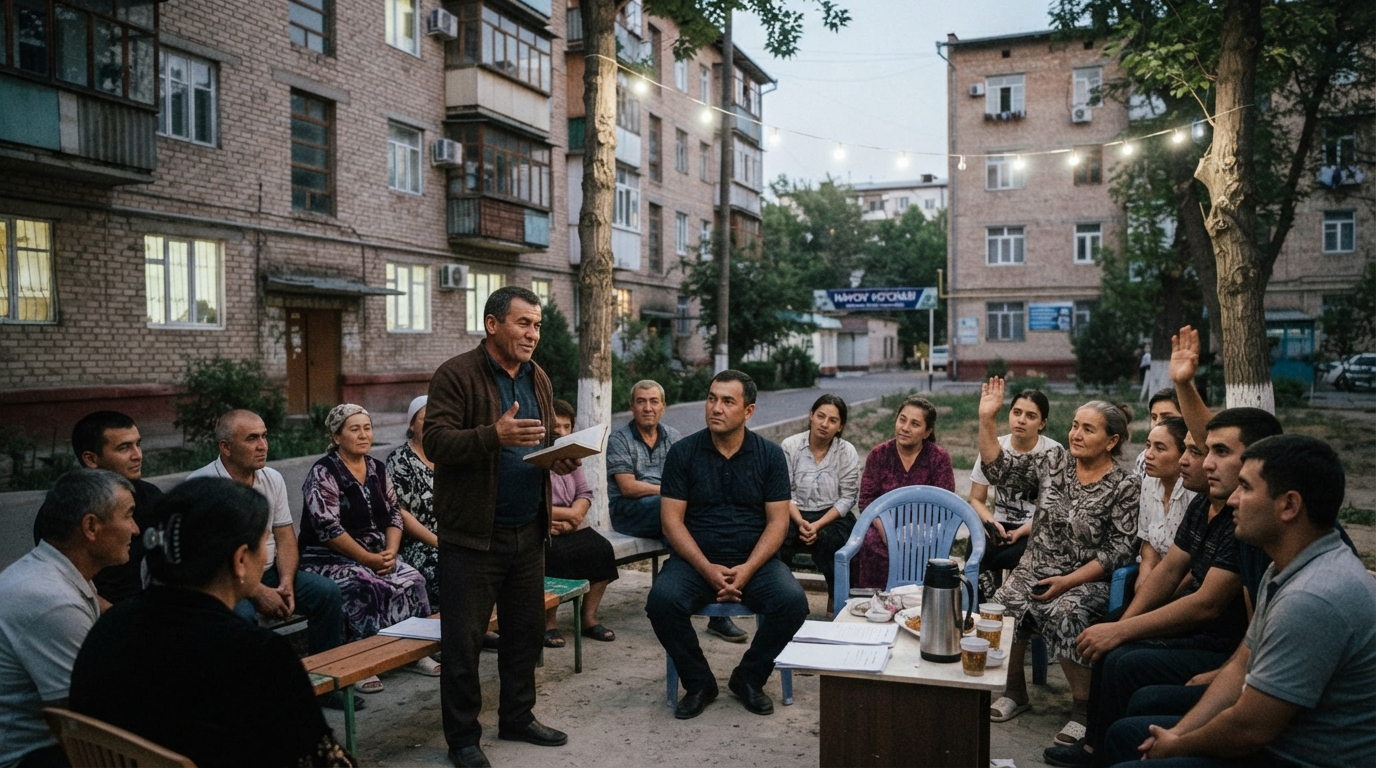
“They are looking for an excuse to liquidate us,” – who doesn’t like the self-management system of apartment buildings in Tashkent?
Some apartment buildings located on Navoi Street in the Shaykhontohur district of Tashkent have abandoned the services of traditional management companies and switched to a self-management system. Kun.uz spoke with Abdurazzok Khojabekov and Bakhtiyor Kadirov, chairmen of the self-management councils of houses No. 35 and 41 on Navoi Street, and learned about the reasons for this decision, the advantages of the system and current problems.
**Self-management experience of house No. 35**
According to Abdurazzok Khojabekov, chairman of the self-management council of house No. 35 on Navoi Street, the house switched to self-management in September 2024. This decision was prompted by problems with the service delivery under the previous management system, in particular, interruptions in the supply of hot water for three months due to financial difficulties. After consulting with the residents, it was decided to manage the house themselves.
The initial period was difficult. Due to confusion in previous calculations, some debts had to be repaid. The work started almost from scratch: separate contracts were concluded with employees performing administrative work, plumbing, electrical and other services, direct work was carried out with service organizations, and prepayments were made where necessary. The billing system was also connected.
According to Khojabekov, the biggest achievement is constant communication and information exchange. Each of the 40 households has one vote, and people from different fields among the residents help with their experience.
**Advantages of self-management**
This system does not allow decisions to be made by one person or a small group, strengthens internal control and increases the initiative of residents. Decisions are made collectively, reducing dependence on decisions coming from the center.
For example, if it is necessary to install new equipment in a house, it is more likely to prevent the transfer of poor-quality products or the misuse of funds. Residents of the house discuss all issues, and only after the majority agrees, a decision is made. This prevents monopolists from forcibly transferring their products. For example, when studying the proposal to replace elevators, residents came to the conclusion that there is no need to replace the existing elevators.
**Problems encountered and fines**
In April of this year, representatives of the Construction and Housing and Communal Services Inspection monitored the activities of House No. 35. When the issue of the dispatch service was raised, it was explained that this task was assigned to the responsible persons in the house and that residents could contact them by phone. Nevertheless, a fine was later issued on the grounds that “the dispatch center is not functioning.” Khojabekov’s opinion was not fully heard, and a second fine was imposed on this issue.
By August 4, a notification was received that house 35 could be removed from the billing system through the billing system. A total of 18 million soums (three consecutive fines of 6 million soums) were imposed.
According to Abdurazzok Khojabekov, the goal of these actions is to “strangle” the self-governing system, punish activists with fines, and force houses to re-attach to centralized management organizations. In his understanding, the more centralized the system is, the easier it is to control it and make decisions. But here the decision is made by the community.
Khojabekov notes that it is possible to maintain constant contact with residents through modern technologies (telephone, Telegram, WhatsApp, e-mail) and says that it is not necessary to build a separate dispatch center. He considers it wrong to apply a single template for each house and evaluates this approach as an attempt to eliminate the self-management system.
**Five-year experience of house 41**
Bakhtiyor Kadirov, chairman of the self-management council of house 41 on Navoi Street, said that they have been managing their houses themselves for five years. This decision was due to dissatisfaction with the activities of the previous TCHSJ. Despite the fact that the service was paid for, payments for services such as gas, electricity and water were not made on time, and in winter there were even times when they were left without gas for three or four days. The residents met and decided to manage the house themselves, and the self-management system was found to be the most optimal. Currently, gas, electricity, water and other mandatory payments are being paid on time.
**House 41 is also facing obstacles**
According to Kadyrov, some officials are trying to return them to the previous form of management. In one case, the residents of the house allegedly agreed to rejoin another management organization. After that, the owners of the apartment gathered and stated that no such decision had been made and that they did not want to return to the previous system.
Kadyrov emphasizes that they want to maintain their chosen form of management and that their experience can be studied as a model for other houses.
**Main advantages of self-management (in the example of house 41):**
1. **Team spirit:** People living in one house become like a big family, they manage their own house. They are in control of paying utility bills on time.
2. **Compact management:** The management system is quite compact. There is a separate team that is in touch day and night. If a problem arises, they try to solve it quickly. The dispatching function is also organized based on their own capabilities, there is no need to spend extra money on a large staff or a separate building.
3. **Employment:** People in need of work from among their own residents are provided with jobs. Currently, five people are working and receiving salaries within this system.
Therefore, this system is not only a system for organizing utility services for them, but also a system for taking responsibility for their own homes. They do not agree to return to the old system.