

There is no such thing as excess oil
Iran has started supplying petroleum products to Tajikistan, but volumes and prices are still unknown
There is No Such Thing as Excess Oil
Iran is already supplying petroleum products to Tajikistan, fulfilling the terms of agreements reached in August. However, supply volumes, prices, and other details have not yet been disclosed. This was reported by Asia-Plus, citing the Ministry of Energy and Water Resources of Tajikistan.
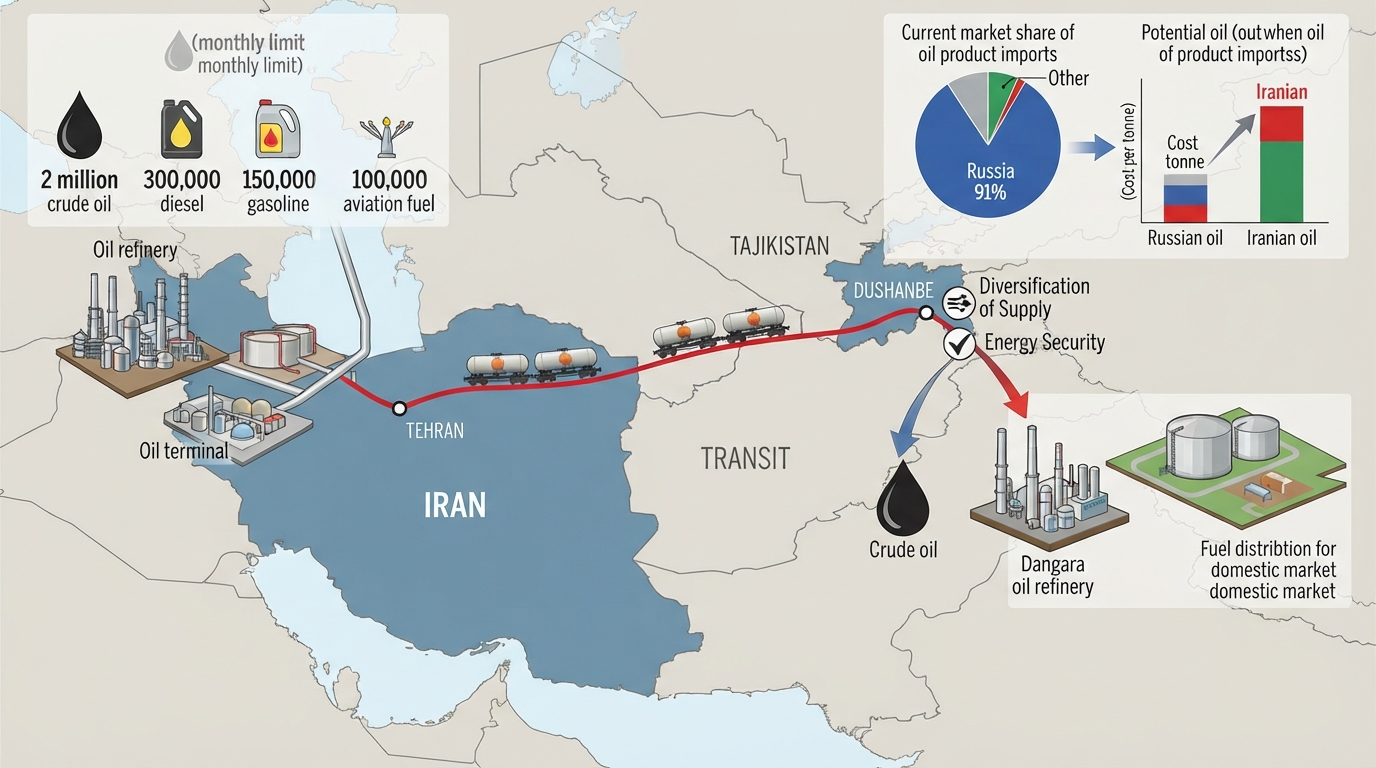
Earlier, Dushanbe discussed with Tehran the possibility of supplying 2.55 million tons of petroleum products. At the same time, it remains unclear whether the parties have agreed on the final volume to be secured in the contract.
The logistical issue is also particularly acute, as the countries do not share a common border. Most likely, the raw materials and products will have to be transported by rail, which is more expensive than delivering oil by sea or via pipelines. Costs will also increase due to transit through the territories of third countries.
Statistics point to the use of rail transport: in January-June of this year, 432.8 thousand tons of cargo were transported between Tajikistan and Iran, of which 334 thousand tons went by rail.
Furthermore, officials did not specify what exactly is included in the cargo from Iran. Tajikistan had requested 2 million tons of crude oil, 300 thousand tons of diesel, 150 thousand tons of gasoline, and 100 thousand tons of aviation fuel. However, Tehran previously stated that the country is experiencing a shortage of motor fuel, which has led to restrictions on its export. Therefore, the priority is the supply of raw materials and kerosene for aircraft. At the same time, the Islamic Republic is unlikely to be able to send more than 5 thousand tons of petroleum products per month to its partners.
Given the large volumes of crude oil, it remains unclear how Tajikistan intends to use it. Supplies at the level of 2 million tons per year significantly exceed the capacity of the country's largest oil refinery, the Dangara refinery. Consequently, the republic's government will either have to increase production capacity or organize long-term storage of the resources.
The commercial aspect is no less important, as without discounts, it will be difficult for the Iranians to compete with Russia. It is noted that more than 91% of the approximately 600 thousand tons of main petroleum products purchased by Tajikistan in the first half of this year came from the Russian Federation. The average cost of imported products was $825 per ton. However, agreements on preferences and the absence of duties are in place between Moscow and Dushanbe. Therefore, the price of Iranian oil is of very great importance.
Nevertheless, most analysts believe that even if Iranian oil turns out to be noticeably more expensive than Russian oil, Tajikistan should not abandon alternative imports. This will reduce dependence on a single supplier and provide room for maneuver in the event of harsh sanctions against the Russian Federation, fuel shortages in the market, price spikes, or any other restrictions.