

There are 129 cars per thousand people in Uzbekistan. Is this a lot or a little?
The number of vehicles owned by the population in Uzbekistan has approached 5 million units. The highest indicator by region is in Tashkent city - about 199 cars per 1,000 people. The next best indicators are recorded in Tashkent (149 units) and Bukhara (146 units) regions. The region with the fewest vehicles per 1,000 people is Jizzakh region - 92 units.
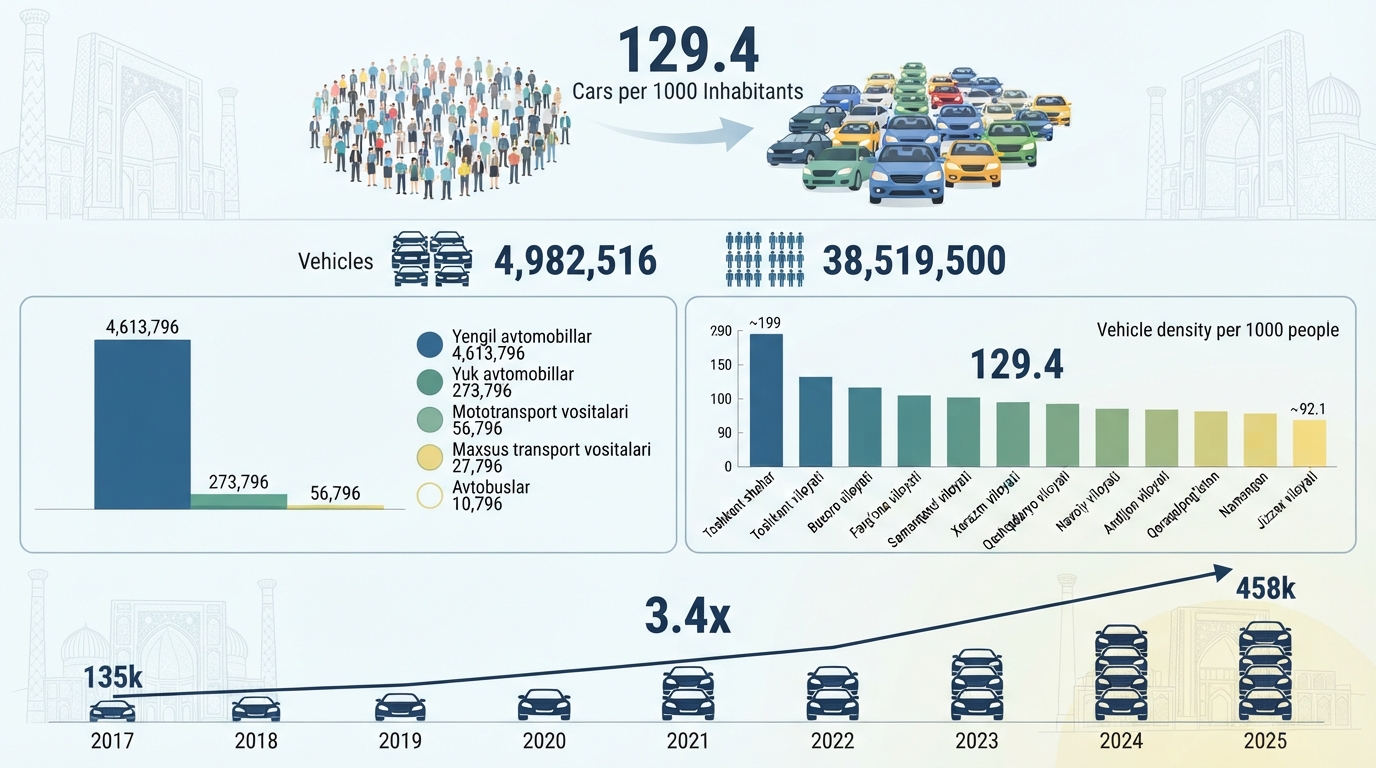
There are 129 cars per thousand inhabitants in Uzbekistan. Is this figure high or low?
According to the National Statistics Committee, as of July 1, 2026, the total number of motor vehicles owned by individuals in Uzbekistan reached 4 million 982 thousand 516 units.
The distribution by type of vehicles is as follows:
* Passenger cars: 4 million 613 thousand 796 units
* Trucks: 273 thousand 796 units
* Buses: 10 thousand 796 units
* Special vehicles: 27 thousand 796 units
* Motor vehicles: 56 thousand 796 units
By region, the largest number of vehicles was registered in Tashkent city (637 thousand 706 units), Fergana region (573 thousand 472 units) and Samarkand region (563 thousand 72 units).
**129 cars per 1000 people**
According to the data provided by the Statistics Agency as of July 1, 2026 (without registration results), the population of Uzbekistan was 38 million 519.5 thousand people. According to Kun.uz calculations, based on these figures, there are an average of 129.4 vehicles per 1,000 people (119.9 for passenger cars only).
The highest indicator by region was recorded in Tashkent city, with almost 199 vehicles per 1,000 people. The next places were occupied by Tashkent region (149.3) and Bukhara region (146.1). The region with the fewest cars per 1,000 people is Jizzakh region (92.1). Also, in Namangan (104.8) and Karakalpakstan (107.1), this indicator is significantly lower than the average in the republic.
It is worth noting that the volume of car supply in the Uzbekistan market is increasing year by year. For example, while 135,000 cars were produced in the country in 2017, this figure will reach about 458,000 in 2025, a 3.4-fold increase in 8 years. With the exception of 2021, production has been increasing significantly every year.