

The world population increased by more than 5 billion in 65 years
In the years 1960–2025, the Earth's population reached 8.2 billion from 3.02 billion. However, this growth has not occurred evenly across the world's regions. While the population in Sub-Saharan Africa has increased nearly sixfold, the growth in Europe and Central Asia stood at 1.4 times.
The world population has increased by more than 5 billion in 65 years
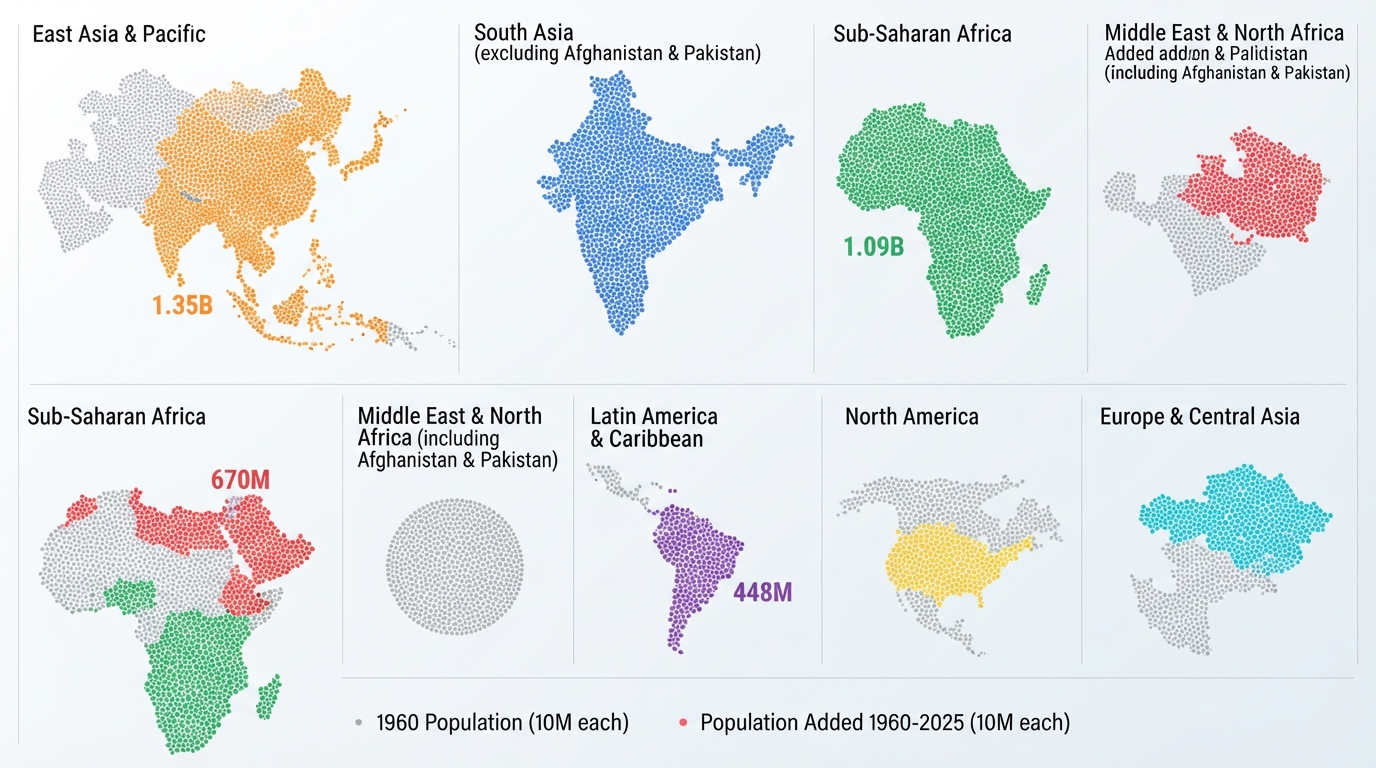
An infographic based on World Bank data and published on the Voronoi platform shows how the world's population has changed over 65 years. It compares indicators for 1960 and 2025 across seven regions of the planet.
Each dot on the infographic represents 10 million people. The grey dots represent the population in 1960, while the colored dots indicate how many people have been added to it up to 2025. To simplify the image, the figures are rounded to the nearest 10 million.
In total, the world population grew approximately 2.7 times during this period. In other words, nearly 5.2 billion people were added to the planet's population.
The largest relative growth was observed in Sub-Saharan Africa. While about 228 million people lived in this region in 1960, by 2025 their number reached 1.32 billion. This represents a 5.8-fold increase. The region's population grew by more than one billion in 65 years.
The next position is held by the group covering North Africa and the Middle East, as well as Afghanistan and Pakistan. The total population of these countries grew from 158 million to 828 million — an increase of approximately 5.2 times.
Attention should be paid to how the regions are grouped here. As of July 1, 2025, the World Bank transferred Afghanistan and Pakistan from the South Asia group to the North Africa and Middle East group. For the sake of consistent comparison, the regional figures for previous years were also recalculated according to this classification.
In South Asia, the population grew from 508 million to nearly 1.69 billion. This exact figure is provided in the data attached to the infographic. Thus, the region's population increased by approximately 1.18 billion or 3.3 times in 65 years. This calculation does not include Afghanistan and Pakistan.
Significant growth was also observed in Latin American and Caribbean countries. The number of residents here grew from 219 million to 667 million. That is, the region's population grew almost three times, adding 448 million people.
The largest increase in absolute numbers added to the population was recorded in the East Asia and Pacific region. In 1960, 1.04 billion people lived in this territory, and by 2025 the figure reached 2.39 billion. The difference is approximately 1.35 billion people.
However, this region was already the most populous area in the world back in 1960. For this reason, although the number of people added was the largest, the relative growth amounted to 2.3 times.