

How will the world's largest cities change in 150 years?
The ranking of the world's largest cities is expected to change significantly in the coming decades. According to forecasts, by 2100, the capital of Bangladesh, Dhaka, will take first place with a population of about 55 million. Jakarta and Karachi will be next, and Tokyo, which has been in the lead for many years, could drop to ninth place.
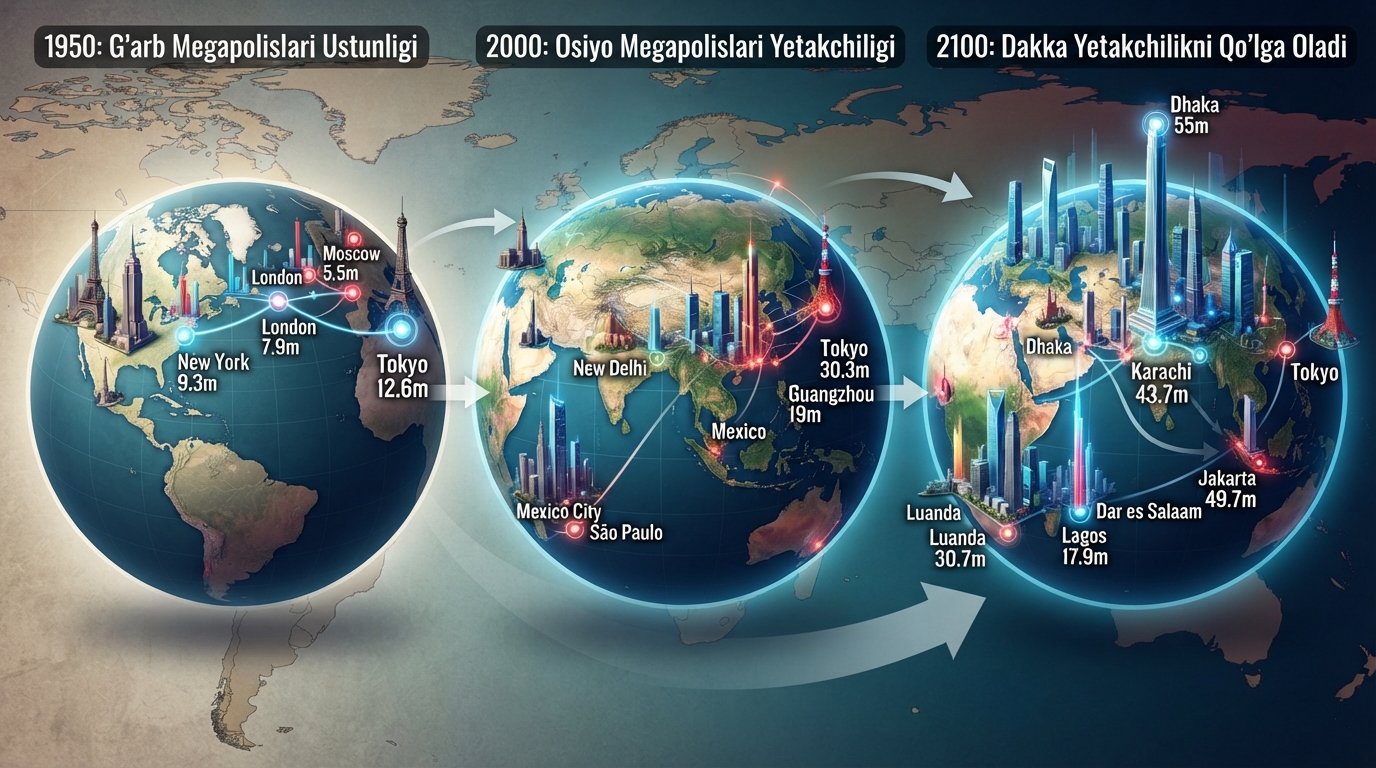
**How will the world’s largest cities change in 150 years?**
This visualization, provided by Visual Capitalist, shows the changes that will occur in the 15 most populous cities in the world between 1950 and 2100. The ranking is based on population estimates from the European Commission’s Joint Research Centre (JRC), and the data is provided by Our World in Data.
**1950: Western megacities dominate**
In 1950, Tokyo led the ranking with 12.6 million inhabitants. In second place was New York with 9.3 million inhabitants. At that time, the share of Western megacities among the world’s largest cities was much higher. In 1950, more than half of the top 15 cities were located in Europe or America. In particular, London had 7.9 million inhabitants, Moscow 5.5 million and Paris 5.4 million.
**Changes in the following decades**
The situation began to change dramatically in the following decades. By 1975, London had fallen out of the top ten, and Paris and Los Angeles had also dropped in the ranking. In the second half of the 20th century, Latin American megacities, especially São Paulo and Mexico City, grew rapidly. By 2000, these two cities had surpassed New York in population to become the largest cities in the Western Hemisphere.
**2000: Asian megacities dominate**
By this time, the top positions in the world rankings were mainly occupied by Asian megacities. In 2000, Tokyo retained its leadership position with a population of 30.3 million. Guangzhou was third with 19 million, and New Delhi was sixth with 18 million.
**2100: Dhaka could take the lead**
According to forecasts, the ranking will change dramatically again by the end of the century. Dhaka is expected to become the world's largest city with a population of almost 55 million people. Jakarta is projected to take second place with 49.7 million people, and Karachi is projected to take third place with 43.7 million people.
Tokyo, the world's largest city in the 1950s and 2000s, is expected to fall to ninth place with a population of 24.1 million by 2100. According to the forecast, the city's population will even decrease from the level of 1975. The main reasons for this are the decline in the birth rate and long-term demographic decline.
Meanwhile, the position of African megacities in the world ranking is also expected to strengthen significantly. In particular, Cairo is projected to retain its status as the largest city outside Asia with a population of 36.7 million people. The population of Luanda could reach 30.7 million, that of Dar es Salaam 20.1 million, and that of Lagos 17.9 million.
Thus, over the 150-year period, the geography of the world's megacities is changing significantly: while in the 1950s, European and American cities dominated the rankings, by the end of the 21st century, the share of Asian and African megacities among the largest cities is projected to increase further.