

The winners of the 2026 Ig Nobel Prize have been announced
In the Swiss city of Zurich, the Ig Nobel Prize ceremony, presented as a humorous alternative to the Nobel Prize, has taken place.
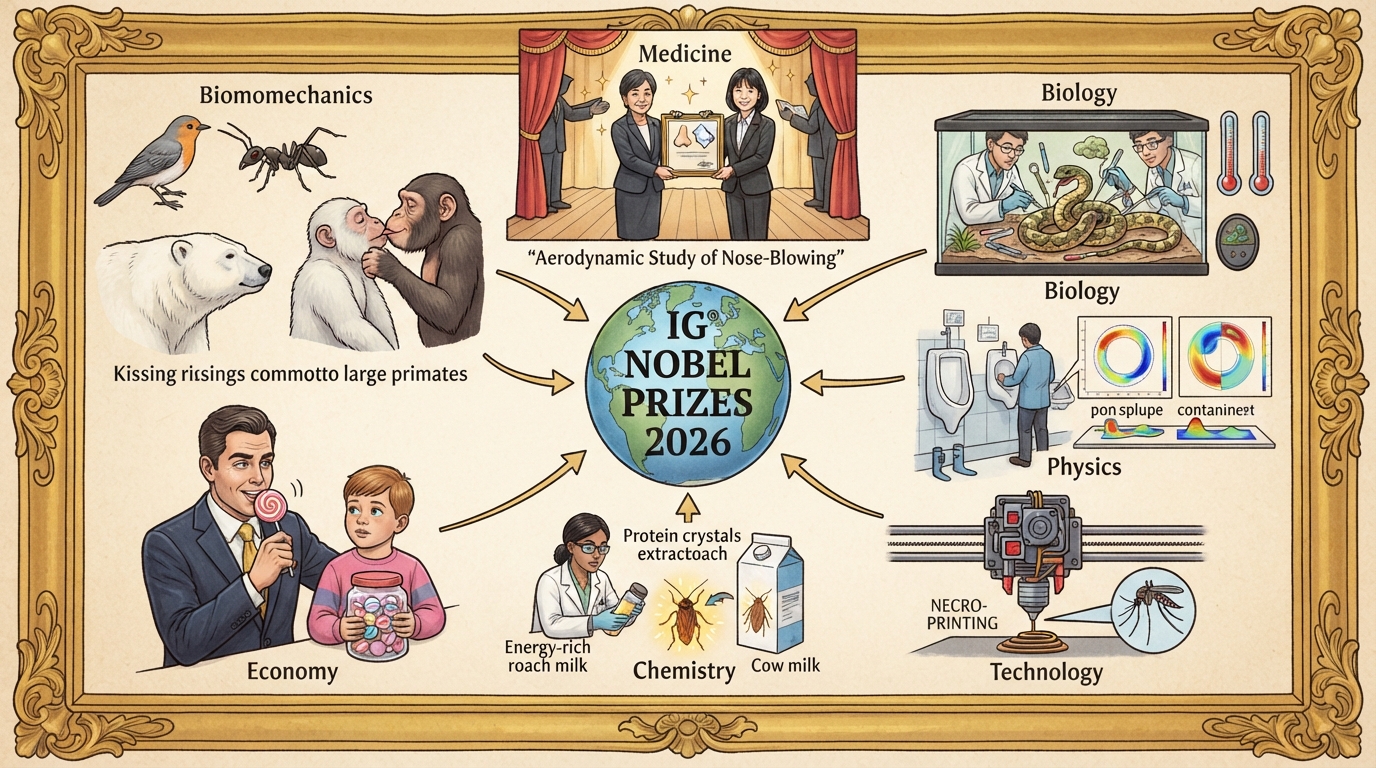
The winners of the 2026 Ig Nobel Prize have been announced. According to the organization's website, the Ig® Nobel Prize is awarded annually for achievements that "first make people laugh, and then make them think."
The Ig Nobel Prize in Biomechanics was awarded to Matilda Brindle, Catherine Talbot, and Stuart West for developing a more precise definition of kissing, using ants, birds, polar bears, and humans as examples. They concluded that most great apes kiss in one form or another.
The Ig Nobel Prize in Economics was awarded to Paul Piff, Daniel Stancato, Stéphane Côté, Rodolfo Mendoza-Denton, and Dacher Keltner for gathering evidence that members of the upper social class are more likely to take candy from a jar reserved for children and engage in other unethical behaviors.
The Ig Nobel Prize in Chemistry was awarded to Sanchari Banerjee, Nathan Coussens, François-Xavier Gall, Nitish Satyanarayanan, Jandhyam Srikant, Koichiro Yagi, James Gray, Stephen Tobe, Barbara Stay, Leonard Chavas, and Subramanian Ramaswamy for discovering that proteins in the milk of a viviparous cockroach contain three times more energy than proteins in cow's milk.
The Ig Nobel Prize in Medicine was awarded posthumously to Tokuji Unno for his scientific work "How to Blow Your Nose - An Aerodynamic Study of Nose-Blowing." On behalf of the late Dr. Unno, the award was accepted by his colleague, Dr. Miki Takahara.
The Ig Nobel Prize in Biology was awarded to João Miguel Alves-Nunes, Adriano Fellone, Selma Maria Almeida-Santos, Carlos Roberto de Medeiros, Ivan Sazima, and Otavio Augusto Vuolo Marques for carefully stepping on different parts of venomous snakes' bodies, repeating the experiment multiple times at different temperatures and times of day.
The Ig Nobel Prize in Physics was awarded to Randy Hurd, Zhao Pan, Ted Truscott, and Kavishan Thurairajah for their theoretical and experimental attempts to create a splash-free urinal. They built prototypes and compared them with existing models. Several hundred experiments were conducted.
The Ig Nobel Prize in Technology was awarded to Justin Puma, Zheng Yan, Evan Johnston, Zixin Zhang, Xiaoyi Lan, Linji Zhang, Hongyu Hou, Zixin He, Ali Afifi, Megan Creighton, Jianyu Li, and Changhong Cao for implementing mosquito proboscises as high-precision nozzles for 3D printing. This process was named "necroprinting." It turned out that the proboscises can withstand high pressure, and their printing capability is higher than some alternatives. The authors even suggested testing the proboscises of other insects, such as bedbugs or tsetse flies, for the same quality.