

The White House has classified Uzbekistan as a country with a high risk of illegal transit of Chinese goods.
Uzbekistan is among 40 countries the White House believes pose a high risk of illegal transit of Chinese goods to circumvent US tariffs. Washington believes these countries could be used for limited processing of goods and the organization of logistics routes.
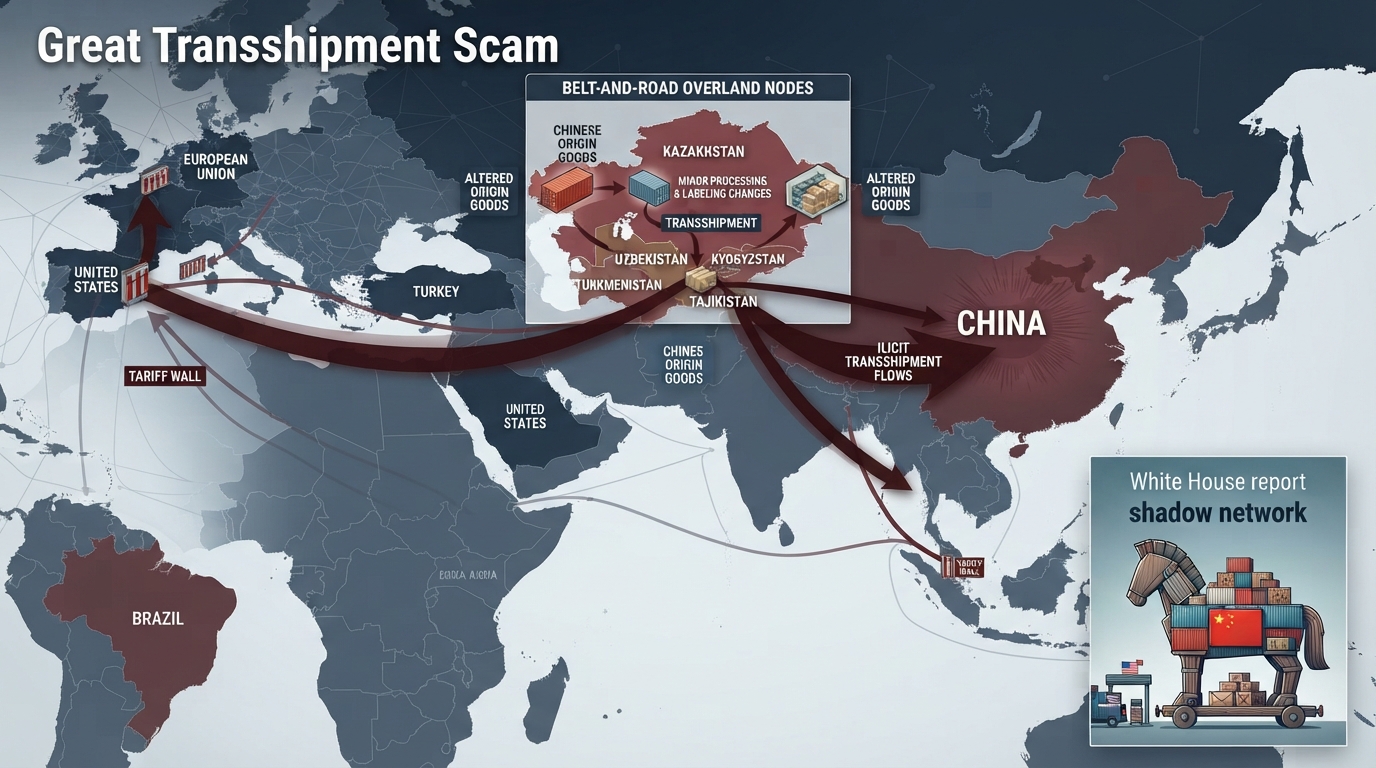
The White House has included Uzbekistan in a list of countries it considers to pose a high risk for the illegal transit of Chinese goods. The purpose of such transit is to circumvent US tariffs by rerouting the goods through third countries. This information is contained in the report "The Great Transshipment Scam," published by the Office of Trade and Manufacturing Policy. The report's cover features a Trojan horse.
The report notes that the United States is facing a growing problem with the illegal transshipment of goods through third countries, which is used to evade tariffs and other trade measures. Exporters from countries with higher tariffs can exploit differences in US tariff regimes to reroute goods through countries with lower tariffs before they reach the US market.
The report's authors explain that illicit transshipment can include relabeling, repackaging, re-invoicing, minor processing, false declarations of origin, or other actions aimed at obtaining tariff treatment that would not apply if the goods' true economic origin were declared.
The report cites China as the most illustrative historical example of this practice. Following the imposition of US tariffs on Chinese goods in 2018, Chinese exporters have increasingly rerouted goods through third countries. The report's authors point out that other countries are now adopting the "Chinese model" to avoid US tariffs.
According to the report, the "Chinese shadow network" of cargo transshipment encompasses America's largest trading partners, many countries in Southeast Asia, and a "massive number" of smaller countries. The White House claims that China-linked exporters are using these countries because they offer cheap labor, lax customs controls, bonded warehouses, specialized assembly facilities, and preferential access to the US market.
The report states that over time, these countries with lower tariffs, of which there are now more than 40, have become the launching pad and center of a new system of tariff evasion: goods, primarily manufactured in China, undergo minimal processing abroad and are exported to the US under new names.
The document divides countries into three groups based on the nature of the risk. The first group includes major trading partners with diversified industries and large export volumes to the US: Canada, the European Union, India, Israel, Japan, Mexico, South Korea, and Taiwan.
The second group includes countries with significant transshipment volumes and, at the same time, deeper integration into Chinese supply chains: Brazil, Indonesia, Malaysia, Thailand, Turkey, and Vietnam.
The third group includes smaller economies with smaller volumes but with a number of advantages, including free zones and lax customs controls. This group includes 24 countries, including Uzbekistan, Argentina, Azerbaijan, Costa Rica, Georgia, Kazakhstan, Kenya, Oman, the UAE, and Switzerland.
The report notes that China-linked exporters can use these jurisdictions for both limited production activities and to organize logistics routes. As local export and transport networks become increasingly dependent on Chinese resources, logistics, and capital, Beijing could gain additional commercial and geopolitical influence.
Therefore, according to the White House, illicit transshipment of goods could reinforce commercial dependence within the Belt and Road Initiative. Ports, rail corridors, free zones, industrial parks, bonded warehouses, and logistics platforms could serve both legitimate trade and the diversion of China-linked cargo, the report states.
The authors believe that countries in the third group could be "particularly useful nodes" in the shadow cargo transshipment network due to their dependence on trade with China.
The report also categorizes countries by the "functional architecture of the shadow cargo transshipment network." Uzbekistan, Kazakhstan, Azerbaijan, and Georgia are included in the functional cluster "Belt and Road Overland Nodes." Their primary role is described as "rail and land transit, cargo consolidation, and the transfer of cargo from land to sea routes."