

The White House has classified Uzbekistan as a country with a high risk of illegal transshipment of goods from China.
The White House Office of Trade Policy has classified Uzbekistan as a country with a high risk of transshipping Chinese goods in circumvention of US tariffs.
The White House has included Uzbekistan in a list of countries with a high risk of illegal transshipment of goods from China.
Tashkent, Uzbekistan (UzDaily.uz) —
Uzbekistan is among more than 40 countries and territories that the White House considers to be jurisdictions with a high risk of illegal transshipment of Chinese goods aimed at evading U.S. customs duties. This is according to a report by the White House Office of Trade and Manufacturing Policy, titled "The Great Transshipment Scam."
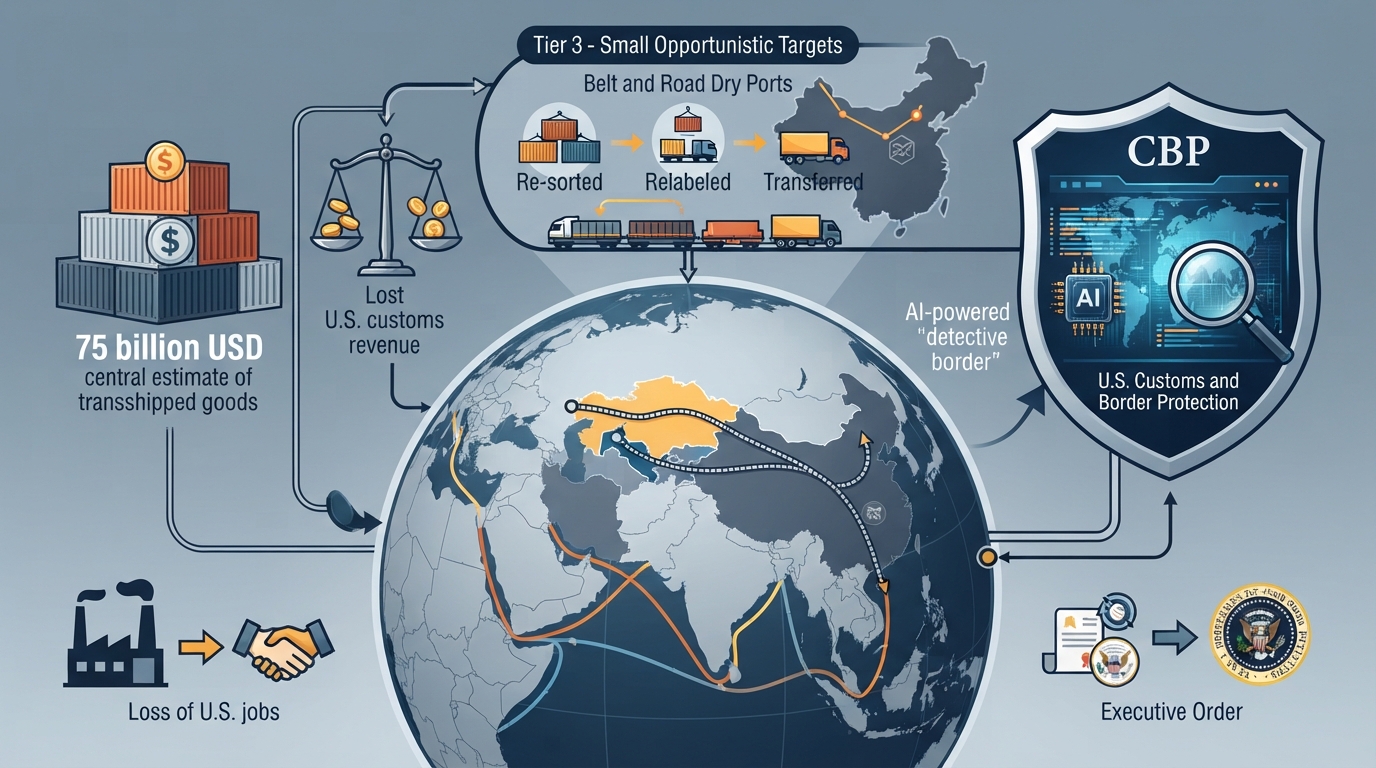
The document places Uzbekistan in the third category, designated as "small opportunistic targets." This group also includes Azerbaijan, Georgia, Kazakhstan, Jordan, Kenya, Morocco, Panama, the United Arab Emirates, and several other countries.
According to the report's authors, countries in this category, although not demonstrating the largest transshipment volumes in dollar terms, possess certain advantages that make them attractive for the diversion of Chinese goods. These advantages include low-cost labor, preferential terms in free economic zones, access to ports or border crossings, the availability of customs warehouses, highly specialized assembly facilities, and preferential access to the US market.
The report specifically identifies Uzbekistan as a functional cluster of "Belt and Road land hubs," along with Azerbaijan, Georgia, and Kazakhstan. According to the authors, the countries in this group serve as transit rail and dry ports, facilitating the consolidation of cargo and its subsequent transfer from land to sea transport. However, the report emphasizes that a country's inclusion in this list does not mean that all its shipments are carried out in violation of US customs regulations.
According to the report, the problem of illegal transshipment arose after the Trump administration imposed Section 301 tariffs on China in 2018. As tariffs on Chinese goods increased, some shipments previously sent directly from China to the US began to transit through countries with lower tariffs. There, through light assembly, repackaging, re-invoicing, or changing documentation, the goods were assigned a new origin.
The report's authors call this network the "shadow transshipment network" and divide the countries within it into three tiers. The first tier includes large, diversified economies such as Canada, the European Union, India, Israel, Japan, Mexico, South Korea, and Taiwan. The second tier consists of countries with a high degree of integration into Chinese supply chains, including Brazil, Vietnam, Indonesia, Malaysia, Thailand, and Turkey. The third tier consists of smaller jurisdictions, including Uzbekistan.
To estimate the annual volume of illicit transshipment, the report uses five independent estimates from the U.S. Council of Economic Advisers, the Department of Commerce, and Goldman Sachs, Exiger, and Altana. These estimates range from $40 billion to $303 billion per year, depending on the methodology used. The White House uses a $75 billion figure based on Exiger calculations as its central scenario.
Using arbitrary tariff differentials of 25%, 35%, and 45%, the report's authors estimate annual U.S. tariff losses ranging from approximately $10 billion (at the most conservative estimate) to over $100 billion (at the most expansive). Under the central scenario of $75 billion in transshipment volume, annual tariff losses are estimated at $19-34 billion.
The report also provides estimates of the broader economic impact. Under the central scenario, it estimates the displacement of approximately 450,000 U.S. jobs, a loss of $113-150 billion in gross domestic product, and a reduction in federal tax revenue of $19-26 billion annually. Under the most expansive scenario, these impacts increase to 1.82 million jobs, over $450 billion in GDP, and $77-103 billion in tax revenue. According to the report, the Trump administration is already taking measures to combat illegal transshipment. These measures include provisions in trade agreements that limit benefits to third countries, as well as the presidential executive order of June 3, 2026, on strengthening customs enforcement, which tightens requirements for importers, collateral, and ownership disclosure. Furthermore, U.S. Customs and Border Protection is developing an artificial intelligence-based system called "Detective Border." This system is designed to analyze data on shipments, routes, and production facilities to identify anomalies and focus law enforcement efforts on the most likely violators.
The authors of the report note that it is premature to assess the final impact of the new measures, as trade and customs statistics are becoming available with a delay, and some provisions of the executive order on customs enforcement have not yet been fully implemented.