

"The system of awarding maximum points to applicants with national certificates is being revised" — Deputy Minister
Uzbekistan is reviewing the procedure for awarding maximum points to applicants with national certificates. 'In a few years, the number of applicants with national certificates may exceed those who take the test. We have begun to develop mechanisms,' said Deputy Minister Sardor Rajabov.
**The procedure for awarding maximum points to national certificate holders is being reviewed - Deputy Minister**
In Uzbekistan, the procedure for awarding maximum points in the relevant subject to applicants with national certificates for admission to state higher education institutions may be reviewed. This was announced by Sardor Rajabov, First Deputy Minister of Higher Education, Science and Innovations, at a press conference in Tashkent on August 18, Gazeta correspondent reports.
According to Sardor Rajabov, in recent years the number of applicants applying to higher education institutions with national certificates has been increasing. The ministry has analyzed the reasons for this increase.
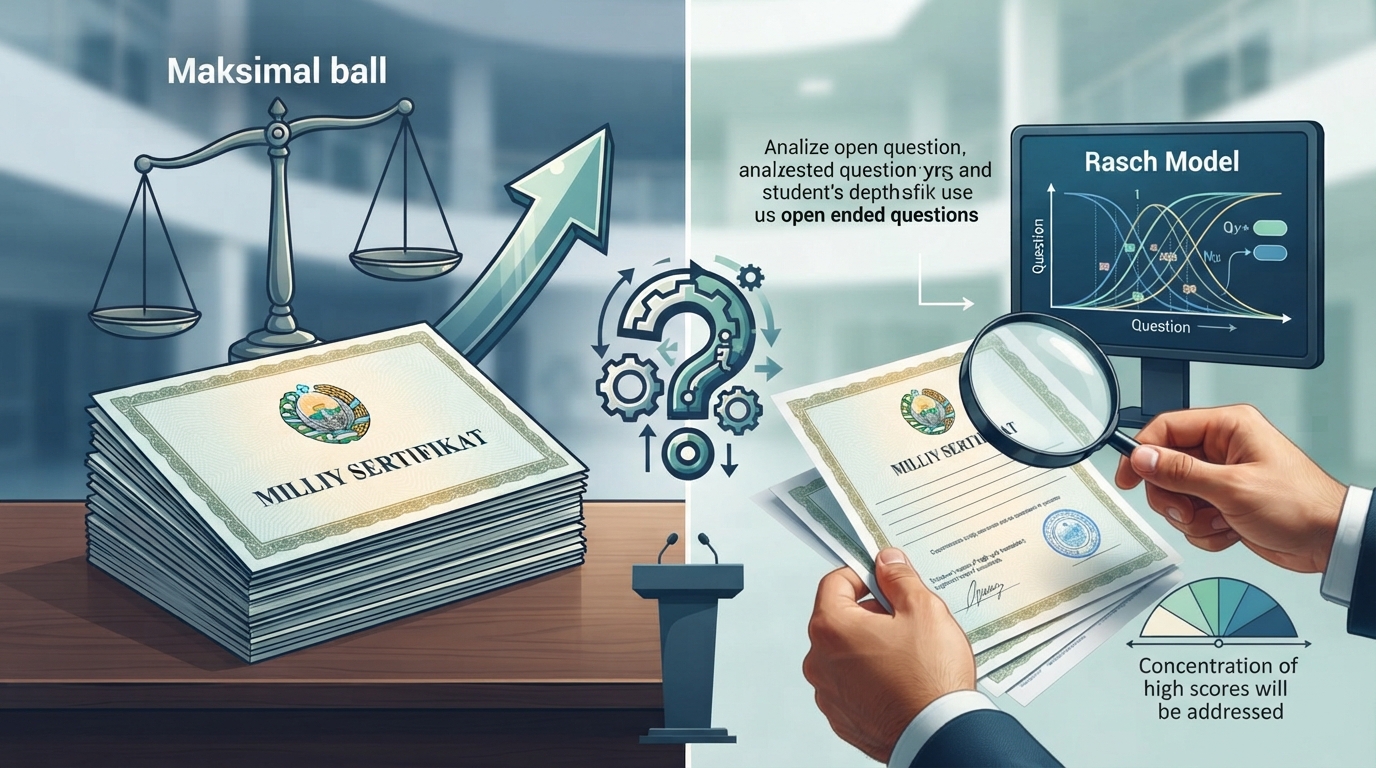
“The questions of the national certificate are slightly different from the questions of the entrance test to higher education. Here, there are not only closed questions, but also open questions. Also, the results are calculated based on the Rash model, not only based on the number of correct answers, but also based on the specified number of answers,” he said.
The Rash model is a system that separately measures the difficulty of each question in the assignment and the student's level of knowledge. It takes into account not just the number of correct answers, but the exact difficulty of the questions a student was able to solve. For example, two students answered the same 5 questions correctly. One answered only the easier questions, and the other answered the most difficult ones. The Rash model gives a higher score to those who answered more difficult questions.
“Many people use the national certification system in the years leading up to graduation. Of course, it is good that this has increased,” said the deputy minister.
In his opinion, in the national certification system, there are fewer cases of “predicting answers” in the test. Rajabov explained this by his time as deputy director of the former State Testing Center.
“You can get some points by randomly marking the answer to a question you don’t know in the test. When I worked as the deputy director of the former State Testing Center, I often saw applicants who filled out the entire answer sheet with only “A” or only “B”. Since the national certificate has open questions, such cases are rare,” he said.
Rajabov said that the ministry is reviewing the mechanism for assigning maximum points when evaluating the results of the national certificate. Issues such as the concentration of high-scoring applicants in one place are also being studied.
“We are currently reviewing how correct the maximum point system is. Because the number of applicants passing with a national certificate is increasing year by year.
I think that in a few years the number of applicants passing with a national certificate may exceed those passing through tests. Therefore, we need to foresee this and develop mechanisms, and we have started this process,” the deputy minister said.
One of the journalists asked for an explanation regarding the objections that applicants who scored high on the test are being limited due to the national certificate and preferential admission. Rajabov said that in such a case, it is necessary to pay attention to the fact that the level of complexity of the national certificate and entrance tests is not the same.
“The national certificate system is more complex than the test system.
Therefore, even if an applicant who received a national certificate receives the maximum score, this result cannot be directly compared with the score received on the test. The level of difficulty in the two systems is different,” he said.
According to him, the ministry analyzed the subsequent study results of students who entered higher education institutions with the maximum score on the national certificate.
“We also analyzed how children who entered higher education institutions with the maximum score on the national certificate are studying. If I am not mistaken, about 60 percent of them study with excellent grades, and the remaining 40 percent with good grades.
That is, there are very few who do not study well,” Rajabov said.
The Deputy Minister noted that various objective and subjective factors, such as family circumstances and the need to work, can affect a student’s performance. Among those who entered with the maximum score through the national certificate, there are very few who were expelled from their studies.
Sardor Rajabov reported that a separate analysis was also conducted on the performance of students admitted to higher education institutions on a preferential basis.
“We conducted an analysis of the performance of students who entered with preferential grades, whether they were expelled or dropped from one course to another. According to primary data, among those who entered with preferential grades, those who showed the highest results are students who entered with preferential grades.
We are now checking the remaining data once again. "In order not to give inaccurate information, we will definitely announce the results after completing the analysis," he said.
For information, out of 678 thousand applicants who applied to study at state universities this year, 193,186 (85,140 in 2025) had national or international certificates in general subjects, and 125,354 (58,216 in 2025) had national or international certificates in foreign languages.
13 thousand applicants with certificates in all subjects were completely exempted from testing. In 2025, 678 applicants took advantage of this opportunity. Following this, the passing scores for admission to study increased significantly.
This year, the average passing score for state grants was 134.6 points, and for payment contracts It was 93.7 points. Last year, these indicators were 121.8 and 84.9 points, respectively.