

The plow and the stirrup
"The time for diplomacy is over." Why the Russian Empire began its expansion into Central Asia and how it organized its new territories?
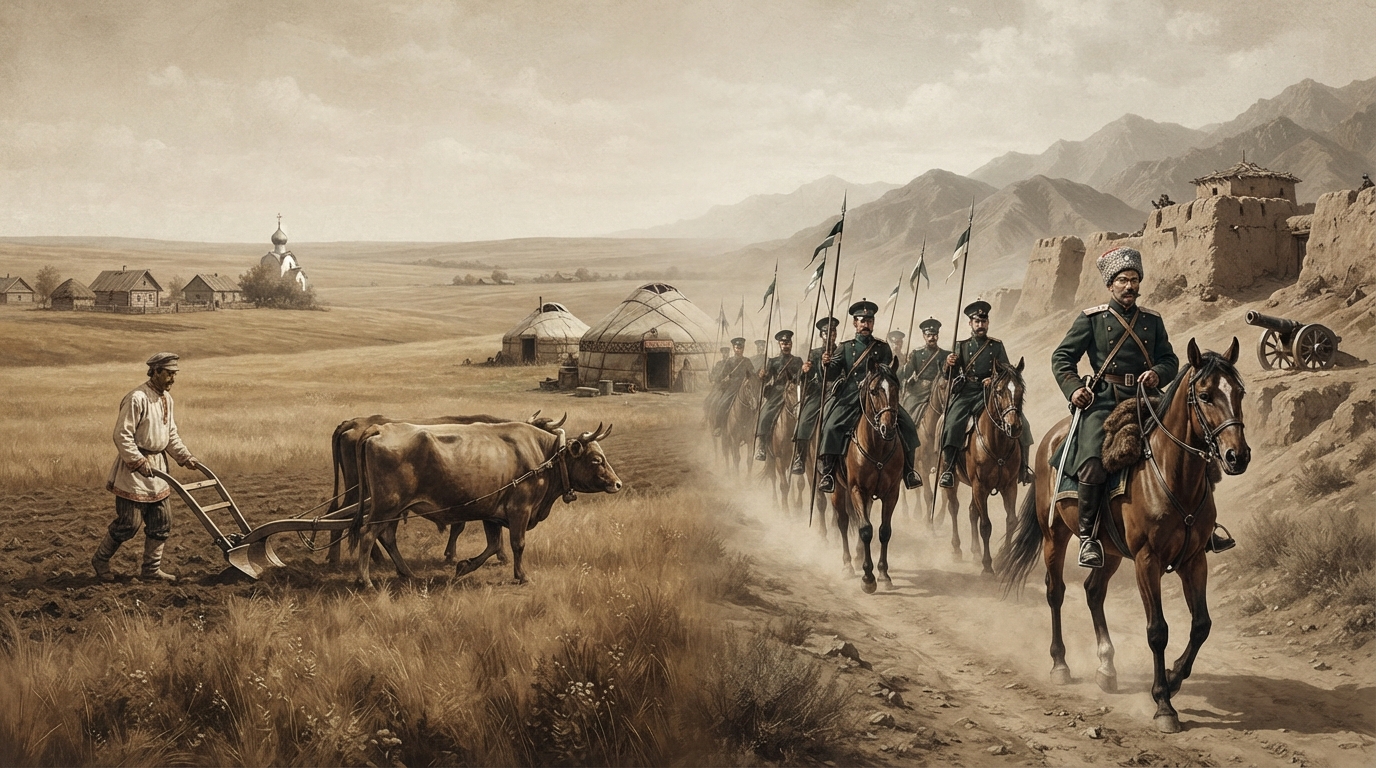
**The Plow and the Stirrup**
Across the entire vast space that was once under the control of the Russian Empire, Kazakhstan and Central Asia occupy a special place. Ukrainian and Belarusian lands, the Baltic states, Finland, and Transcaucasia were won from strong external adversaries at various stages of history, while gigantic Siberia—from the Urals to the Pacific Ocean—became Russian as a result of a colonization movement. The situation was different with the Kazakh steppes and the oases of Turkestan: the Russian Empire arrived there with a civilizing mission. How these vast spaces became part of the Russian Empire in the 19th century and what this led to is the subject of a new book by historian and international relations expert Timofey Bordachev, "The Plow and the Stirrup: How the East Became Part of Russia's Political Culture."
As the state of affairs in the Kazakh steppe and Central Asia changed, Russia itself changed as well. Already from the first quarter of the 19th century, the conviction was growing stronger in the Russian Empire that policy in the Near East should be more decisive. This was facilitated by a new view of its eastern neighbors that was taking shape in Russia.
Now, "the myth of the incalculable wealth of India, the path to which lay through Central Asia, was gradually replaced by an understanding of the political, economic, and moral backwardness of the Emirate of Bukhara, and the Khanates of Khiva and Kokand. The development of Russia's eastern trade now began to be linked to the possibility of changing (modernizing) the political and economic structure of these states" [Central Asia as Part of the Russian Empire / executive editors: S.N. Abashin, D.Y. Arapov, N.E. Bekmakhanova].
Thus, the most important stimulus for a more decisive advance into the oases of Central Asia was the domestic Russian desire for reform and the emergence of the idea of Russia's civilizing mission. At the same time, there was no doubt that in practice these ideas would bear little resemblance to European colonialism, which only hid behind claims of bringing civilization to the peoples of Asia and Africa.
Formally, the political justifications were relatively similar, but in practice they differed, since no one in the European empires set themselves the task of turning the inhabitants of the colonies into equal citizens of their own—for Russia, this was natural and existed from the very beginning.
By the early 1830s, control over the Kazakh khanates was already almost completely established—a long-term strategy of gradual integration and study of such complex neighbors was yielding results. The most decisive step was the adoption in 1822 of the Steppe Statute, which finally liquidated the basis of internal autonomy in the person of the power of the sultans [Bekmakhanov E.B. Kazakhstan in the 20s–40s of the XIX Century: a textbook].
Russia, as always, slowly but surely absorbed even the most resistant social organisms.
As for relations with the khanates of Central Asia, in "Russian society, faith in the successful development of trade with the Central Asian states was gradually fading, the realization of which was impossible without ensuring the protection of caravan routes from attacks by nomads" [Central Asia as Part of the Russian Empire / executive editors: S.N. Abashin, D.Y. Arapov, N.E. Bekmakhanova].
In the early 1840s, the flywheel of a relatively active military policy in the Central Asian direction gradually began to gain momentum: in 1853, Fort Perovsky was established on the site of the Kokand fortress of Ak-Mechet, and the following year, the fortification of Vernoye (now Almaty) was founded in the foothills of the Alatau.
The complete "pacification" of the Kazakh steppe pushed the Russian authorities to the next step: to move the border to the south and, instead of the former Irtysh and Orenburg lines, to create a new chain of fortifications already on the immediate northeastern borders of the Central Asian khanates. The decision on the military annexation of Turkestan to Russia became only a matter of time.
In full accordance with the Russian tradition of preferring peaceful solutions to military invasions, the mission of Nikolai Pavlovich Ignatyev (1858)—Russia's last embassy to the Uzbek khanates—was authorized to negotiate with Khiva terms of a lasting peace that were exceptionally favorable to it:
"Russia consigned past conflicts to oblivion, waived compensation for damages suffered by its merchants in the past, granted merchants from Khiva the rights and privileges enjoyed by traders from other Asian countries, admitted a Khivan trade agent to Orenburg, and agreed to pay a 2.5 percent duty on goods transported in transit along the Amu Darya and 5 percent on goods unloaded from merchant ships in the khanate" [Gulomov H. Diplomatic Relations of the Countries of Central Asia with Russia in the XVIII — First Half of the XIX Century].
Thus, even on the eve of the most decisive measures against its Turkestan neighbors, the Russian government continued to act within the framework of its traditional foreign policy culture, preferring to reach an amicable agreement. Another matter was that for the negotiating partners, such an approach left a lot of uncertainty, and they never knew to what extent the attempt being made was actually the last one.
The failure of this mission, which was Russia's last attempt to negotiate, led to the fact that "many political and military figures of tsarism formed the point of view: it is time to move from diplomacy to direct military pressure on the khanates. Therefore, it is not at all surprising that in the mid-60s of the XIX century, when the decisive offensive of the tsarist troops deep into Central Asia began, the Asian Department of the Ministry of Foreign Affairs was headed by the former leader of the mission to Central Asia, N. Ignatyev" [Gulomov H. Diplomatic Relations of the Countries of Central Asia with Russia in the XVIII — First Half of the XIX Century].
In fact, by that time Russia could have long solved the Central Asian problem by force. And the only real deterrent was our age-old desire to do without radical solutions.
In Khiva, Kokand, and Bukhara, they could not understand this—and found themselves in a trap into which many of Russia's opponents, even of a more serious scale, had fallen and continued to fall.
The personal factor also played a role. By that time, "the Ministry of War, the Russian general staff, and the local Siberian and Orenburg authorities had their own view of Russia's policy in Central Asia. After the Governor-General of Eastern Siberia, Nikolai Nikolaevich Muravyov, annexed the Amur region to Russia in 1858, his West Siberian and Orenburg colleagues were seized by a thirst for conquest and glory.
It is known that upon learning of Muravyov being granted the title of Count of the Amur, the Governor-General of Western Siberia, Gustav Khristianovich Gasford, began to dream of decorating his lineage with the title of Count of Trans-Ili. In their desire to win fame, the generals virtually stopped responding to the orders of the central authorities, embarking on military adventures at their own peril and risk, counting on the fact that victors are not judged" [Central Asia as Part of the Russian Empire / executive editors: S.N. Abashin, D.Y. Arapov, N.E. Bekmakhanova].
Most of the senior officers of the Russian army operating in the Central Asian direction were participants in the Crimean War, had extensive combat experience, and an equally strong desire to morally compensate for the failure in the confrontation with European adversaries. In other words, they were eager to prove themselves where it was possible.
Summing up how Russia behaved during its more than 200-year "standing" on the borders of Central Asia, it can be said that its strategy fully reflected all the basic habits inherent in Russian foreign policy culture.
First, they were in absolutely no hurry and, until the very last moment, preferred a "bad peace to a good quarrel," even in relations with the most recalcitrant and deceitful neighbors like Khiva or Kokand.
Second, they resolutely did not want to fight when conflict could theoretically be avoided. For more than a century, Russia played cat and mouse with its restless neighbors in Kazakhstan, paying absolutely no attention to the fact that their behavior did not fit at all into European ideas of how subjects should act in relations with their suzerain.
Third, Russia looked pragmatically at its neighbors in the region as part of a much broader geopolitical disposition, which included relations with China or Persia. The "buffer" position of the Kazakhs and the Central Asian khanates did not bother the empire at all; on the contrary, it gave a certain freedom of maneuver without imposing excessive obligations. And the fact that the new subjects and neighbors deceived Russia at every turn did not matter much, because the strategic outline of relations with them was, on the whole, quite clear.
It is no coincidence that historians note that the Russian Ministry of Foreign Affairs was convinced for many decades of the usefulness of the absence of a firm border in this area.
In the most humble report of the administrator of the Ministry of Foreign Affairs, Count K. V. Nesselrode, dated January 14, 1850, for example, it was pointed out that Russia's interests lay in "postponing the drawing of a boundary line for as long as possible," (...) and the establishment of firm borders at that time would have shackled the diplomatic activity of the tsarist government in this direction" [Basin V.Y. Russia and the Kazakh Khanates in the XVI-XVIII Centuries (Kazakhstan in the Foreign Policy System of the Russian Empire)].
Such a line looks both pragmatic and distinct from our constant desire to ensure the security of internal political and economic centers through external expansion.
And finally, the practical actions of the Russian administration toward the Kazakhs fully reflected the connection between Russia's internal development and how it behaved on its newly annexed and not yet properly integrated peripheries.
The policy was exceptionally flexible, and "the annexed regions had different administrative and legal statuses. (...) they were not simply mechanically integrated into the Russian political-administrative system. Some administrative territories coincided with ethnic distribution. This principle was preserved and consolidated by the reforms of the XVI–XIX centuries for the Kazakhs, Kyrgyz, Karakalpaks, Turkmen, and others.
The elective principle was introduced into the practice of the socio-political life of the nomadic peoples of the East, which was consolidated in all-Russian legislation and legal proceedings. Part of the local aristocracy and tribal nobility was equated to the service class according to the 'Table of Ranks' of 1722, receiving for their service noble titles, class ranks, salaries, awards—medals and orders, and land holdings" [Central Asia as Part of the Russian Empire / executive editors: S.N. Abashin, D.Y. Arapov, N.E. Bekmakhanova].
The slow and "sluggish" Russian foreign policy, the endless "cutting off of the tail in pieces"—these are mental imprints of the original need to conserve extremely limited forces. Especially in the East, where after the fall of the Golden Horde in the late 15th and early 16th centuries and the subsequent conquest of Kazan in the mid-16th century, the last Horde state capable of threatening the central lands of Russia, we had no adversaries comparable in military capabilities.
In fact, Russia's entire strategy toward Kazakhstan and Central Asia until the beginning of the 19th century was a strategy of slowly "taming" its new neighbors, and the pace of this process was determined not by threats from their side, but by the resources of the empire itself and the place of the region in the priority of the tasks facing it. At the same time, at the heart of this strategy, there was no long-term assumption that the lands of interest to us must sooner or later become part of the Russian state.
Russian foreign policy in general rarely involves setting long-term goals. And in this case, an important circumstance was also the absence of any serious reasons to rush to extend its rule to Kazakhstan and Central Asia.
However, by the middle of the 19th century, the former policy toward the Uzbek khanates of Central Asia had exhausted itself, and it was impossible to create a new one due to the objective circumstances of the lack of time necessary for this by our standards. The decision to proceed with direct conquest was not the easiest one for Russia—it contradicted its habits and foreign policy style, but in the conditions that had developed by the middle of the century, it looked like the only possible one.
And this conquest took place—Russia began a new experiment, the results of which are with us to this day. The time for diplomacy was over; the time for empire had begun.