

One's own deck is closer
Turkic-Slavic symbiosis: why is Kazakhstan shifting its emphasis? — expert opinion
One's Own Deck is Closer
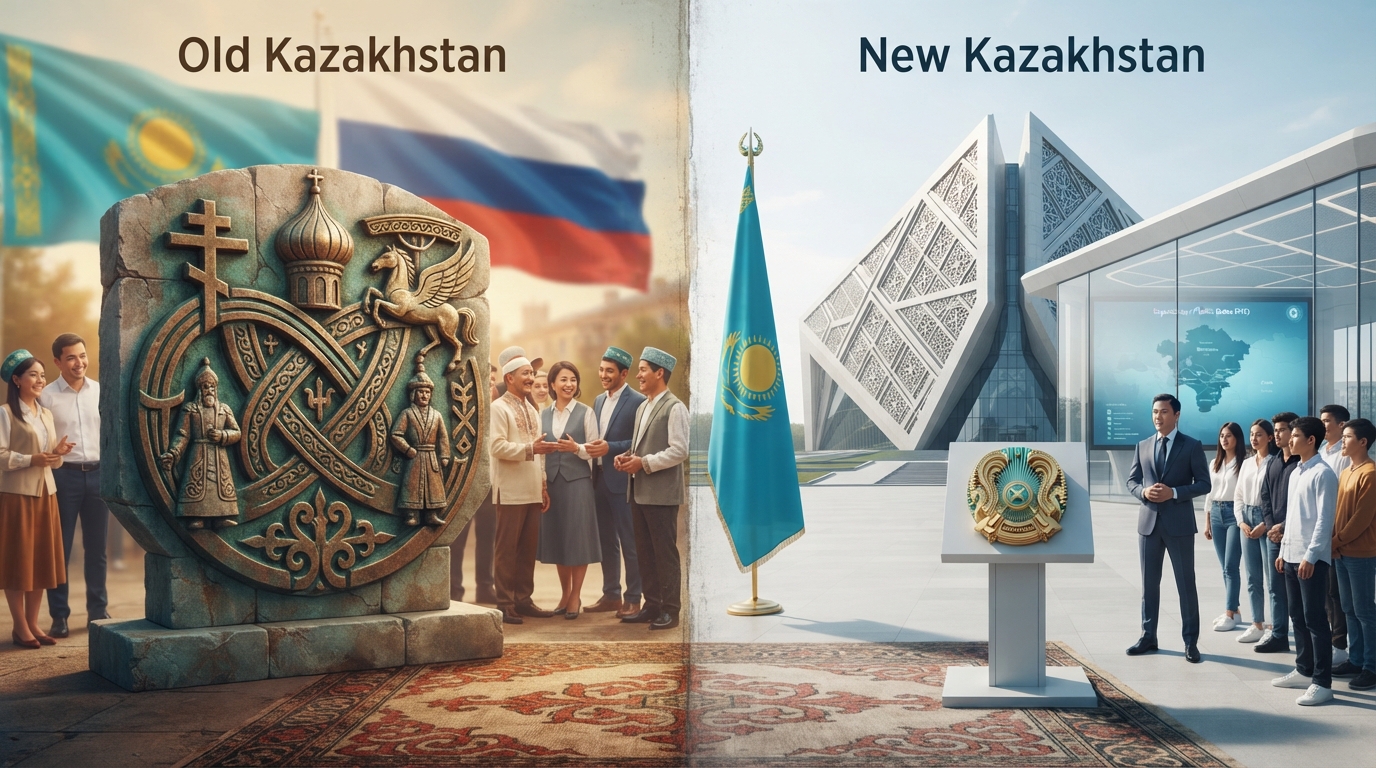
In "old Kazakhstan," the idea of Turkic-Slavic unity, as one of the pillars of Eurasianism, enjoyed great popularity. It was actively promoted and discussed at various levels and platforms. However, in "new Kazakhstan," interest in it has noticeably declined. There are several reasons for this—both external and related to the change in the country's political course. We decided to discuss these very reasons with experts.
So, what explains the decline in interest in the Turkic-Slavic synthesis? Does it make sense to bring this idea back? And how relevant is it for Kazakhstan today in general?
Maksim Kramarenko, Head of the Institute of Eurasian Policy: "The 'Turkic-Slavic' is being replaced by the 'Turkic'"
— Yes, this is indeed true: interest in this idea has declined. But it is important to understand that it has not disappeared and has not been rejected—it has simply ceased to be in demand in its previous form.
In "old Kazakhstan," Eurasianism served as a universal tool. It solved three tasks at once: it maintained interethnic harmony in the republic, built special relations with Moscow, which during that period was the main "guardian" of the country's independence, and at the same time allowed Astana to speak to the West on behalf of a "bridge between civilizations."
In the 1990s and 2000s, this topic performed a very specific function: it backed the project of Eurasian integration with a historical legend—the Steppe and Rus as two beginnings of one common destiny, the nomadic and settled worlds complementing each other. The first president consistently promoted this framework—through the Assembly of People of Kazakhstan, through interest in the ideas of Lev Gumilyov, through dozens of conferences and books. In essence, it was a historical justification for "practical Eurasianism."
It is worth noting that support for the EAEU in those years remained at the level of 76–86%.
— Why did this change?
— Probably three main reasons can be identified to explain this. But none of them boils down to the simple thesis that "Kazakhstan turned away from Russia."
The first is that the author has left. Eurasianism was Nursultan Nazarbayev's personal project, his trademark in the country's external positioning. Since 2019, this narrative has had no owner. Kassym-Jomart Tokayev speaks the language of national interest, not civilizational synthesis. This explains why the shift occurred precisely then. Under a different transition of power, the rhetoric could well have persisted for decades.
The second is Ukraine. 2014, and then 2022, radically changed the optics, which external anti-Russian forces were able to strongly influence, on the one hand forming a battering ram against Moscow from Kyiv, and on the other—baselessly placing responsibility for the Ukrainian crisis on Russia.
Sanctions against Moscow and the threat of secondary sanctions to Astana itself made "romantic" Eurasianism with a Slavic-Turkic coloring simply inconvenient. Relations with Russia have been preserved, but have become purely pragmatic. And this is no longer a question of the elite's desire. This cause operates regardless of who is in Akorda, and its influence is irreversible in the sense that the rhetoric cannot be brought back by a willful decision until the configuration of sanction pressure itself changes.
The third is that against the background of the first two reasons, the principle of multi-vector policy has finally prevailed: the country balances between centers of power, avoiding ideological exclusivity. But this is no longer a reaction, but a conscious choice. Kazakhstan decided to fill the vacated space with an alternative foreign policy ideology—the Turkic framework through the Organization of Turkic States.
— In which direction is the turn taking place?
— Where is the route of national-state building shifting?! I think not to the West and not into the embrace of Moscow—it is moving inward. The "Turkic-Slavic" is being replaced by the "Turkic." Kazakhstan is increasingly positioning itself as part of the Turkic world—through, I repeat, the OTS, through a common heritage, through cultural closeness. At the heart of this, most likely, lies not confrontation, but a redefinition of oneself.
The difference is fundamental: previously the republic said "we are a bridge between two worlds," now it says "we are one of the worlds." One can say that in "old Kazakhstan," "Eurasianism" and the "Turkic world" were two parts of one composition; now the second part clearly outweighs the first.
At the same time, the term "Eurasianism" itself has not disappeared from use—Tokayev may well call the Golden Horde and the Eurasian heritage part of the cultural code of the Kazakhs. But this is no longer the Slavic-Turkic synthesis in its former form, but an appeal to the common Steppe, predominantly Turkic-Mongol past, embedded in the logic of its own, Kazakh-centric identity.
Inside the country, the vector is the same: the pathos of "friendship of peoples" is being replaced by the calm language of civic institutions and legal status.
Does this mean that the topic is closed for good? No. Its return cannot be completely ruled out. With a new round of rapprochement with Moscow, the rhetoric of unity could theoretically be revived, as the historical material has not gone anywhere. But today it has ceased to be a supporting pillar of Kazakhstan's state ideology. From a foundation, it has turned into an optional storyline—interesting to historians, but so far less needed by politicians.
Zhaksylyk Sabitov, historian, political scientist: "In foreign policy, the trend is strengthening; in domestic policy, it is weakening"
— When discussing the relevance of the idea of Turkic-Slavic unity as one of the components of Eurasianism, it is very important to separate the domestic and foreign agendas.
Let's start with the foreign one. If we look at the treaties concluded between Kazakhstan and Russia in recent years, or at the jointly promoted historical projects, we can clearly see that the idea of Turkic-Slavic unity, or rather the peaceful coexistence of two civilizations, continues to play an important role.
Thus, one of the documents signed by the presidents of the two countries speaks of the thousand-year symbiosis of Ancient Rus and the Great Steppe. This confirms that the idea of positive Turkic-Slavic interaction is rooted in the distant past. And, undoubtedly, it will remain present at the level of foreign policy rhetoric for a long time to come.
Moreover, with the growing interest in the heritage of the Ulus of Jochi, Kazakhstan was able to organically integrate into the concept of Turkic-Slavic symbiosis another historical layer related to the fact that Russian principalities were part of the Golden Horde during a certain period.
At the same time, certain changes are observed in domestic political rhetoric. While in the 1990s the topic of Turkic-Slavic symbiosis, along with Eurasianism, was indeed quite popular here, due to demographic processes and the transformation of the population structure, it is gradually losing its position. Simply put, as the share of Slavic ethnic groups decreases, the need for it becomes less.
But this is not about some cardinal shift. This topic still remains important. It is periodically addressed, emphasizing that Kazakhstan has created a successful model of interethnic and interreligious tolerance and peaceful coexistence of representatives of different ethnic groups and religions.
From this, the conclusion follows that in foreign policy, the Turkic-Slavic trend is strengthening within the framework of Kazakh-Russian interaction. In domestic rhetoric, on the contrary, it is weakening due to demographic changes.