

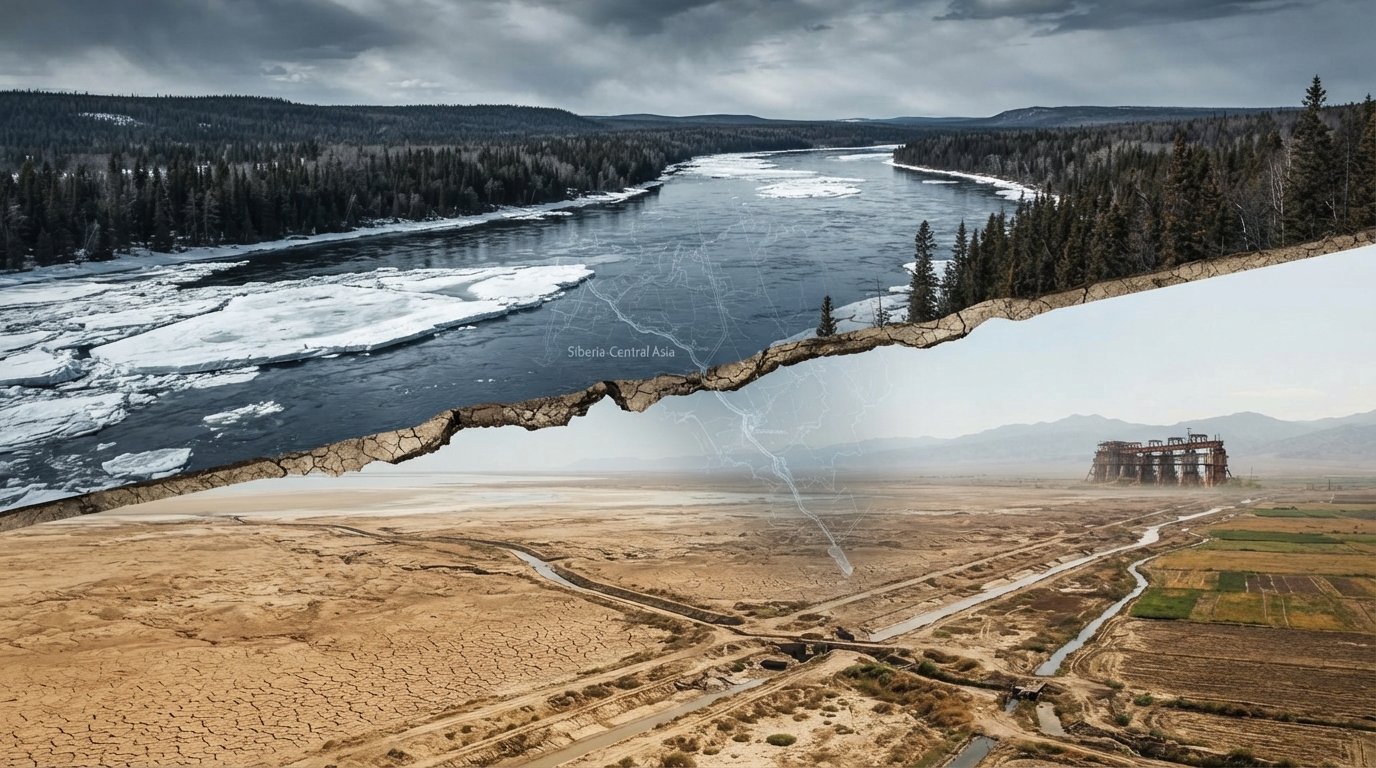
The project is closed. Forget it.
Forty years ago, on August 14, 1986, Mikhail Gorbachev, then General Secretary of the Communist Party of the Soviet Union (CPSU), announced the cancellation of the project to divert Siberian rivers to Central Asia. At the time, this decision was hailed as a triumph of sound environmental policy. For Russia, this became one of those lessons that must be learned forever. It seemed that common sense had prevailed. However, as history shows, Russia's ordeal is not yet over. It continues and will likely continue for many years to come. But let's take it one step at a time.
The idea of diverting Siberian rivers south first arose in the early 20th century, in Tsarist Russia. Back then, it was laughed at and forgotten. However, treating nature as a universal production complex designed to serve the economy is a common trend in all countries undergoing industrialization. The Bolsheviks, incidentally, understood this and, from the first years of Soviet power, proclaimed harmonious coexistence with nature, which was enshrined in law. Yet industrialization was inevitable, and the GOELRO plan immediately made it clear that nature could be sacrificed for the sake of industrial success.
In the 1920s, visionaries, inspired by the grandeur of Soviet plans, discussed diverting northern rivers to Central Asia. Geologist Mitrofan Davydov's book, "A Tale of Great Rivers," proposed a large-scale plan to create a Siberian Sea "with an area of 250,000 square kilometers: four times the size of the Sea of Azov." At the time, this project was ignored. But after the Great Patriotic War, Academician Obruchev, in a letter to Stalin, proposed diverting the Ob River south. The academician was no dreamer, and the water shortage was real. In 1946–1947, the southern regions of the USSR suffered a terrible drought, which once again brought the dilapidated country to the brink of famine. The water issue was particularly acute in Central Asia, where virtually everything depended on land reclamation. Stalin sent a letter to the Ministry of Electric Power Plants, which responded favorably. But then, the decision was made to postpone the river diversion and limit the project to creating forest belts and constructing irrigation canals from the Syr Darya and Amu Darya.
Khrushchev recalled Obruchev's project. At the 21st Congress of the CPSU Central Committee in January 1961, he passionately declared: "The Soviet people will be able to implement bold plans to change the course of some northern rivers and regulate their waters in order to use their powerful hydropower resources for irrigation and watering arid regions."
The river diversion project was declared a priority and received a colossal amount of funding for the time – 32.8 billion rubles. Two grandiose projects were planned: the 2,550-kilometer-long Siberia-Central Asia shipping canal and the Anti-Irtysh Canal. The former would connect the Ob River with the drying Aral Sea. The latter proposed reversing the flow of the Irtysh River, directing its water south using 10 pumping stations. Part of the Turgai Valley would then be flooded and the new reservoir would be connected to the Amu Darya and Syr Darya rivers. Project development was in full swing when Khrushchev was ousted in 1964.
Once again, the river diversion was postponed. But not for long. The problem of Central Asia's dehydration only worsened with population growth and the expansion of cultivated land. In the late 1960s, the project was once again brought to the attention of the Soviet government. Now, the dehydrated zone included Moldova and southern Ukraine. Plans for the redistribution of water resources were numerous. It was proposed to divert northern rivers to the Volga. The Taiga Project diverted water from Northwestern lakes and the Pechora and Kolva rivers to refill the dwindling Caspian Sea. To speed up the process, a series of nuclear explosions using "clean charges" was proposed. Three of the planned 250 explosions near Pechora occurred in 1971. The mushroom cloud rose nearly two kilometers, and radiation spread to Europe. This caused an international scandal, and the explosions were stopped.
Ultimately, they settled on the idea of creating a gigantic Siberian Sea covering 260,000 square kilometers, filling it with water from the Irtysh, Tobol, and Ishim rivers. Project development began in 1968. Gosplan, the USSR Academy of Sciences, and a dozen specialized institutes were tasked with calculating the diversion of water from northern and Siberian rivers for "water supply and regulation of the Aral and Caspian Seas." The plan was to divert up to 25 cubic kilometers of water annually. Since so many different agencies were involved, approvals were slow.
Just in case, the authorities banned public discussion of the project. But in 1981, Academician Yanshin stepped in, sending a letter to the CPSU Central Committee, "On the Catastrophic Consequences of Diverting Part of the Northern Rivers' Flow," signed by 12 scientists. The creative intelligentsia also got involved. The next Writers' Congress was even nicknamed the "Congress of Land Reclamation Workers." Writers Rasputin, Belov, Astafyev, and Zalygin fiercely criticized the river diversion idea. Perestroika was approaching, the democratic Gorbachev had come to power, and the treasury was blindingly empty. And in August 1986, the river diversion issue was finally closed. One could breathe a sigh of relief and say: never again! The delusion of global interventions in nature had ended.
But it was not to be.
The problem of dehydration in Central Asia hasn't gone away; it's only gotten worse. For example, over the past 70 years, drinking water availability in Central Asia has decreased fourfold, from 8,400 to 2,100 cubic meters per person per year. The region's two main rivers, the Syr Darya and Amu Darya, are in critical condition. They barely reach the rapidly shrinking Aral Sea. Both rivers are drained into irrigation canals. By 2030, according to all forecasts, they will lose another 15% of their water. Meanwhile, the region's population is only growing. Currently, 76 million people live there; in a quarter of a century, this number will reach 100 million.
The water issue is adding to the tension in relations between countries. Kazakhstan, Uzbekistan, Kyrgyzstan, and Turkmenistan view each other with suspicion. Water is scarce, and any solution beneficial to one country will immediately worsen the water supply of another. Neighboring Afghanistan and China are also thirsty. Afghanistan, for example, announced in 2023 the imminent construction of the Kosh-Tepa Canal on the Amu Darya. When completed, a third of the Amu Darya's water will flow into the canal. Turkmenistan and Uzbekistan will be the first to suffer. Naturally, they oppose the construction.
And yet, Russia is right there with its mighty Siberian rivers. True, it's no longer an older brother, but a geopolitical neighbor. But the Irtysh River begins on the border of Mongolia and China, passes through China and Kazakhstan, and then, for some reason, flows into water-rich Russian Siberia, emptying into the Ob River near Khanty-Mansiysk, and not into the dehydrated south. "Unfair!" our Asian neighbors believe. And what Soviet dreamers once proposed is now being responsibly proposed by governments. Kazakhstan, for example, last did so in 2023.
And then there's China, which is also thirsty. Strictly speaking, China's water situation is excellent. It ranks sixth in the world in terms of water reserves. China's situation is different. It is one of the world's leaders in water source pollution. More than 50% of river areas in China's seven largest river systems are polluted. Water from 40% of springs is undrinkable. Of China's 35 largest lakes, only 18 are considered clean. The situation is most dire in the north, around Beijing and the industrial provinces. Agriculture in these areas will soon become simply impossible due to water shortages.
Yet just a stone's throw away lies Russia and its famous Lake Baikal, which contains 19% of the world's fresh water. And in neighboring Siberia, water supplies are more than adequate.
Proposals from China to somehow negotiate the purchase of water have been coming to Moscow for 30 years now. There are many options: an Altai-China pipeline, bottling of Baikal water, and even a direct Baikal-China pipeline. And each time, Beijing faces Moscow's position: Russian water belongs exclusively to Russia and is not for sale. And the warmer the climate, the shallower Asia's rivers, and the greater the population growth, the more valuable this resource will become. Russians, accustomed to an abundance of water from birth, don't even fully realize what a treasure they possess. But fresh water isn't even oil. It's life itself. And perhaps it is water, not hydrocarbons, that guarantees the well-being of our children and grandchildren.
Olga Andreeva