

"The permit is for three floors, but they're building 12." Kadyrov called for tougher penalties for illegal construction.
MP Alisher Kadirov warned of serious corruption risks and large cash flows in Uzbekistan's construction sector. He stated that current laws are insufficiently effective, so developers must understand in advance that attempting to circumvent the rules will lead to significant losses.
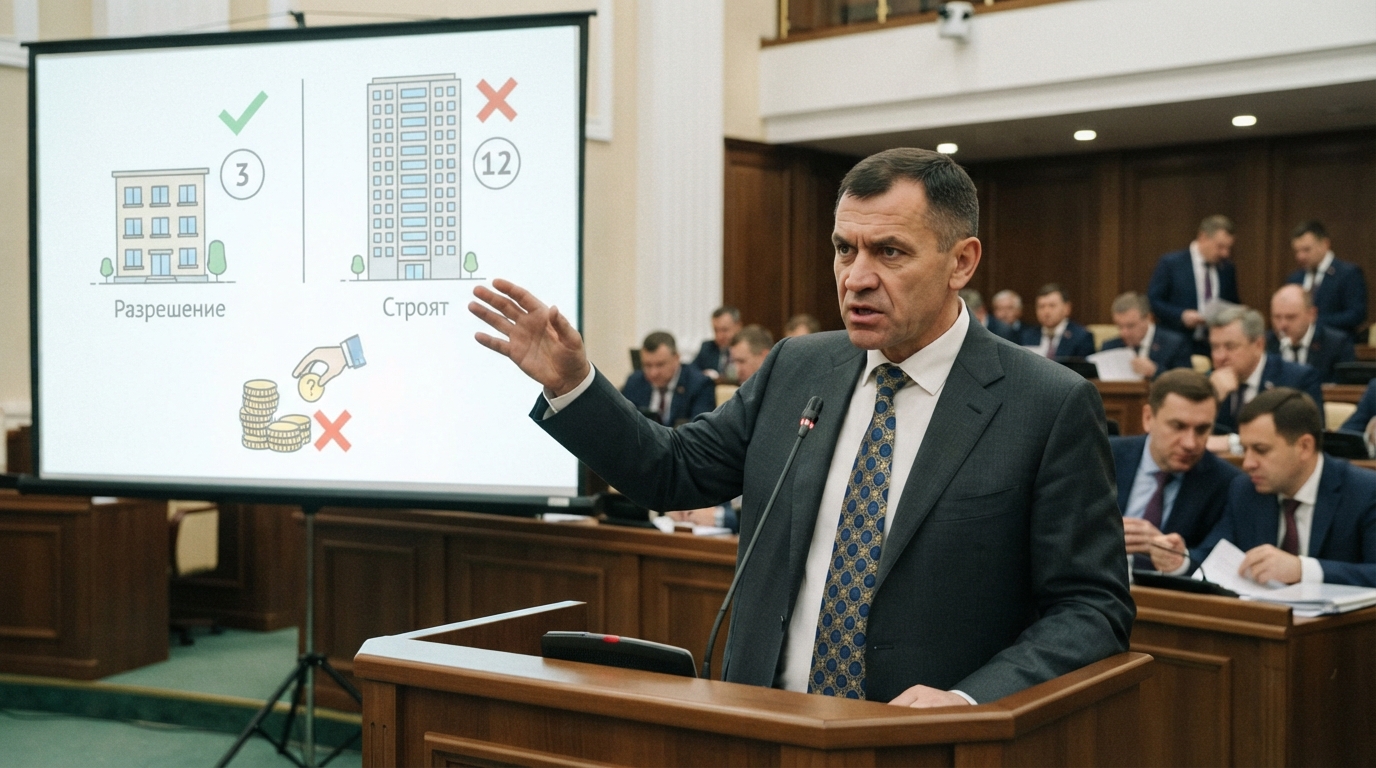
"Permit for 3 floors, but they're building 12." Kadyrov called for tougher penalties for illegal construction.
Illegal construction and disregard for urban planning regulations pose a serious threat to public safety. This was stated by Alisher Kadyrov, MP and leader of the Milliy Tiklanish party, at a meeting of the Legislative Chamber of the Oliy Majlis on August 11.
He spoke during a discussion of a bill that provides for new financial penalties for serious violations of urban planning regulations. It proposes levying 2.2 million soums per square meter on companies for serious construction violations. The bill passed its first reading, but some deputies considered the penalties disproportionate, warning of a possible rise in housing prices and an excessive burden on developers.
Kadyrov acknowledged that the proposed measures have sparked controversy even within his faction. "All the objections raised so far are justified." "We discussed this bill twice in our faction during the first reading, and there were also very heated debates within our faction. Our deputies don't like increasing fines," he noted.
At the same time, the deputy emphasized that the discussion participants ultimately concluded that accountability in the construction sector needs to be strengthened. "Illegal construction in the city, construction anywhere and anyhow, where they get a permit for three floors and build 12, has become a very serious threat today," stated Alisher Kadyrov.
According to him, one of the reasons for the current situation is the ineffectiveness of current mechanisms and corruption risks in the industry. "There are very serious corruption issues here. We're talking about enormous amounts of money. The cost of one project, for example, can reach $10 million. Enormous amounts of money are circulated in this sector, and large profits are generated, partly due to the ineffectiveness of current legislation," the party leader said.
The parliamentarian stated that current regulations do not provide a sufficient deterrent. "Our current law is not effective. And why?" "Because this sector has proven to be highly corrupt. This poses a threat to us," he noted.
As an argument, the deputy cited the aftermath of devastating earthquakes in Colombia and Turkey, when multi-story buildings collapsed "like sand," taking the people inside with them. In his opinion, it's unacceptable to expose the public to enormous risk just for the sake of entrepreneurial profit.
"If one developer is capable of violating current laws and putting our population in grave danger for the sake of profit, if they can build in the city wherever they want, whatever they want, and how they want, thereby destroying social relations between the state and the citizen, then who gave developers such authority? Why can they act so freely in Uzbekistan? So, the problem lies in our laws," Kadyrov emphasized.
The deputy believes that the new liability mechanism should make violating urban planning requirements inherently unprofitable. "One of the main goals of this law is to ensure that a developer who wants to solve an issue with money knows in advance that this will lead to losses. "So he understands in advance that the consequences will be very serious. That he won't be able to give money to someone or somehow circumvent the rules and escape responsibility," the deputy said.
"If he's conducting illegal construction, the penalty, calculated per square meter, should make such a violation economically unprofitable even at the initial calculation stage," Kadyrov noted.
At the same time, the head of Milliy Tiklanish emphasized that the interests of entrepreneurs and the economy must be taken into account, but the safety of citizens must remain a priority. "We must, of course, care for and support entrepreneurs, their income, and the economic interests of our country. But our first priority must be the safety of our people, improving their quality of life, and protecting them from such problems, especially in the construction sector," he stated.
The bill was supported by 88 deputies, with 15 voting against, including six representatives of Adolat and seven from the People's Democratic Party of Uzbekistan. The document is planned to be revised for the second reading, taking into account the comments made.
At the end of December 2025, Minister of Construction, Housing, and Communal Services Sherzod Khidoyatov reported that approximately 38,000 apartments had been illegally constructed in Uzbekistan since 2018–2019. Some of these buildings are still under construction. According to the minister, some multi-story buildings were constructed without the necessary permits and inspections, as well as without proper quality control of construction materials. A working group was created to study the situation and develop solutions.
Earlier, on July 14, the Legislative Chamber passed a law criminalizing the occupancy of apartment buildings that have not yet been commissioned. The law was passed in three readings and sent to the Senate. Then, Deputy Prosecutor General Salom Samadov reported that an inspection over seven years had identified 383 apartment buildings that had been illegally constructed without compliance with urban planning documentation, utility connections, or registration. More than 20,000 apartments had been sold in these buildings.
In addition, another 136 apartment buildings were not commissioned due to various violations, although more than 8,000 people already lived in them.