

Uzbekistan plans to impose a fine of 2.2 million soums per square meter for construction violations.
Uzbekistan has proposed levying fines of 2.2 million soums per square meter on companies for gross violations during construction. The bill passed its first reading, but some members of parliament deemed the sanctions disproportionate and warned of a potential rise in housing prices and an excessive burden on developers.
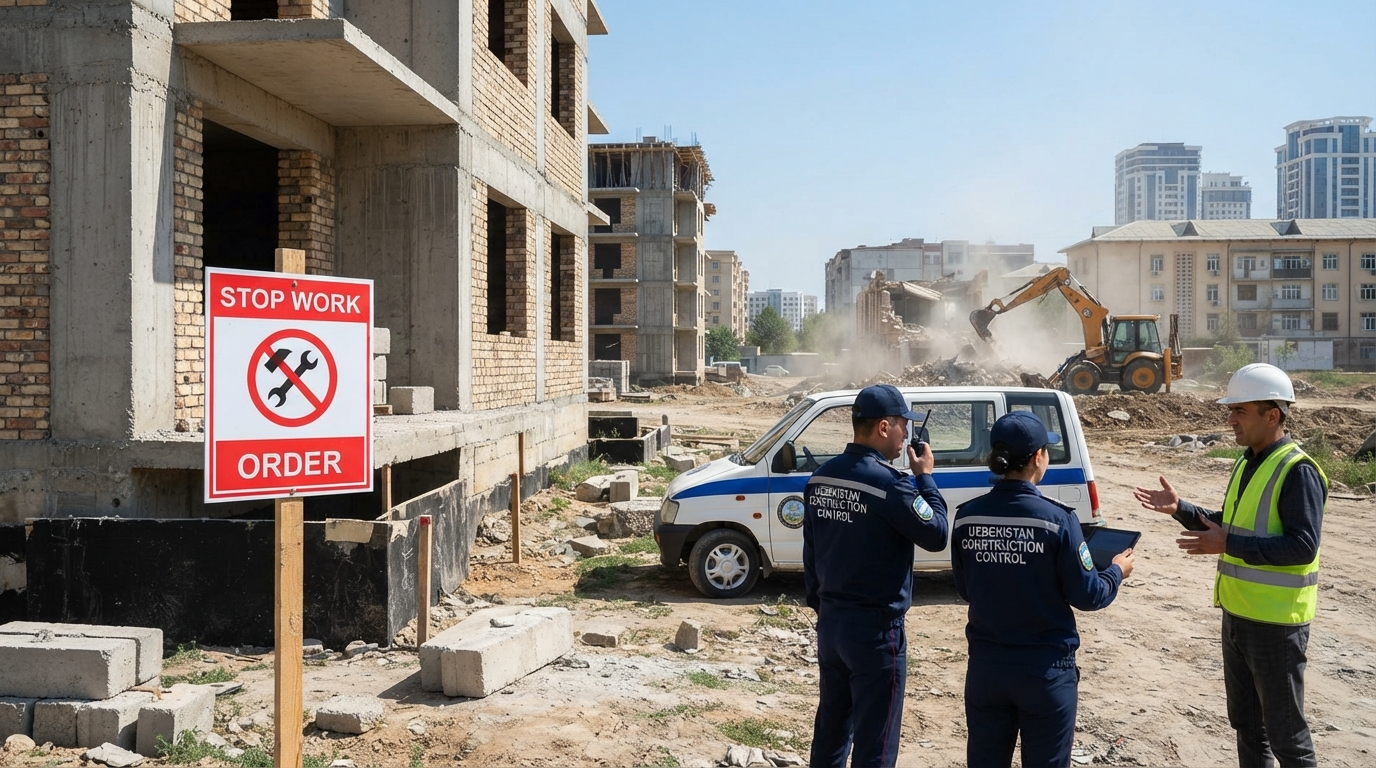
Uzbekistan is considering a bill introducing fines of 2.2 million soums per square meter of illegal construction. The Legislative Chamber of the Oliy Majlis adopted the bill in its first reading on August 11.
Introducing the bill, MP Nozimbek Rustambekov noted an increase in urban planning violations: approximately 8,000 in 2023 and nearly 9,000 in 2024. More than 4,000 projects were halted due to poor construction and installation work. In 2025, 2,653 administrative fines were issued, and 2,350 violations were rectified through demolition.
The bill's authors believe that existing penalties are not always a sufficient economic deterrent for violators. The problems cited include construction that violates approved documentation, the misuse of land, the commencement of work without the necessary permits and notifications, and the artificial delays of projects.
The bill proposes introducing financial sanctions against legal entities for serious violations of urban planning requirements. Specifically, it proposes imposing a fine of 5 BRV (2.2 million soums as of September 1) on the client, contractor, and, if necessary, subcontractor for each square meter of total construction completed by the time the violation is discovered. However, paying the fine does not legalize the illegally constructed structure; it will still have to be brought into compliance with urban planning documentation and legislation.
Zukhriddin Mavlonov, a member of parliament from the Adolat party, expressed concern about the proposed mechanism. He recalled that Article 99 of the Administrative Code already provides for fines for violating urban planning regulations: 70 BRV (30.8 million soums) for a first violation and 150 BRV (66 million soums) for a repeat violation. According to his calculations, for a 500-square-meter property, the proposed penalty would amount to 1.1 billion soums, which, in his opinion, contradicts the principle of proportionality enshrined in Article 20 of the Constitution.
Mavlonov also criticized the collection mechanism, which, he said, allows for the possibility of collecting the financial penalty through tax authorities via collection without a prior court decision. He pointed out the lack of time limits for the decision to enter into force and for appeal, which exist in administrative proceedings.
Furthermore, the deputy expressed disagreement with the proposed distribution of the collected funds: 60% of the proceeds go to the National Committee for Urbanization and Sustainable Development of the Housing Market, 10% to the Inspectorate for Control over Construction, Housing, and Utilities, and only 10% to the local budget. Mavlonov believes that if the goal is solely to prevent illegal construction, then the penalties in the Administrative Liability Code should be strengthened, and all fines should be directed to the local budget.
A representative of the National Urbanization Committee explained that the current administrative penalties and the proposed financial sanctions apply to different categories of violators: the new measure is intended for legal entities. He also noted that the right to appeal in court remains, and entrepreneurs will be able to appeal to the administrative court. The committee representative proposed reconsidering the distribution of the proceeds from the sanctions before the second reading of the bill.
Speaker of the Legislative Chamber Nuriddin Ismoilov also expressed concerns about the potential size of the financial sanctions. He cited the example of a nine-story residential building, where, if a violation is detected, the penalty could reach approximately 12 billion soums. Ismailov questioned how construction companies would be able to operate under such conditions if these fines were collected immediately and without the possibility of appeal. He urged developers to further examine this issue.
MP Anvarkhon Temirov of the People's Democratic Party also criticized certain provisions of the document, believing that introducing additional financial penalties in the presence of administrative liability provisions could increase the burden on entrepreneurs and lead to artificially inflated housing prices. He also noted the absence of an anti-corruption expert review by the time the draft was reviewed. A representative of the National Committee acknowledged the need to complete the relevant procedures before preparing the draft for its second reading.
MP Ekaterina Smesova inquired about how the proposed regulations would protect citizens who have already invested in projects under construction, particularly those participating in shared-equity construction. She also proposed creating a single, open resource where citizens could verify that a developer has all the necessary documentation before purchasing an apartment.
In response, Deputy Minister of Construction, Housing, and Utilities Davronzhon Adilov recalled the bill recently passed by the Legislative Chamber to protect participants in shared construction projects, which provides for the implementation of an escrow system. He stated that a separate platform should also be created where buyers can verify that a project has the necessary documents and permits.
Eighty-eight deputies voted in favor of the bill, while 15 voted against (including six from the Adolat party and seven from the People's Democratic Party of Ukraine). The document is planned to be revised to take into account the deputies' comments before its second reading.